%20(1).png)
June 19, 2026
Best Recruitment Software for Manufacturing Companies
Compare the best recruitment software for manufacturing companies to screen candidates faster, run AI video interviews, assess role fit, and reduce manual hiring work.
.avif)
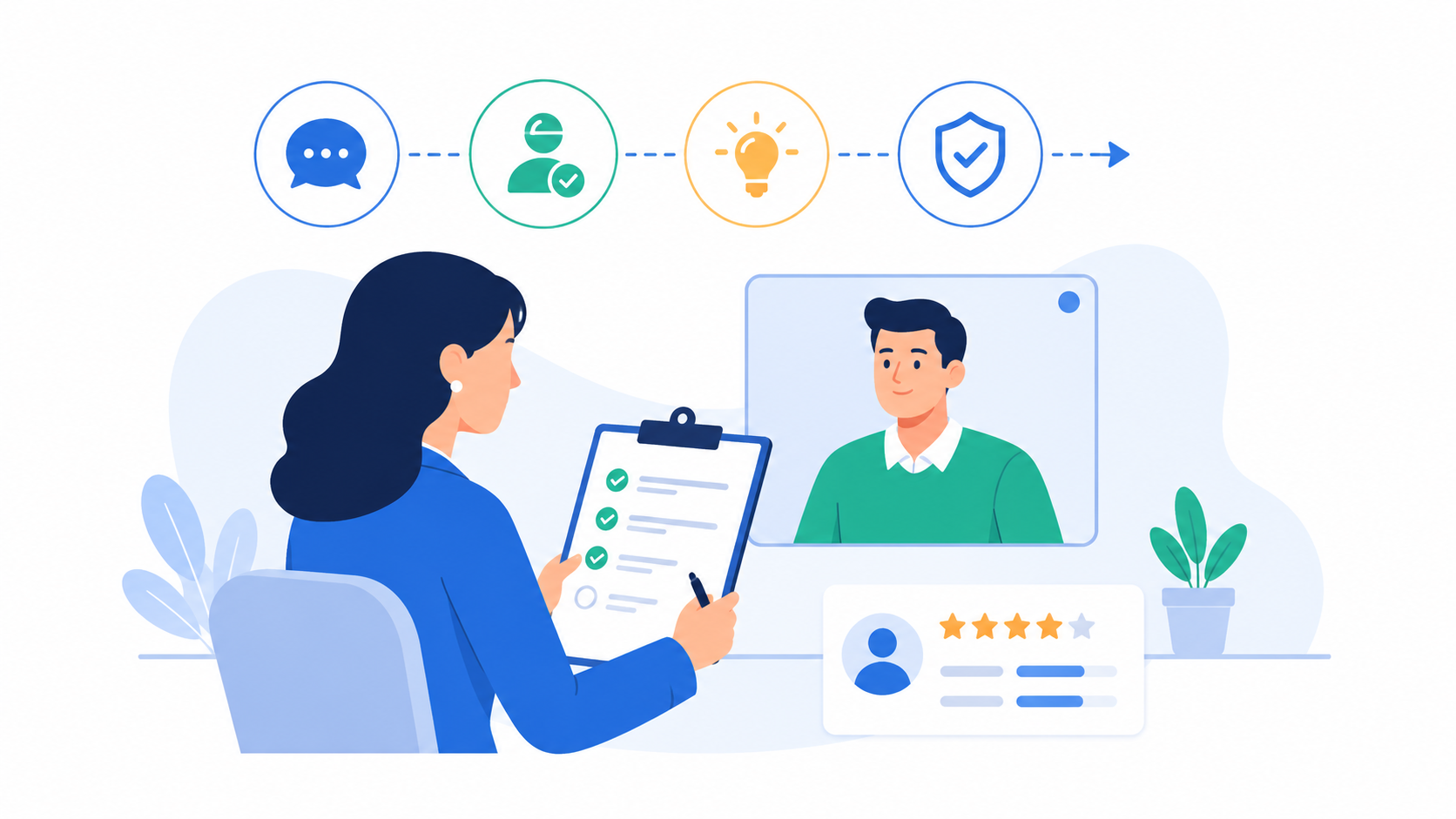
AI video interview questions should not be treated as a random checklist or copied directly from a live screening interview.
In a live interview, recruiters can clarify vague answers, ask follow-up questions, or redirect the conversation in real time. AI video interviews work differently. Candidates usually answer on their own time, so the questions need to be clear, specific, and easy to respond to without extra explanation.
Good questions help employers understand things like role fit, relevant experience, communication style, motivation, practical judgment, availability, and answer consistency. In this guide, we’ll look at how employers can build a more focused set of questions for structured first-round review.
A good AI video interview question helps hiring teams review candidates against the same role-related criteria.
For first-round screening, the strongest questions usually do five things:
The main mistake is asking questions that sound professional but do not help the hiring team make a better screening decision.
For example, “Tell me about yourself” may produce a long answer, but it often gives recruiters uneven information.
A stronger version would be, “Tell us about the experience, skills, or work situations that make you a relevant candidate for this role.”
That version gives candidates clearer direction and gives recruiters a more useful answer to review.
Before writing the questions, define the signals you want to review. For most first-round AI video interviews, those signals are role understanding, relevant experience, communication clarity, motivation, practical judgment, availability, and consistency.
The questions below are grouped by those signals so hiring teams can build a shorter, more focused interview instead of using a generic list.
These questions help employers see whether candidates understand the job beyond the title.
Example questions:
What to look for:
Answers that show the candidate understands the actual responsibilities, work environment, and expectations of the role.
Watch out for:
Generic answers that repeat the job title or show little understanding of the day-to-day work.
These questions help employers move beyond resume keywords and understand what the candidate has actually done.
Example questions:
What to look for:
Specific examples that explain what the candidate did, what they were responsible for, and how it connects to the role.
Watch out for:
Broad claims, repeated job titles, or lists of duties without context.
These questions help recruiters review how clearly candidates organize and explain their answers.
Example questions:
What to look for:
Clear, structured, and easy-to-follow answers that fit the communication needs of the role.
Watch out for:
Rambling, vague, or off-topic answers that make the response difficult to review.
See also: What Recruiters Can Learn from AI Video Interview Responses
Motivation questions help employers understand why the candidate is interested and whether their expectations match the role.
Example questions:
What to look for:
Answers that connect the candidate’s goals, preferences, or experience to the actual role.
Watch out for:
Vague interest, unrealistic expectations, or signs that the candidate wants a very different type of role.
These questions show how candidates think through realistic work situations.
Example questions:
What to look for:
Calm thinking, ownership, practical next steps, and awareness of when to escalate.
Watch out for:
Blaming others, skipping important context, or jumping to action without explaining the reasoning.
These questions should stay focused on job-related requirements such as schedule, location, travel, or start date.
Example questions:
What to look for:
Clear confirmation that the candidate can meet the stated requirements of the job.
Watch out for:
Unclear constraints that could affect scheduling, attendance, or role fit later.
These questions help recruiters check whether the candidate’s answers align with their resume, application, and role expectations.
Example questions:
What to look for:
Answers that add useful context, clarify gaps, or connect past experience to the role.
Watch out for:
Major contradictions between the interview answer, resume, and application details that need human review.
Not every role needs the same AI video interview questions. A customer-facing role may need stronger questions about communication and practical judgment, while an operations role may need questions about availability, reliability, and process discipline.
Instead of asking every type of question, employers should choose the signals that matter most for the role. Use the table below to decide which question categories to prioritize before building the final question set.
Hiring teams do not need to ask every type of question. A high-volume frontline role may only need role understanding, availability, communication clarity, and practical judgment. A more complex role may need deeper questions around relevant experience, judgment, and consistency.
The question set should be short enough for candidates to complete comfortably, but clear enough for recruiters to review meaningfully.
See also: How AI Video Interviews Improve Candidate Experience
KitaHQ is an AI-powered candidate screening platform that helps hiring teams run structured AI video interviews before deeper human interviews.
Recruiters can generate interview questions from a job title or job description, then add, remove, or edit those questions before sending them to candidates. Candidates can complete the interview on their own time from a web link, without waiting for a recruiter to join a live call.
After completion, recruiters and hiring managers can review candidate responses before deciding the next step. KitaHQ does not make final hiring decisions; it supports early-stage screening and human review.
The best AI video interview questions are not the longest or most creative questions. They are the questions that help employers collect structured, role-related, and reviewable candidate signals.
When those questions are paired with clear review criteria, AI video interviews can help recruiters and hiring managers compare candidates more consistently before deciding who should move forward.
KitaHQ is an AI hiring software that helps teams screen faster, run AI video interviews, and evaluate candidates consistently.