%20(1).png)
June 18, 2026
Best Teacher Recruitment Platforms for Candidate Screening
Compare the best teacher recruitment platforms by workflow fit, from sourcing and ATS management to candidate screening, interview reports, and school hiring review.
.avif)
Healthcare recruitment challenges are usually discussed as a shortage problem. Hospitals, clinics, pharmacies, medical device teams, and healthcare service providers often compete for the same pool of nurses, clinical support staff, patient coordinators, medical assistants, pharmacy staff, and operations employees.
That is true. Staffing shortages, burnout, credentialing requirements, multi-location hiring, and compliance complexity all make healthcare hiring harder than many other industries.
But there is another problem inside the hiring workflow: too much screening work reaches the manager too early.
When early screening is loose, managers spend interviews confirming basic availability, explaining role realities, checking whether the candidate understands patient-facing expectations, or discovering that a required license, certification, or schedule fit is unclear. By the time this happens, the organization has already spent recruiter time, manager time, and candidate attention.
Healthcare hiring is structurally different from many commercial or office-based roles because the hiring decision often affects patient experience, safety, privacy, service continuity, and regulatory requirements.
For example, a clinic hiring a medical assistant is not only checking whether the person has experience. The team may also need to understand whether the candidate can follow protocols, communicate clearly with patients, handle stressful situations professionally, document information accurately, and work the required shift pattern.
A hospital hiring clinical support staff may need to balance volume, urgency, certification requirements, and manager availability. A pharmacy operations team may need candidates who can handle inventory, customer questions, prescription-related escalation, and patient frustration without breaking protocol. A healthcare billing or patient coordination team may need people who can manage sensitive information and communicate clearly across departments.
That is why healthcare recruitment challenges often include:
Healthcare recruitment also carries higher operational stakes because background checks, credential verification, licensing requirements, and regulatory expectations can add complexity to every open role.
This does not mean every part of healthcare hiring can or should be automated. It means the early process needs clearer separation between what can be screened early and what must be validated later by qualified humans or approved systems.
In many healthcare hiring workflows, the manager interview is supposed to validate fit, judgment, team needs, and role readiness.
But in practice, manager interviews often become re-screening calls.
A clinical lead may spend the first 15 minutes asking questions the recruiter already asked. A clinic manager may discover the candidate cannot work the required shift. A pharmacy supervisor may realize the candidate has not handled patient escalation before. A healthcare operations manager may notice that the candidate’s communication style is unclear, but there is no structured record from the earlier screen to compare against.
This creates three problems.
First, manager time is used on candidates who may not have passed basic screening criteria. In healthcare, managers are often already balancing patient care, staffing gaps, compliance tasks, and operational issues. Every unnecessary interview competes with higher-value work.
Second, candidate evaluation becomes inconsistent. If each recruiter or manager asks different early questions, the team may compare candidates based on memory, notes, or personal impressions rather than consistent criteria.
Third, the hiring team learns important information too late. Shift mismatches, communication concerns, unclear license status, or poor understanding of patient-facing expectations should not first appear at the manager interview stage.
The fix is not to make hiring less human. The fix is to make the early screening process more structured before managers get involved.
Healthcare teams should not send every applicant directly to a manager interview. Before that stage, recruiters should aim to clarify whether the candidate meets the basic conditions for a useful manager conversation.
The criteria will vary by role, but most healthcare hiring workflows should screen for the following areas.
Role fit means the candidate’s background, experience, and expectations align with the position.
For example, a patient coordinator role may need someone comfortable with appointment handling, patient communication, documentation, and administrative accuracy. A medical assistant role may require direct patient interaction, clinic flow support, and familiarity with clinical procedures. A pharmacy assistant may need customer handling, inventory discipline, and escalation awareness.
This does not mean the recruiter must make the final decision. It means obvious mismatches should be filtered before manager time is used.
Healthcare roles often involve licenses, certifications, or minimum qualifications.
Early screening can ask candidates to self-report their license or certification status, expiration timeline, or required documents. However, this should not be treated as official verification.
Official credential checks, license verification, sanctions checks, employment validation, fraud checks, and compliance review must still be handled by the appropriate human team, verification provider, or approved process.
Many healthcare hiring problems come from schedule mismatch.
A candidate may look qualified on paper but be unavailable for night shifts, rotating schedules, weekend coverage, urgent start dates, or multi-site assignments. If this is discovered only during the manager interview, the process has already wasted time.
Shift availability should be clarified early, especially for hospitals, clinics, elder care providers, pharmacies, and healthcare operations teams.
For patient-facing roles, communication is not a soft bonus. It is part of service quality.
Candidates may need to explain next steps clearly, handle frustrated patients, respond calmly to family members, or communicate delays without creating confusion. Early screening should include scenario-based questions that reveal how candidates speak, structure their answers, and manage tone under pressure.
Healthcare teams need people who know when to act and when to escalate.
A junior staff member may not be expected to solve every issue independently, but they should understand when to involve a nurse, pharmacist, supervisor, physician, or operations lead.
Early screening can test basic judgment through realistic scenarios, such as a patient complaint, missing information, medication-related concern, delayed appointment, or urgent operational issue.
Healthcare candidates may handle sensitive patient information, personal data, or confidential operational details.
Before manager interviews, recruiters should look for basic awareness of confidentiality, appropriate communication, and professional boundaries. This does not replace compliance training, but it helps identify candidates who understand the seriousness of the environment.
In healthcare environments, poor documentation can create confusion, delays, and risk.
For clinic operations, patient coordination, medical billing, pharmacy operations, and support roles, early screening should look at whether candidates can describe information clearly, follow process, and hand off details accurately.
Early screening questions should not try to replace clinical evaluation. They should help recruiters understand whether a candidate is ready for a useful manager interview.
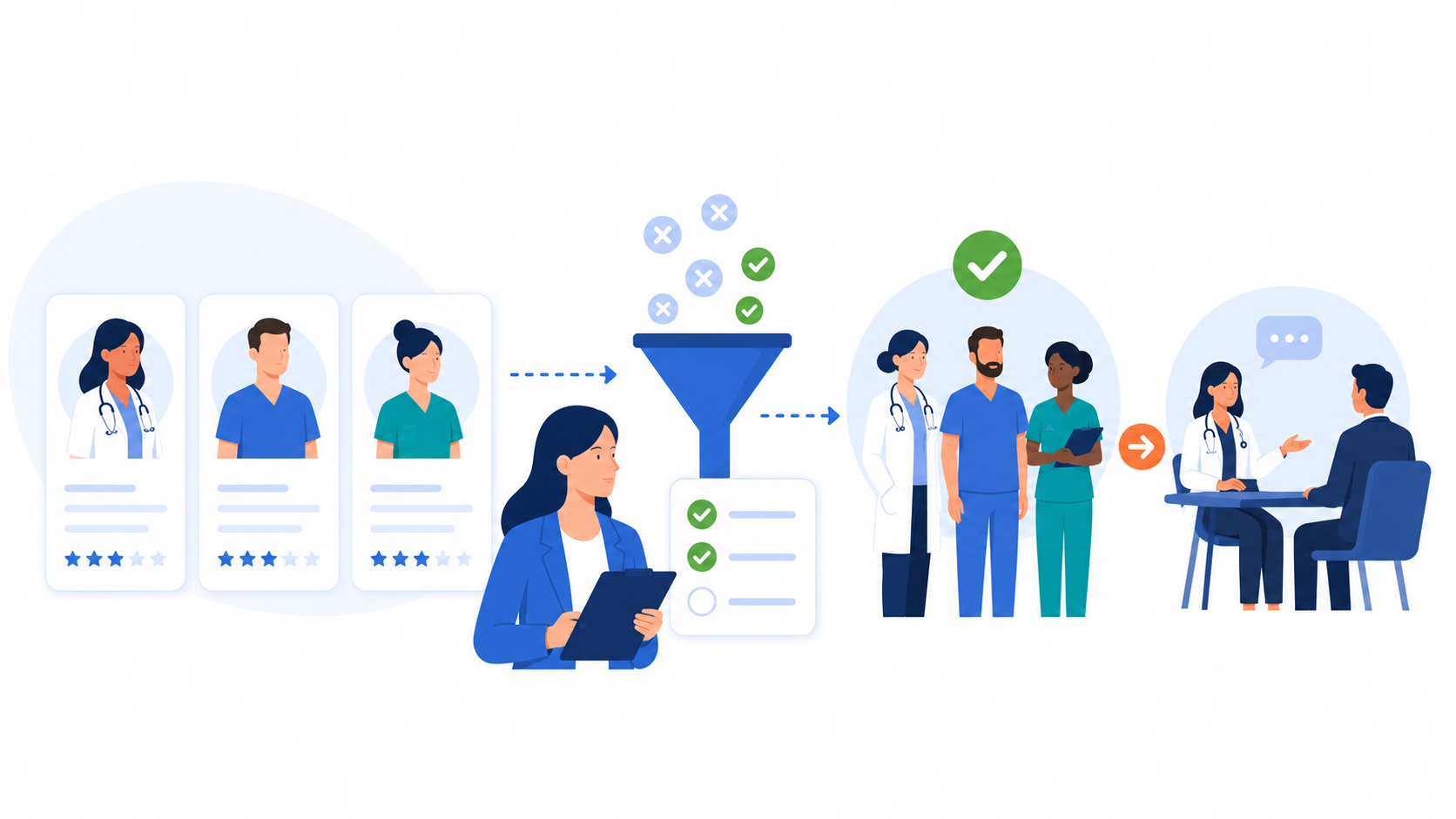
Healthcare teams can reduce manager screening work by separating early checks from manager validation.
A practical workflow could look like this:
This is where AI candidate screening and AI video interviews can support healthcare hiring teams. The goal is not to automate healthcare hiring decisions. The goal is to move repeatable screening work earlier and give recruiters a clearer basis for shortlisting before manager review.
For example, KitaHQ’s healthcare recruitment software can support a workflow where AI resume screening helps surface relevant experience and role-fit signals, AI video interviews let candidates complete structured first-round interviews without live scheduling, and AI interview assessment helps score responses against role-specific criteria. Recruiters and hiring managers can then review candidate reports with summaries, transcripts, recordings, scores, strengths, concerns, and suggested follow-up areas before deciding who should move forward.
This keeps the workflow useful without replacing the parts of healthcare hiring that still need human or approved-system review, such as license verification, sanctions and fraud checks, employment validation, clinical competency validation, final interviews, and hiring decisions.
For healthcare and medical device teams, structured screening is most useful when recruiters need comparable candidate information before manager review
Boston Scientific used KitaHQ to screen sales and business trainee candidates across Indonesia and the Philippines, helping recruiters review adaptability, resilience, business judgment, and sales motivation across regional locations.
Fairview also used KitaHQ to screen school health roles with questions on emergency response, student safety, parent communication, ethical judgment, and collaboration with school teams.
In both cases, the value is not replacing expert review. It is giving recruiters and managers clearer screening context before they spend time on the next hiring step.
How to Start Improving the Workflow
Healthcare hiring teams do not need to redesign everything at once. Start with one repeatable role where manager interviews are being used too early.
For example, choose one of these roles:
Then answer five questions:
Once these are clear, the team can build a more structured screening workflow using CV review, AI candidate screening, AI video interviews, recruiter review, and manager-ready reports.
Healthcare recruitment challenges will not disappear by adding more interviews to the calendar.
In many teams, the real improvement comes from protecting manager time. Recruiters need a clearer way to identify relevant candidates, ask consistent early questions, and send managers better screening context before interviews begin.
AI resume screening and AI video interviews can support that process when used carefully. They can help reduce repetitive screening work, standardize early evaluation, and give managers clearer reports to review.
But they should not replace human judgment, regulated verification, or final hiring decisions.
The strongest healthcare hiring workflows use technology to make early screening more consistent, then keep managers focused on the decisions only humans should make.
For repeatable healthcare roles, KitaHQ’s healthcare recruitment software helps teams move basic screening earlier, prepare clearer candidate reports, and keep manager interviews focused on human validation.
KitaHQ is an AI hiring software that helps teams screen faster, run AI video interviews, and evaluate candidates consistently.