%20(1).png)

June 14, 2026
What Recruiters Can Learn from AI Video Interview Responses
Learn what recruiters can review in AI video interview responses, common red flags to watch for, and why human review still matters before candidates move forward.
.avif)
AI video interview responses can tell recruiters more than whether a candidate looks confident on camera.
When reviewed properly, they can reveal how a candidate explains their experience, understands the role, handles realistic scenarios, communicates under pressure, and responds to follow-up questions. They can also help recruiters spot gaps that may need deeper review before a candidate moves forward.
But there is an important distinction.
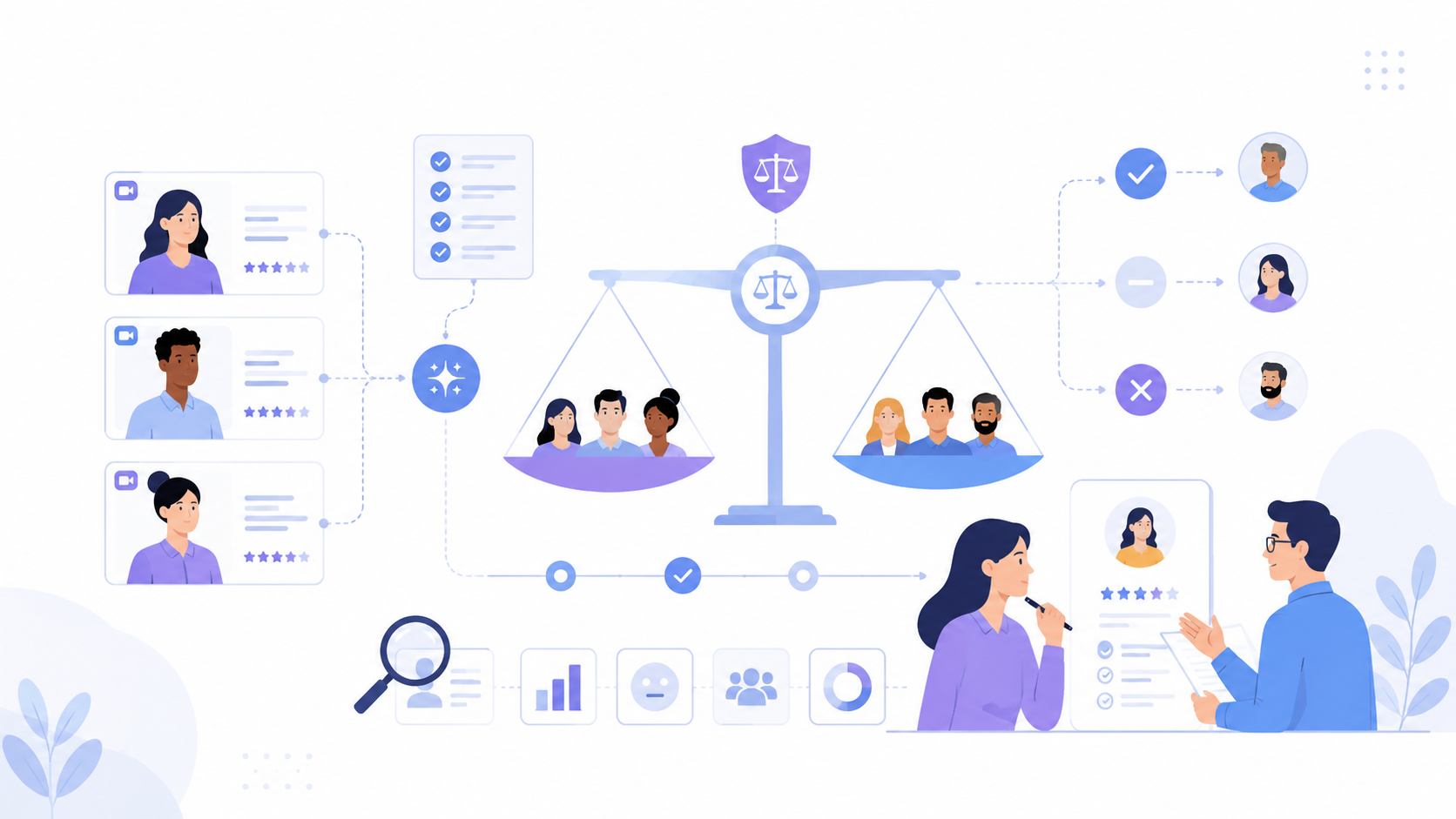
AI video interviews should not be treated as automatic pass-or-fail decisions. A short response, nervous delivery, accent, camera quality, or imperfect wording should not automatically become a rejection reason. The real value is in helping recruiters and hiring managers review candidate signals more consistently, with a clear candidate report to support human judgment.
This article explains what employers can learn from AI video interview responses, which red flags are worth reviewing, what recruiters should not overinterpret, and how AI candidate screening can support a better hiring workflow.
AI video interview responses are useful because they create a structured record of how each candidate answers the same or similar role-related questions.
Instead of relying only on a resume, recruiters can review how candidates speak about their experience, explain decisions, respond to practical scenarios, and connect their background to the role.
The most useful signals usually fall into five areas.
A strong candidate usually shows that they understand the work beyond the job title.
For example, a retail candidate may explain how they handle difficult customers during peak hours. A teacher candidate may describe how they adapt explanations for students with different learning levels. A sales candidate may explain how they qualify a prospect before pitching.
These answers help recruiters see whether the candidate understands the actual work, not just the title.
A weak signal is when the answer stays generic. If a candidate says they are “hardworking,” “fast learner,” or “good with people” without connecting those claims to the role, the recruiter may need to ask deeper follow-up questions later.
AI video interview responses can help recruiters review whether a candidate communicates clearly.
This does not mean judging accent, voice, or camera confidence. It means reviewing whether the candidate can explain ideas in a structured way, answer the question asked, and provide enough context for the hiring team to understand their thinking.
For client-facing, teaching, sales, service, or team-based roles, communication clarity can be an important early signal.
Recruiters can look for answers that are specific, relevant, and easy to follow. If a candidate gives a confusing answer, jumps between unrelated points, or avoids the question, that may be a follow-up area for the next interview stage.
Some candidates give a final answer. Stronger candidates often explain how they reached that answer.
This matters because employers are not only hiring for what a candidate has done before. They also need to understand how the candidate thinks through real situations.
For example, if the interview asks how a candidate would handle an angry customer, a stronger answer may include listening first, clarifying the issue, offering a practical option, and escalating when needed. A weaker answer may jump straight to “I will solve the problem” without explaining how.
AI video interview responses help recruiters review the reasoning behind the answer, not just the conclusion.
See also: How AI Video Interviews Improve Candidate Experience
Recruiters can also learn whether the candidate’s motivation matches the role.
This is useful when many applicants apply quickly without fully understanding the job. A candidate may have the right resume keywords but still be unclear about why they want the role, whether they understand the work schedule, or whether the position fits their expectations.
A strong answer usually connects past experience, interest, and realistic expectations. A weak answer may sound vague, mismatched, or overly focused on a different career path.
This should not automatically disqualify the candidate, but it tells recruiters what to clarify next.
Because AI video interviews produce a reviewable set of responses, recruiters can compare whether a candidate’s answers are consistent.
For example:
Inconsistent answers do not always mean dishonesty. Sometimes candidates are nervous or unclear. But inconsistency can help recruiters identify what needs verification during recruiter review or hiring manager review.
Red flags should be treated as review signals, not automatic rejection reasons.
A red flag means, “This needs a closer look,” not “This candidate must be removed.” Recruiters should review the candidate report such as transcript and recording before deciding whether the concern is real, role-relevant, or simply caused by nerves, language comfort, or interview unfamiliarity.
Here are common red flags employers can look for.
Generic answers are one of the most common issues recruiters may notice.
Examples include:
These answers are not automatically bad, but they do not give recruiters much to review. A stronger candidate usually adds an example, situation, result, or practical explanation.
For example, instead of saying “I can work under pressure,” a stronger candidate might explain how they handled a busy store shift, a difficult customer queue, or a last-minute operational issue.
The red flag is not the phrase itself. The red flag is the lack of specific context.
Some candidates can describe themselves well but still show limited understanding of the role.
This may happen when candidates apply to many jobs quickly, reuse the same answers, or misunderstand the actual work required.
For recruiters, this is useful because role misunderstanding often causes problems later. A candidate may accept the next interview, but later realize the schedule, workload, customer interaction, language requirement, or role scope does not match their expectations.
In AI video interview responses, recruiters can look for whether the candidate understands:
If this is unclear, the next step should be clarification, not automatic rejection.
A resume can list experience, but an interview response shows whether the candidate can explain that experience.
A candidate may have a relevant job title but struggle to describe what they actually did. Another candidate may have a less obvious background but explain transferable experience clearly.
Recruiters should look for whether the candidate can answer questions such as:
Weak explanation may mean the candidate lacks experience, but it may also mean the question was too broad or the candidate needs prompting. This is why recruiters should review the answer in context.
Another useful signal is whether the candidate answers the question asked.
Some candidates provide long responses but never address the core question. Others may repeat prepared talking points that sound polished but do not respond to the scenario.
For employers, this can matter in roles that require listening, customer handling, stakeholder communication, or process discipline.
A response that avoids the question may suggest:
Recruiters should check whether this happens once or across multiple responses. One missed answer may not matter. A repeated pattern may deserve closer review.
Scenario-based questions can help employers understand how candidates think in realistic situations.
For example:
A strong response usually shows practical judgment. The candidate explains what they would do first, how they would communicate, when they would escalate, and how they would prevent the issue from getting worse.
A weaker response may ignore the customer, blame someone immediately, skip important steps, or give an unrealistic answer.
This does not mean the AI video interview should make the decision. It means recruiters have a structured signal to review before deciding whether the candidate should move forward.
Inconsistency across interview responses can be useful for recruiter review.
For example, a candidate may say they have handled customer complaints before, but later struggle to explain a basic customer-handling scenario. Another candidate may say they are available for shift work, but later mention constraints that may affect the schedule.
Recruiters should not assume bad intent. Inconsistency can happen because of nerves, unclear wording, or misunderstanding.
However, inconsistent answers help recruiters know exactly what to clarify next.
See also: 8 Most Affordable AI Video Interview Tools: Pricing Guide for Hiring Teams
Yes, recruiters can watch AI video interviews, but they may not always need to watch every full recording from start to finish.
In a structured AI candidate screening workflow, recruiters may start with the interview report, summary, scores, and transcript. These help them identify which responses need deeper review. If a candidate looks promising, borderline, or unclear, the recruiter or hiring manager can open the recording for more context.
This creates a more efficient review process.
Instead of manually repeating the same early interview questions for every candidate, recruiters can review structured outputs first, then focus their attention where human judgment is most needed.
This is especially useful when teams receive many applications, hire across locations, or need multiple managers to review the same candidate context.
Not every unusual response is a red flag.
Recruiters should be careful not to overinterpret signals that may be unrelated to job performance or role fit.
For example, hiring teams should avoid judging candidates based only on:
Some roles require strong spoken communication, but recruiters should still separate communication relevance from personal style. A candidate who pauses before answering may still give a thoughtful response. A candidate who is less camera-confident may still have strong role fit.
A better approach is to focus on the content of the answer:
This keeps AI video interview review more useful and less dependent on surface-level impressions.
See also: Can AI Video Interviews Reduce Interview Bias? What They Can and Cannot Fix
KitaHQ helps hiring teams use AI video interviews as part of candidate screening.
Candidates can complete interviews on their own time, without live scheduling. Recruiters can review summaries, scores, transcripts, and recordings after interviews are completed.
This helps teams review more than whether a candidate submitted a resume. They can see how candidates answer role-related questions, explain their experience, respond to scenarios, and show communication or role-fit signals.
KitaHQ also supports AI interview assessment, so teams can review candidate responses against standard or custom criteria such as soft skills, technical skills, role understanding, and practical judgment.
Recruiters and hiring managers still decide who moves forward. KitaHQ helps structure the review process so hiring teams can make those decisions with clearer candidate context.
AI video interview responses are most valuable when they help recruiters understand candidates more clearly before the next hiring stage.
The goal is not to let AI make hiring decisions. The goal is to give hiring teams a more structured way to review candidate answers, spot useful follow-up areas, and compare candidates with better context.
Recruiters should look for signals such as role understanding, communication clarity, practical judgment, motivation, and consistency. At the same time, they should avoid overinterpreting surface-level factors such as nervousness, accent, camera quality, or short pauses.
With KitaHQ, hiring teams can use AI video interviews as part of candidate screening, review candidate reports, and keep recruiter review at the center of the decision-making process.
KitaHQ is an AI hiring software that helps teams screen faster, run AI video interviews, and evaluate candidates consistently.