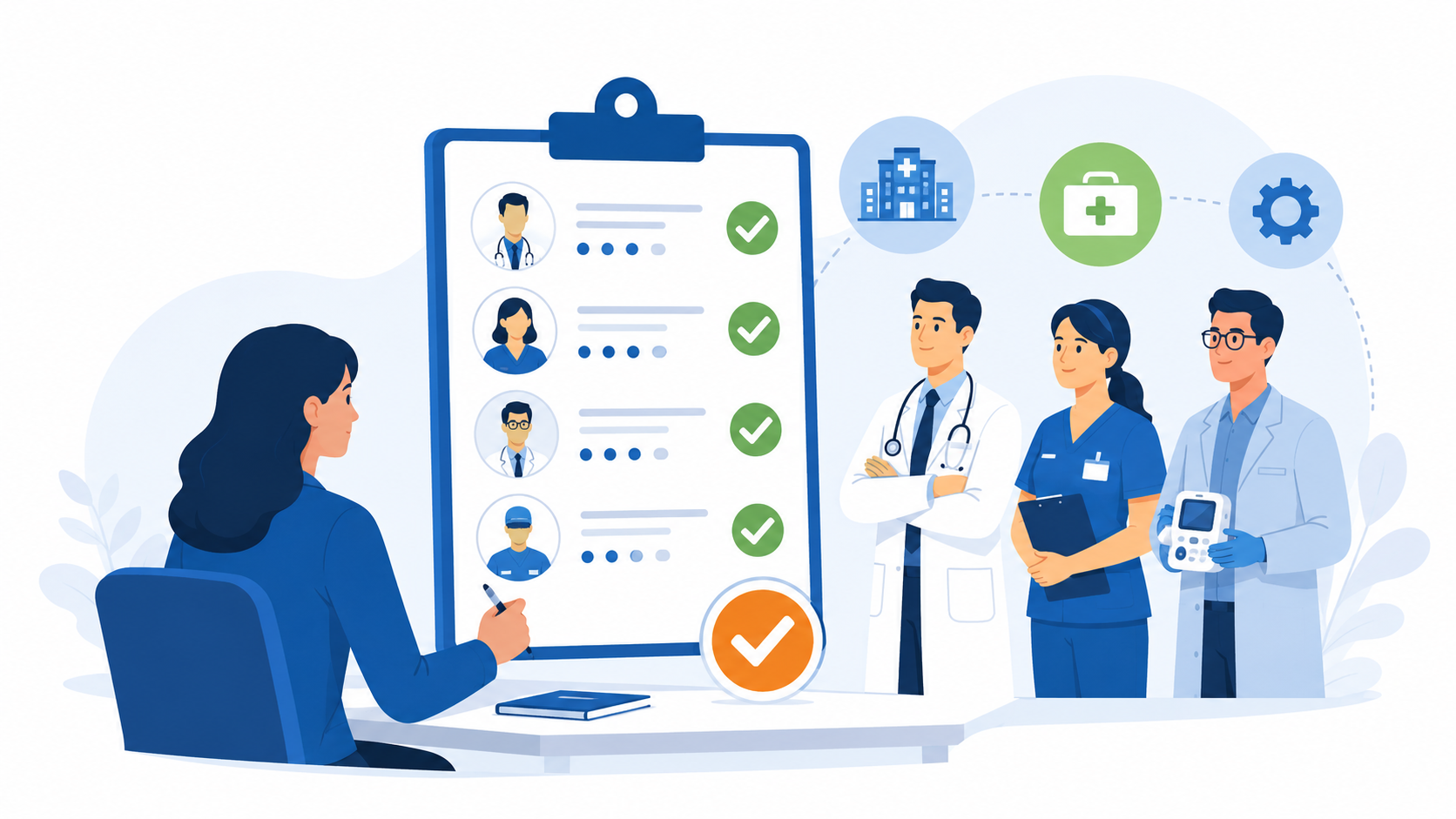
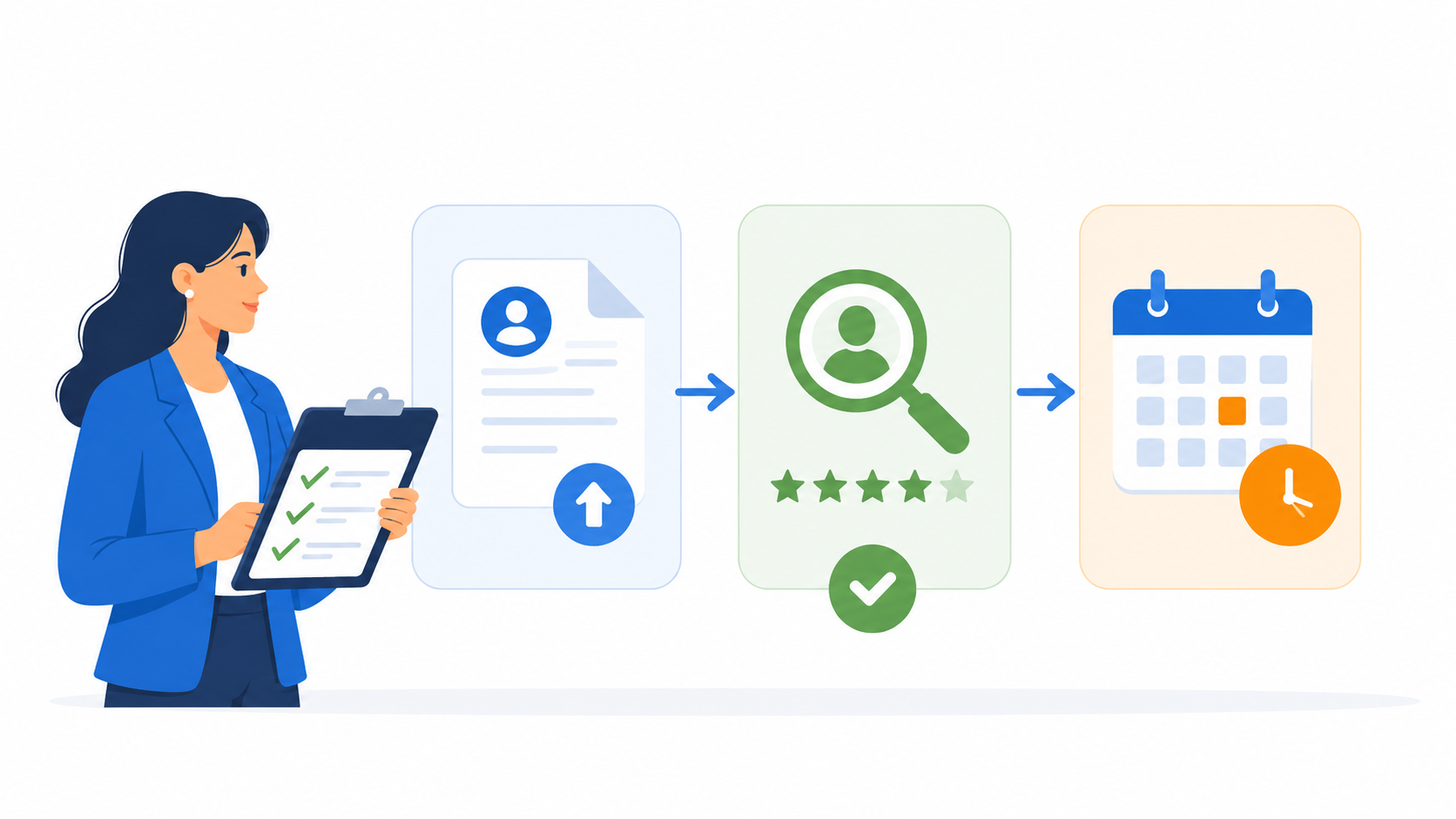
The goal of early screening is not to replace judgment. It is to help hiring teams identify which candidates deserve deeper review faster and more consistently. healthcare candidates takes more than checking whether someone has the right experience. A good healthcare candidate screening checklist helps hospitals, clinics, and medical device teams understand whether candidates can work safely, communicate clearly, follow protocols, handle pressure, and fit the day-to-day realities of the role.
That is why the checklist should not be a simple list of yes-or-no questions. It should separate what can be reviewed early, what should be assessed through interviews, what needs hiring manager review, and what must be verified through the proper human or specialist process.
This guide gives healthcare recruiters a practical checklist for screening candidates before deeper interviews. It is designed for repeatable hiring across clinical support, patient-facing, pharmacy, healthcare admin, operations, and medical device roles.
The 5-Layer Healthcare Candidate Screening Checklist
Use this checklist as a staged workflow instead of a single pass/fail form.
The most important point: early screening can help prioritize candidates, but it should not replace verification or final hiring judgment.
Layer 1: Basic Role Requirement Checklist
Start with the requirements that determine whether the candidate can realistically move forward.
Checklist
- Does the candidate have the required education or training background?
- Does the resume mention the required license or certification, if applicable?
- Is the candidate located in the right area or open to the required work arrangement?
- Can the candidate meet the expected shift schedule?
- Does the candidate have relevant experience in a similar healthcare setting?
- Is the candidate available within the hiring timeline?
- Does the candidate understand whether the role is onsite, field-based, hybrid, or remote?
- Are there any obvious gaps between the candidate’s background and the role requirements?
For regulated or credentialed roles, this step should only identify whether a license or certification is claimed. It should not be treated as proof that the credential is valid.
Layer 2: Resume Screening Checklist
After basic requirements, review the resume for signs of relevant healthcare exposure and role fit.
For hospitals
Look for experience in structured, high-pressure, or multi-department environments. Useful signals may include ward exposure, patient coordination, emergency support, admissions, documentation, discharge support, medication handling support, or cross-functional work with nurses, doctors, pharmacists, and administrative teams.
For clinics
Look for patient-facing communication, appointment handling, front desk coordination, billing, insurance documentation, medical assistant work, triage support, or experience in fast-moving outpatient settings.
For medical device teams
Look for customer-facing healthcare experience, technical product understanding, field work, clinical application exposure, hospital account handling, sales support, product training, or experience communicating with healthcare professionals.
Resume checklist
- Has the candidate worked in a similar healthcare environment?
- Is their experience relevant to the patient group, department, product, or workflow?
- Do they show stable role progression or repeated short tenure?
- Do they mention documentation, reporting, or compliance-related tasks?
- Have they worked with healthcare professionals, patients, caregivers, or hospital administrators?
- Do they have experience with shift work, on-call support, field visits, or multi-location work if required?
- Are there gaps or unclear claims that should be clarified in the interview?
- Does the resume show enough relevance to justify interview review?
Resume screening is helpful for narrowing the pool. But many important healthcare signals only appear when candidates explain how they communicate, prioritize, and respond to situations.
Layer 3: AI Video Interview Checklist
AI video interviews are useful when recruiters need a structured way to ask candidates the same role-relevant questions without live scheduling. Candidates can complete interviews on their own time, and recruiters can review responses, transcripts, recordings, scores, and candidate reports before deciding who should move forward.
For healthcare hiring, AI video interviews are most useful for assessing early signals such as communication clarity, patient or customer handling, escalation judgment, confidentiality awareness, shift expectations, and practical role understanding.
They should not be used to make final hiring decisions. They should help recruiters and hiring managers decide which candidates deserve deeper review.
Interview checklist
- Does the candidate answer clearly and directly?
- Can the candidate explain healthcare-related experience in practical terms?
- Do they understand the role setting and daily expectations?
- Do they show appropriate empathy when discussing patients, caregivers, or healthcare customers?
- Can they describe how they handle pressure, conflict, or urgent situations?
- Do they know when to escalate instead of guessing or acting beyond scope?
- Do they understand confidentiality and sensitive information handling?
- Do they show professionalism in tone, examples, and communication?
- Are there concerns that a hiring manager should probe further?
How to Judge Interview Responses
Use the interview checklist with clear response signals, not just yes-or-no answers.
This helps recruiters compare responses more consistently while still giving hiring managers space to validate technical depth, clinical judgment, and final fit.
For example, a medical device hiring team screening candidates across Indonesia and the Philippines may need to compare early responses across regional locations. In that case, AI video interviews can help collect structured responses before recruiter review, while the hiring team still decides who progresses based on role fit, communication, and manager judgment.
Layer 4: Hiring Manager Review Checklist
Recruiters should not send hiring managers a pile of resumes without context. The manager needs a clear summary of why each candidate is worth reviewing and what risks need follow-up.
A useful candidate report should help the manager quickly understand:
- Candidate background
- Relevant healthcare experience
- Interview summary
- Strengths
- Concerns
- Role-specific scoring
- Transcript or recording for review
- Suggested follow-up areas
Manager review checklist
- Does the candidate meet the core role requirements?
- What role-specific strengths were shown during screening?
- What concerns need deeper review?
- Did the candidate give specific examples or generic answers?
- Is the candidate likely to handle the pace, setting, and communication demands of the role?
- What should be tested or clarified in the next interview?
- Does the manager agree with the screening criteria used?
- Should the candidate move forward, stay on hold, or be rejected?
This layer is where structured screening becomes useful. The recruiter is not asking the manager to trust a score blindly. The recruiter is giving the manager a clearer review starting point.
Layer 5: Verification Checklist
Some healthcare hiring steps should never be replaced by early screening tools or interview responses.
Screening can identify claims. Verification confirms whether those claims are valid.
Verification checklist
- License validity
- Certification validity
- Employment history
- Education claims
- Professional references
- Sanctions or exclusion checks
- Background checks
- Right-to-work checks
- Role-specific compliance requirements
- Hands-on clinical or technical competency validation
These checks should be handled by the appropriate HR, compliance, credentialing, clinical, or specialist verification process.
For clinical or regulated roles, the safest approach is to treat early screening as a prioritization step, not a validation step.
Healthcare Screening Checklist by Team Type
Different healthcare teams should emphasize different screening signals.
This prevents the checklist from becoming too generic. A clinic receptionist, a hospital support worker, and a medical device field specialist should not be screened with the exact same questions.
What to Screen in Resumes vs Interviews
A common mistake is expecting resumes to answer questions they cannot answer.
A resume can show where someone worked, what responsibilities they had, and whether their background appears relevant. But it does not reliably show how they communicate, handle patients, escalate problems, or respond under pressure.
Use resumes and interviews differently.
This separation helps recruiters avoid two extremes: rejecting candidates too early based only on resumes, or advancing candidates without enough structured screening.
Example Healthcare Screening Questions
Use these as starting points. Adjust them based on the role, seniority, setting, and risk level.
General Healthcare Screening Questions
- What type of healthcare setting have you worked in before?
- What part of your previous experience is most relevant to this role?
- What shift arrangements are you able to commit to?
- How do you handle repetitive tasks that require accuracy?
- Tell us about a time you had to communicate with a frustrated patient, caregiver, or customer.
- How do you protect confidential or sensitive information at work?
- What would you do if you were unsure about a patient, customer, or process issue?
- How do you manage competing priorities during a busy shift?
Hospital Candidate Questions
- Tell us about a time you worked with multiple departments or team members to solve a patient-related issue.
- How do you respond when a situation becomes urgent and instructions are unclear?
- How do you make sure documentation is completed accurately during a busy shift?
- What would you do if you noticed a possible process or safety concern?
Clinic Candidate Questions
- How would you handle a patient who is upset about a delay?
- How do you balance patient service with administrative accuracy?
- Tell us about a time you had to manage many appointments, calls, or requests at once.
- What would you do if a patient asked for information you were not authorized to provide?
Pharmacy Operations Questions
- How do you stay accurate when completing repetitive or detail-heavy tasks?
- What would you do if a customer challenged a process or policy?
- How do you manage inventory, queue pressure, or handover tasks?
- When would you escalate an issue instead of handling it yourself?
Medical Device Candidate Questions
- How would you explain a technical product issue to a healthcare professional who is short on time?
- Tell us about a time you had to support a customer in the field.
- How do you prepare before visiting a hospital, clinic, or healthcare customer?
- What would you do if a customer asked a question outside your knowledge or authority?
Copyable Healthcare Candidate Screening Template
Use this template for recruiter review before sending candidates to the hiring manager.
Candidate Information:
- Candidate name:
- Role applied for:
- Hiring team:
- Location:
- Availability:
- Expected start date:
- Screening date:
1. Basic Requirements
2. Resume Review
3. Interview Review
4. Manager Handoff
5. Verification Required
How to Use This Checklist in Practice
Start by choosing the role category: hospital, clinic, pharmacy, healthcare admin, or medical device. Then decide which criteria belong in resume screening, which belong in AI video interviews, and which must be verified later.
For each role, define:
- Must-have requirements
- Nice-to-have experience
- Interview questions
- Pass, borderline, and concern signals
- Manager follow-up questions
- Verification steps
- Final reviewer ownership
This makes the checklist more than a document. It becomes a shared screening standard across recruiters, hiring managers, and verification owners.
For teams that want to turn this checklist into a more structured healthcare recruitment software workflow, the next step is to separate early screening, interview assessment, candidate reports, manager review, and verification ownership across the hiring process.
A healthcare candidate screening checklist should help the team move faster without blurring responsibility. Recruiters can screen earlier. Hiring managers can review stronger shortlists. Verification teams can confirm what must be formally checked. And final hiring decisions stay with the people responsible for making them.
.avif)
%20(1).png)