.avif)


.png)
.png)


Recruiters repeat the same early screen questions across many applicants.
.svg)
Clinician calendars don’t align, candidates disengage while waiting.
.svg)
Different locations apply different criteria. Managers end up re-screening because they mistrust the shortlist.
.svg)
License status clarity, confidentiality judgement, or communication barriers surface too late in the process.
Self-reported status on licenses and certifications.
Assessing if a candidate knows when to act vs escalate to a senior clinician.
Assessing baseline confidentiality and ethics needed to handle sensitive patient scenarios.
Ability to explain next steps clearly and de-escalate frustrated patients or family members.
Accurate notes and structured handoffs in busy environments.
Alignment with night shifts, standing requirements, and patient volume expectations.
.avif)

Role: Medical Operations
QUESTION
“The clinic’s vaccine fridge has failed, putting $20,000 of inventory at risk. What are your first three steps to manage this crisis?”
SKILLS ASSESSED
Emergency response logic
Risk mitigation
Resource management
.png)
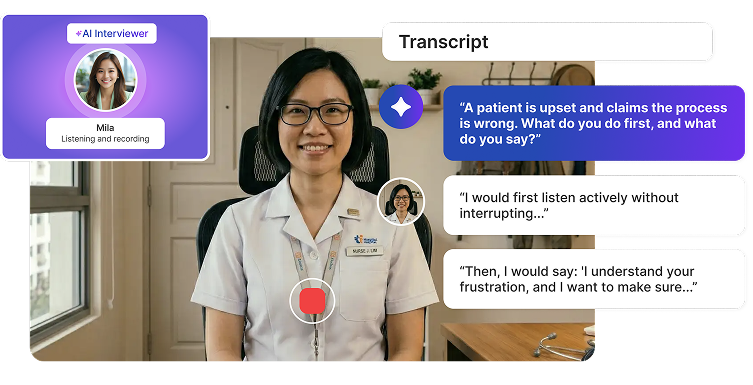
Role: Clinic Nurse
QUESTION
“A patient is upset and claims the process is wrong. What do you do first, and what do
you say?”
SKILLS ASSESSED
Patient communication and de-escalation
Prioritisation and safe next steps
Professional tone under stress
Role: Pharmacy Assistant
QUESTION
“A customer is frustrated because they received the wrong prescription. How do you handle the situation, and what do you say?”
SKILLS ASSESSED
Clinical judgment
Patient de-escalation
Protocol adherence
.png)

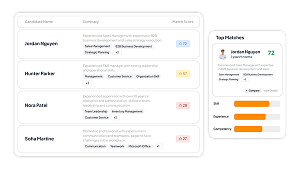
A clear summary aligned to candidate role scorecard.
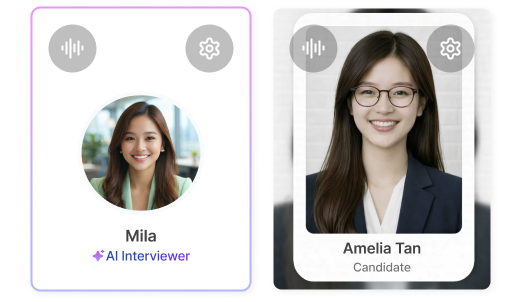
Full transcript and recording so clinical leads can review without re-running the first round.
Strengths, concerns, and what to validate next, especially when the candidate is borderline.
Compare candidates across the same criteria to build faster, more consistent shortlists across clinics or locations.
AI recruitment tools for sales improve high-volume efficiency and keep experts focused on critical decisions.

High-volume nursing and clinic roles with repeat hiring cycles.
Hiring surges where scheduling first rounds becomes the bottleneck.
Multi-location healthcare hiring needing consistent early screening.
Telehealth teams screening clinicians for remote judgement.
- License and certification verification, sanctions and fraud checks
- Employment validation and reference checks
- Final face-to-face interviews and hiring decisions
- Hands-on clinical competency validation where required
Frequently Asked Questions
Understanding AI Hiring Platform for Healthcare
Is this a fit for our healthcare hiring?
Fits high-volume or repeatable roles (nurses, clinic support, telehealth clinicians, junior ops leads). Not designed for executive hiring or final-stage decisions.
What do hiring managers actually receive?
Structured scores tied to a hiring scorecard, interview transcript, recording, and a short structured summary, so managers don’t repeat first-round screens.
Where does this sit in the hiring process?
After applications and before hiring manager interviews, replacing most first-round screens for repeatable roles.
What still requires humans or other systems?
License/certification verification, sanctions and fraud checks, employment validation, final decisions.
What is the most common failure case?
When answers become scripted, scoring criteria are vague, or managers don’t trust the scoring. Prevent it with scenario prompts, clear pass/borderline/fail definitions, and regular calibration.
Can this screen telehealth clinicians without overpromising?
Yes, if you focus on early signals like remote reasoning, escalation judgement, confidentiality judgement, and communication clarity. It should not replace clinician-led technical rounds.
Explore Other Hiring Solutions

Banking

Sales

Education

Retail