.avif)



.avif)

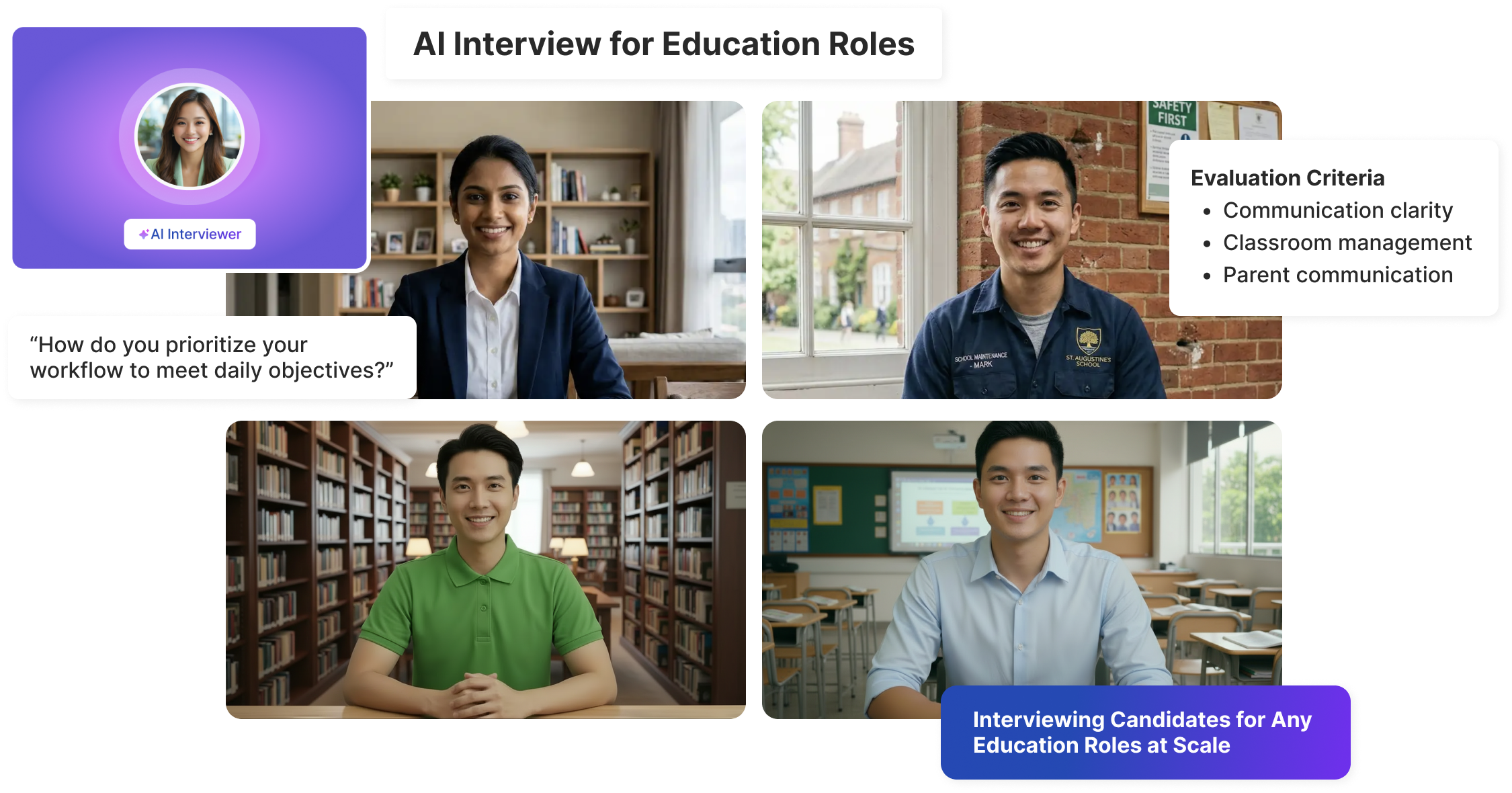
Student care and tuition roles with repeat
hiring cycles.
Who This is For in Education Hiring?
Designed for staffing agencies handling permanent, contract, and outsourced recruitment
projects at scale
.png)
Classroom
Teachers

Admin and
Office
.png)
Health, Safety &
Facilities
How Education Hiring Breaks with Scale
High-volume education hiring creates repeat work, inconsistent screening, and late-stage surprises.

High-Volume Burnout
Recruiters lose hundreds of hours repeating baseline questions for every teaching and staff applicant.
.svg)
Scheduling Bottlenecks
Scheduling delays between busy school leaders and candidates lead to missed hires during urgent
recruitment windows.
.svg)
Unreliable Shortlists
Subjective screening across different interviewers creates inconsistent quality and hard-to-compare candidates.
.svg)
Delayed Discovery of Mismatches
Work-week constraints and pedagogical misalignment often stay hidden until the very last stage.
What to Assess in First-Round Interviews
Consistent, structured assessments before manager review
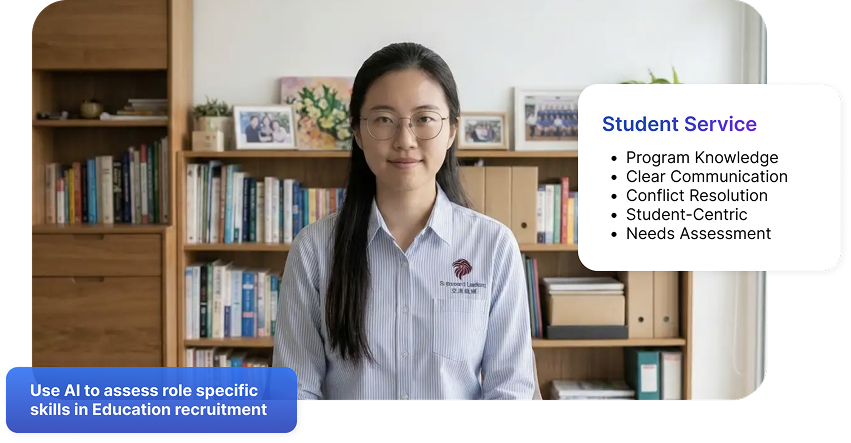
Classroom Management
Assessing student engagement strategies and the ability to maintain a focused learning environment.
Inclusive Teaching
Assessing how they adapt lessons for varying ability levels and
learning needs.
Conflict Resolution
Evaluating responses to parent or colleague disagreements for professionalism and clarity.
Syllabus Mastery
Probing for real-world familiarity with your specific curriculum and planning standards.
Mock Class Delivery
Applicants perform a short teaching segment to showcase their lesson delivery, structure, and pacing.
Operational Alignment
Hard confirmation of start dates, travel limits, and holiday shift availability.
How KitaHQ Fits Into an Education Hiring Workflow
Replace most first-round interviews with structured screening that produces shareable summaries, transcripts, and recordings.
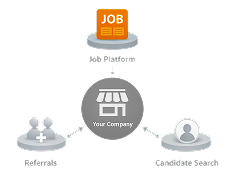
Sourcing
- Consolidate applicants from job boards and referrals. Automatically group by subject, level, campus, and start date.
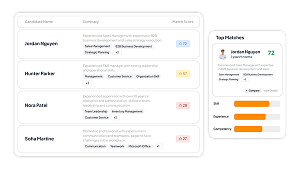
Hiring Manager Review
- School leaders review the reports to focus their final interviews on high-potential talent.
Example Questions and Assessments for Education Roles
Customize questions and assessments to match the role, level, and school expectations.
Role: Secondary School English Teacher
QUESTION
“Deliver a 20-minute lesson on The Tell-Tale Heart (Edgar Allan Poe) and teaching close reading & analysis of language, mood, and perspective.“
SKILLS ASSESSED
Delivery and clarity
Lesson design and teaching strategies
Curriculum competence
.png)
Role: Admissions & Enrollment
QUESTION
“How do you handle a parent who is hesitant about our tuition fees during an intake interview?"
SKILLS ASSESSED
Objection Handling
Financial Communication
Value-based persuasion
.png)
Role: Facilities & Maintenance
QUESTION
“You find a leak in the science lab after hours. Who do you notify and how do you secure the area?”
SKILLS ASSESSED
Emergency Response
Risk Prioritization
Operational Accountability
.png)
Decision-Ready Candidate Intelligence
Skip the note-taking. Receive structured, data-backed reports that make it easy to compare talent and plan your final interviews.

Interview Summary
A Candidate snapshots vetted against your specific academic bar and shift requirements.
Transcript and Recording
Full recordings for easy review of communication style and the mock teaching segment.
Gap Analysis
Insights into strengths and borderline skills to guide your final-round evaluation.
Shortlist View
A central dashboard to compare talent across multiple schools or tuition centers instantly.
Where KitaHQ Fits in Your Hiring Workflow
Fit Cases to Use KitaHQ

High-Volume Roles: Ideal for student care and tuition positions with repeat hiring cycles.
Multi-Branch Consistency: Ensures a unified
first-round screening bar across all your centers.
Hiring Surges: Rapidly scales for term-start peaks, relief pools, and urgent backfills.
Leadership Efficiency: Delivers faster shortlists so academic leads skip the repetitive baseline vetting.
Where Human Expertise Remains Essential
- Selection & Culture: Final round interviews and cultural fit assessments.
- Pedagogical Finality: Live mock-teaching reviews and teaching decisions.
- Due Diligence: Comprehensive safeguarding and reference checks.
- Regulatory Compliance: Verification of teaching licenses and certifications.
Stop Wasting Time on Manual Candidate Screening.
Ensure every educational institution secures top tier talent with an objective and data driven screening process.
Schedule Your Call
Explore Other Hiring Solutions


Frequently Asked Questions
Understanding AI Hiring Platform for Education
Which education roles does this workflow fit best?
This fits repeatable roles where first-round screening is the bottleneck, such as student care teachers, tuition teachers, and common subject teacher hiring across multiple centres. It is most useful when you are backfilling frequently or hiring in batches before term starts.
What should still be done by humans after this first round?
Live teaching observation, panel interviews, reference checks, and final hiring decisions should remain human-led. Use the outputs to decide what to probe next, not to skip judgment-heavy final rounds.
What sits outside scope for education hiring?
Credential verification, safeguarding checks, employment validation, and any license or certification verification remain outside the platform. Screening and structured evaluation are covered, verification remains outside KitaHQ.
How do we avoid scripted answers in first-round interviews?
Scripted answers usually happen when questions are too generic. Use scenario prompts tied to your role realities (student behaviour, parent conversations, lesson pacing) and require specific examples from the candidate’s past work.
What is the common failure case with hiring managers, and how do we prevent it?
The workflow fails when managers do not trust the outputs and re-interview everything from scratch. Prevent this by aligning on 4 to 6 decision criteria upfront, and ensuring every candidate is screened against the same prompts so comparisons feel fair.
Can this work for urgent relief coverage and fast backfills?
Yes, if your criteria are already defined and you are hiring from a known role template. Speed depends on how quickly you can review the outputs and how many candidates you run through in parallel.
How should we use the mock teaching segment without over-indexing on performance?
Treat it as an early check for clarity, structure, and basic presence, then validate teaching quality live. If the role requires strong classroom delivery, keep the mock segment short and use the next round for deeper observation.
What do academic leads actually get that helps them decide faster?
They receive consistent summaries plus full transcripts and recordings, which let them review teaching approach and responses without re-asking basics. This makes the next round tighter because leaders can focus on what to validate, not what to discover.
“KitaHQ has transformed how we approach hiring. We’ve reduced time to hire by 50%, expanded access to multilingual talent, and can customise scoring rubrics so every hiring decision aligns with our values, not generic AI models.”

Grace Ho
•
Head of EdTech

“Before KitaHQ, our average time-to-hire was lagging at 5 to 7 days per candidate. Since switching, we’ve slashed that down to just 2 days. The efficiency gain is incredible, it’s allowed our team to move at the speed of the market without losing quality.”

Angela Gabriella
•
Senior HR Recruiter
