

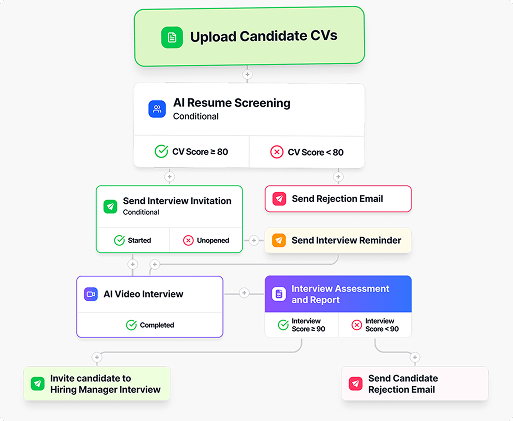
Repeated hiring for service advisors across one or more dealerships
Who This Is For in Automotive Hiring
Built for automotive companies hiring technical, service, sales, customer-facing,
and operational roles across automotive businesses.
and operational roles across automotive businesses.

Dealership Sales Teams

Service and Repair Teams

Branch Leadership Team

Specialized Technicians

Collision Operations

Aftersales Teams
Why Automotive Hiring Breaks Down
Automotive hiring becomes harder when technician supply is limited, technical
requirements vary, and every readiness check depends on manual recruiter work.
requirements vary, and every readiness check depends on manual recruiter work.

Qualified Technician Shortage
Dealerships and repair shops compete for too few trained technicians across service, diesel, collision, and EV roles.

Manual Readiness Checks
Recruiters repeatedly confirm shift availability, certifications, weekend schedules, and pay expectations before interviews.
.svg)
Specialized Skills Mismatch
Candidates may have automotive experience but lack the exact diagnostic, EV, ADAS, transmission, or collision skills required.
.svg)
Technical Fit Is Unclear
Resumes rarely show which vehicle systems, diagnostic tools, repair tasks, or manufacturer platforms candidates can handle.
Where KitaHQ Fits in the Automotive Hiring Process
Our recruitment software for the automotive industry creates a faster hiring workflow, from resume
screening to candidate reporting.
screening to candidate reporting.

1
Sourcing and Applications
Post jobs through job boards, referrals, career pages, or other applicant sources.

2
Early-Stage Screening
KitaHQ screens resumes, runs AI video interviews, assesses candidates’ hard and soft skills, and prepares clear reports for recruiter review.
.avif)

3
Manager Interviews and Selection
Hiring teams review shortlisted candidates and decide who should get hired.

4
Offer and Onboarding
Manage offers, contracts, employee records, and onboarding through your existing system.
AI Resume Screening for Automotive Roles
Screen automotive resumes against role-specific requirements before recruiters
and workshop managers review every application manually.
and workshop managers review every application manually.
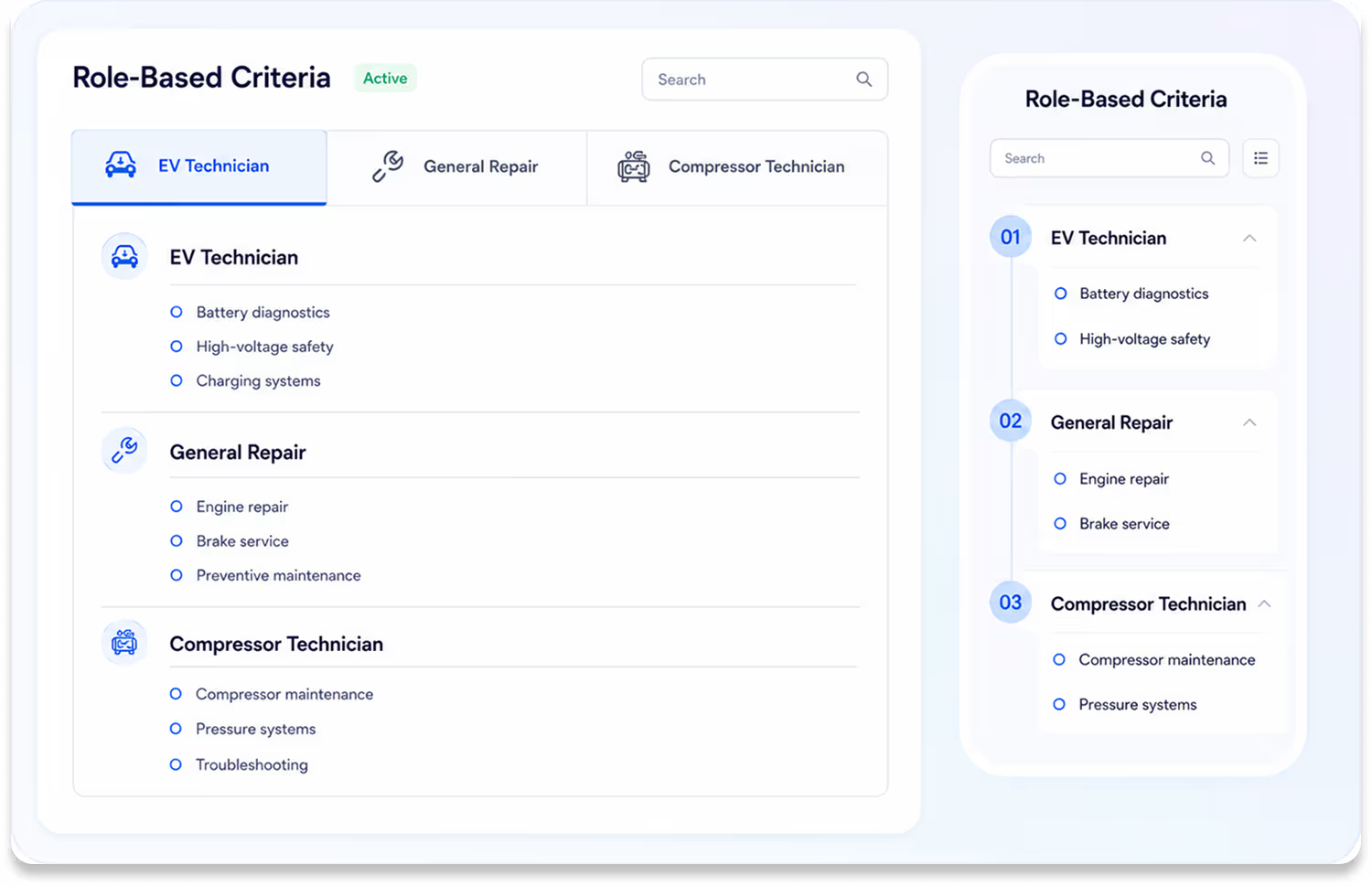
Custom Skill Criteria
Recruiters can set and run different screening criteria simultaneously for service, diesel, collision, EV, ADAS, parts, and customer-facing roles.
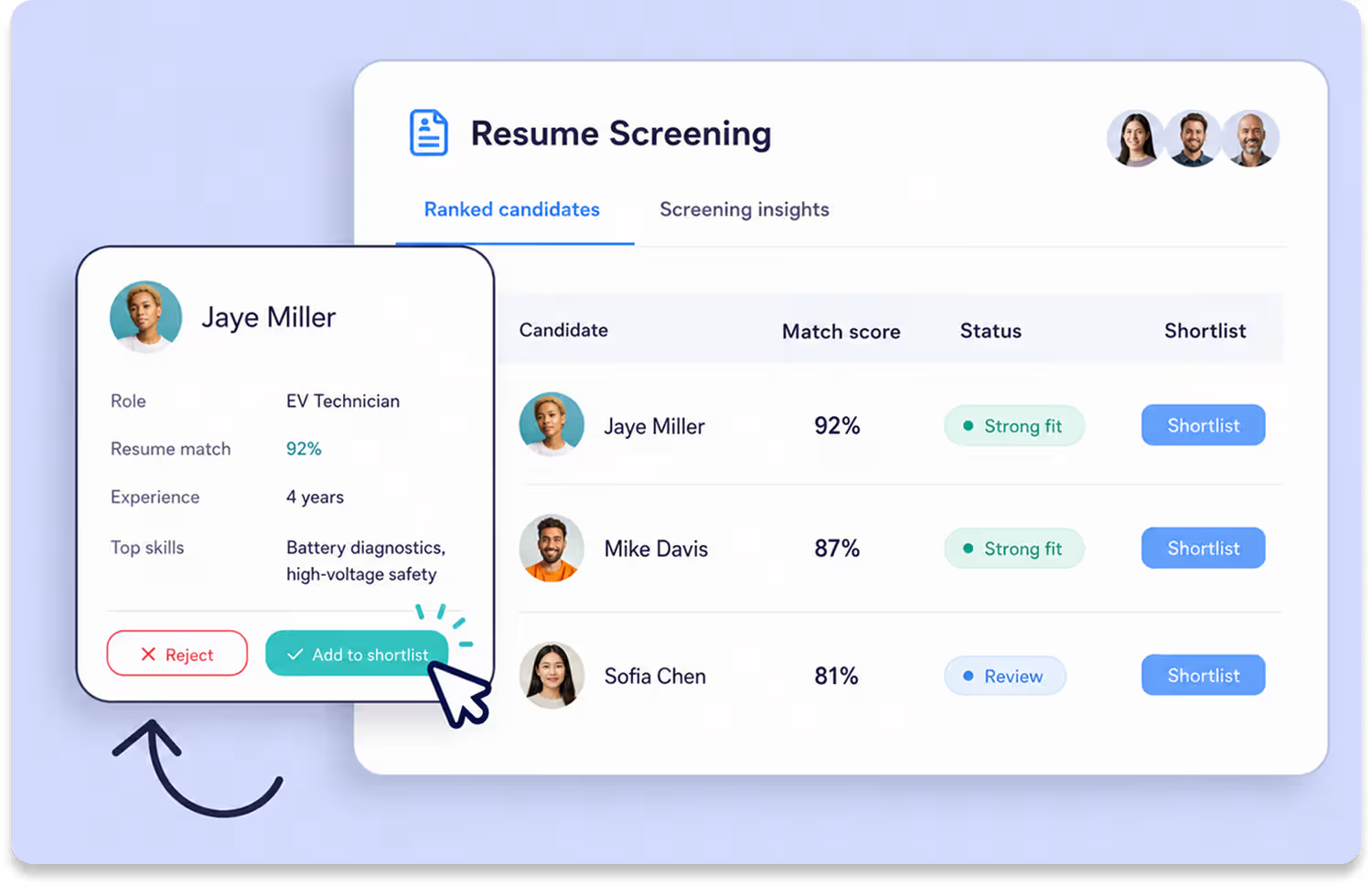
Ranked Candidate View
Review the strongest resume matches first based on custom criteria, while keeping recruiters responsible for shortlisting decisions across automotive roles.
AI Video Interviews for Automotive Hiring
Automotive recruiting software uses AI video interviews to check candidates’ basic
fit, reducing repetitive first-round screening for recruiters.
fit, reducing repetitive first-round screening for recruiters.
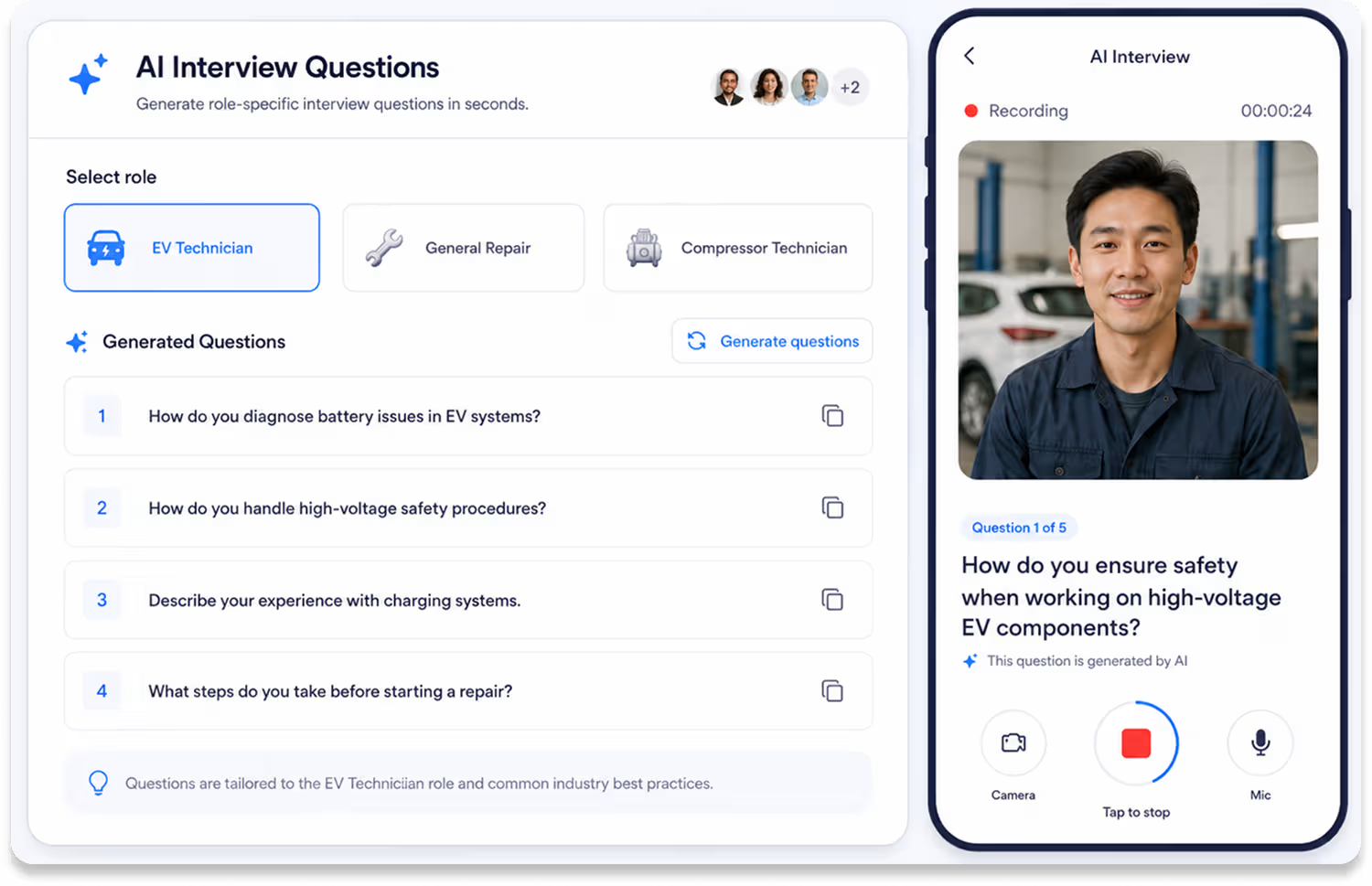
Role-Specific Questions
Generate and customize interview questions to evaluate candidates’ automotive knowledge, workshop experience, and technical understanding.
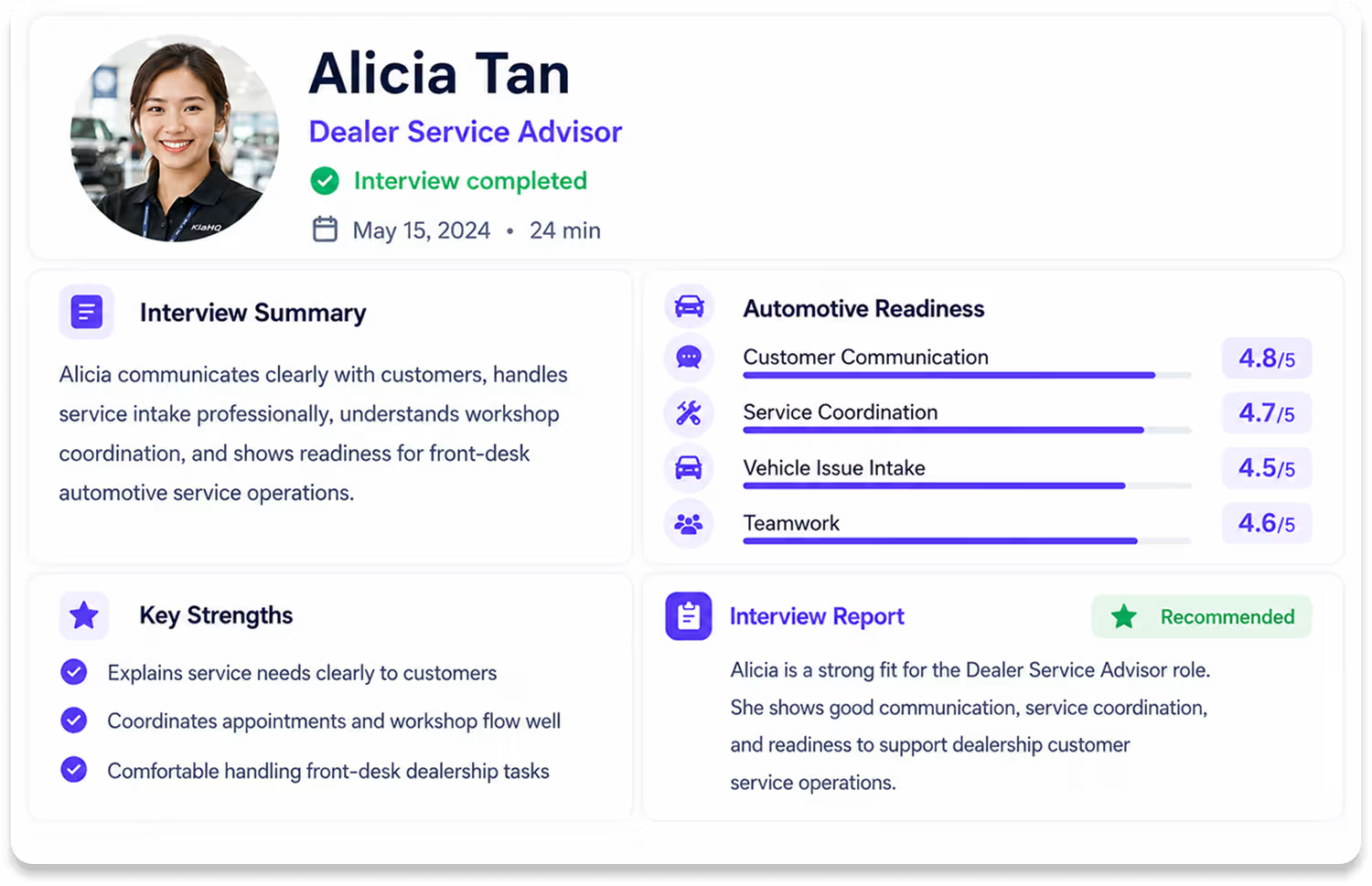
Automotive Readiness Checks
Use the same questions and criteria across automotive candidates to check shift availability, weekend schedules, and stated license requirements.
What to Assess in Automotive Hiring
Evaluate the candidate signals that resumes alone rarely explain before
practical tests or deeper manager interviews.
practical tests or deeper manager interviews.
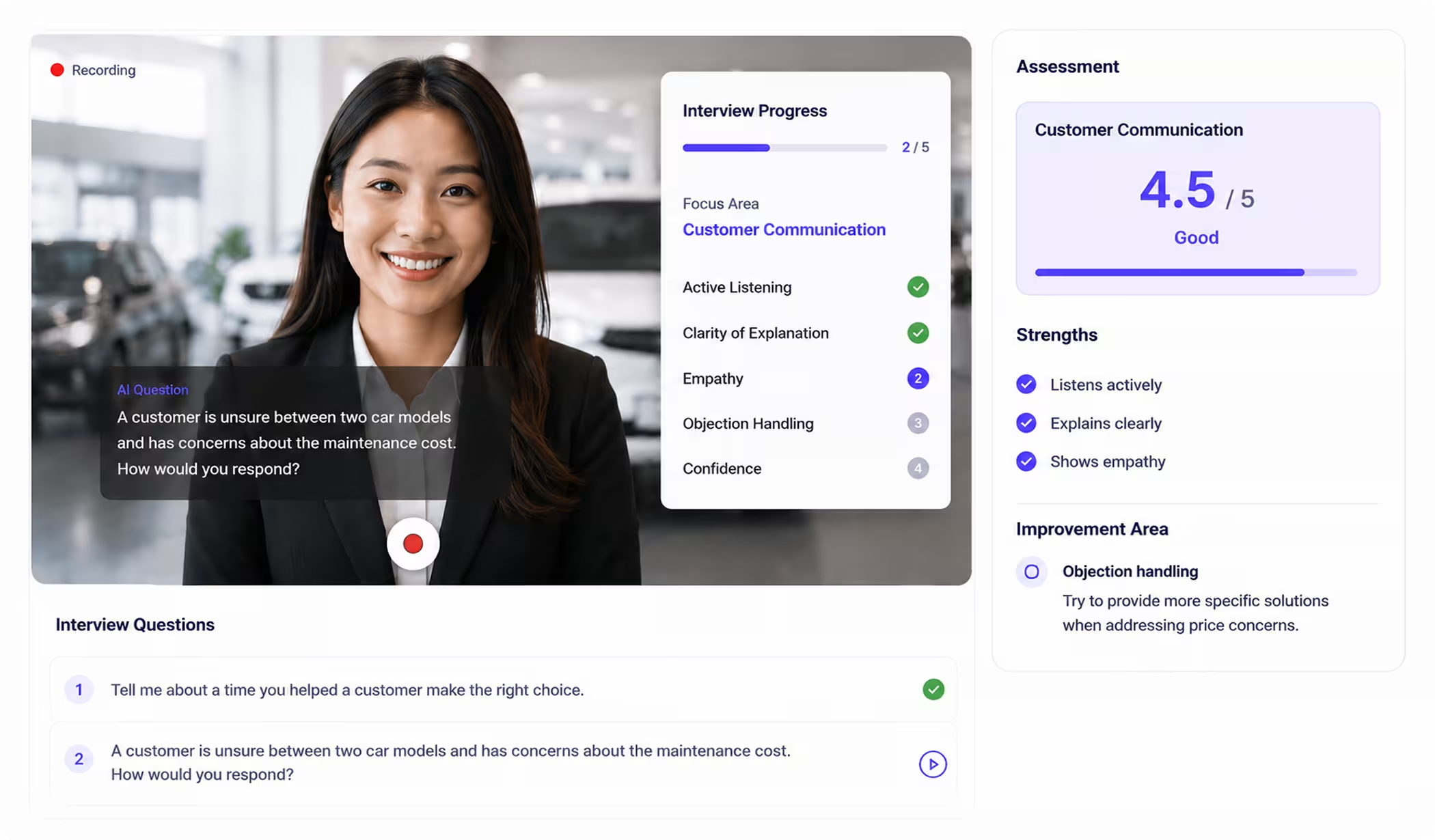
Customer Interaction
Customer Communication
Assess how clearly candidates explain vehicle features, services, repair needs, or pricing to customers.
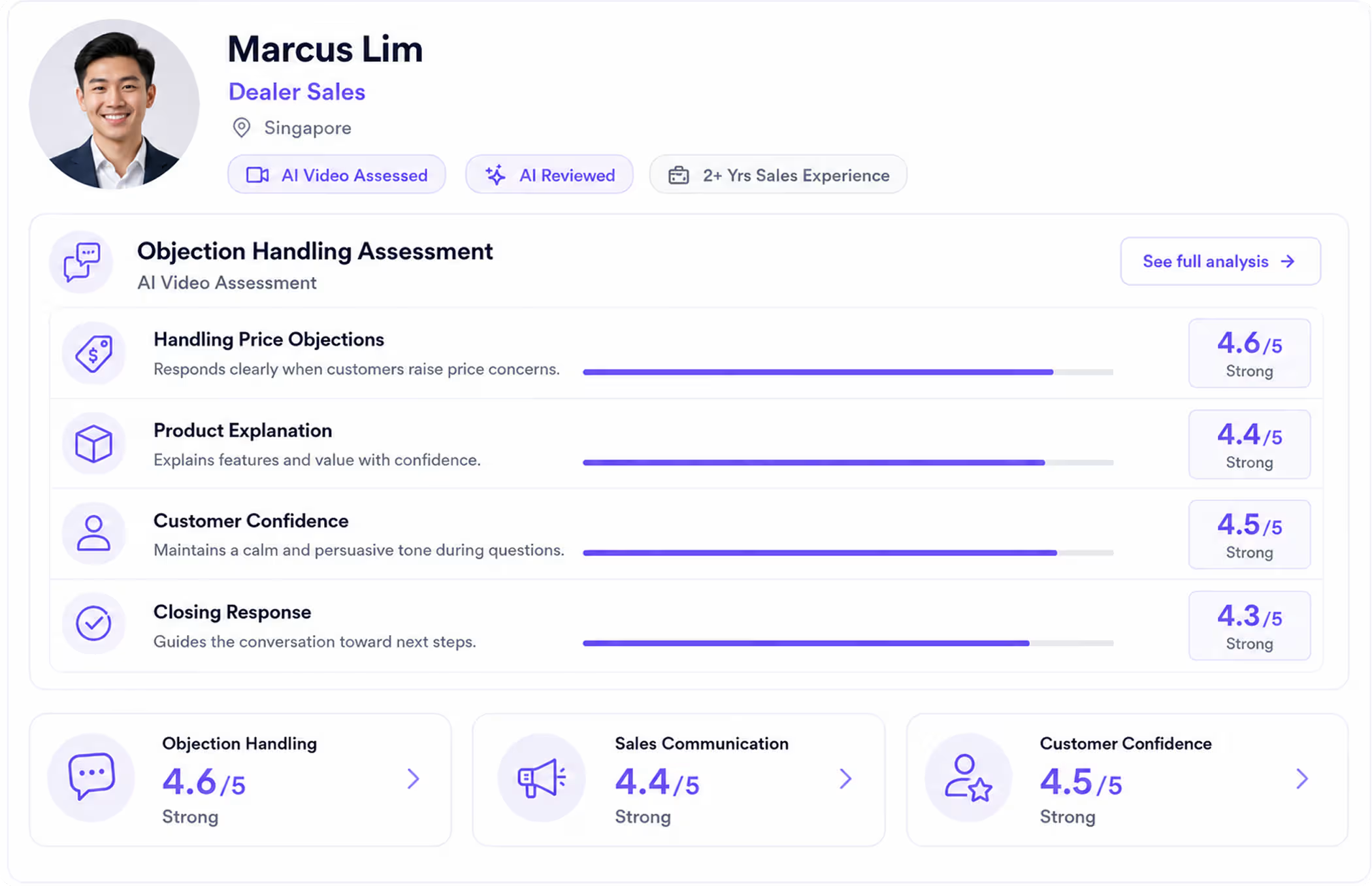
Sales Readiness
Objection Handling
Evaluate how candidates address concerns about price, vehicle suitability, repair costs, or purchase decisions.
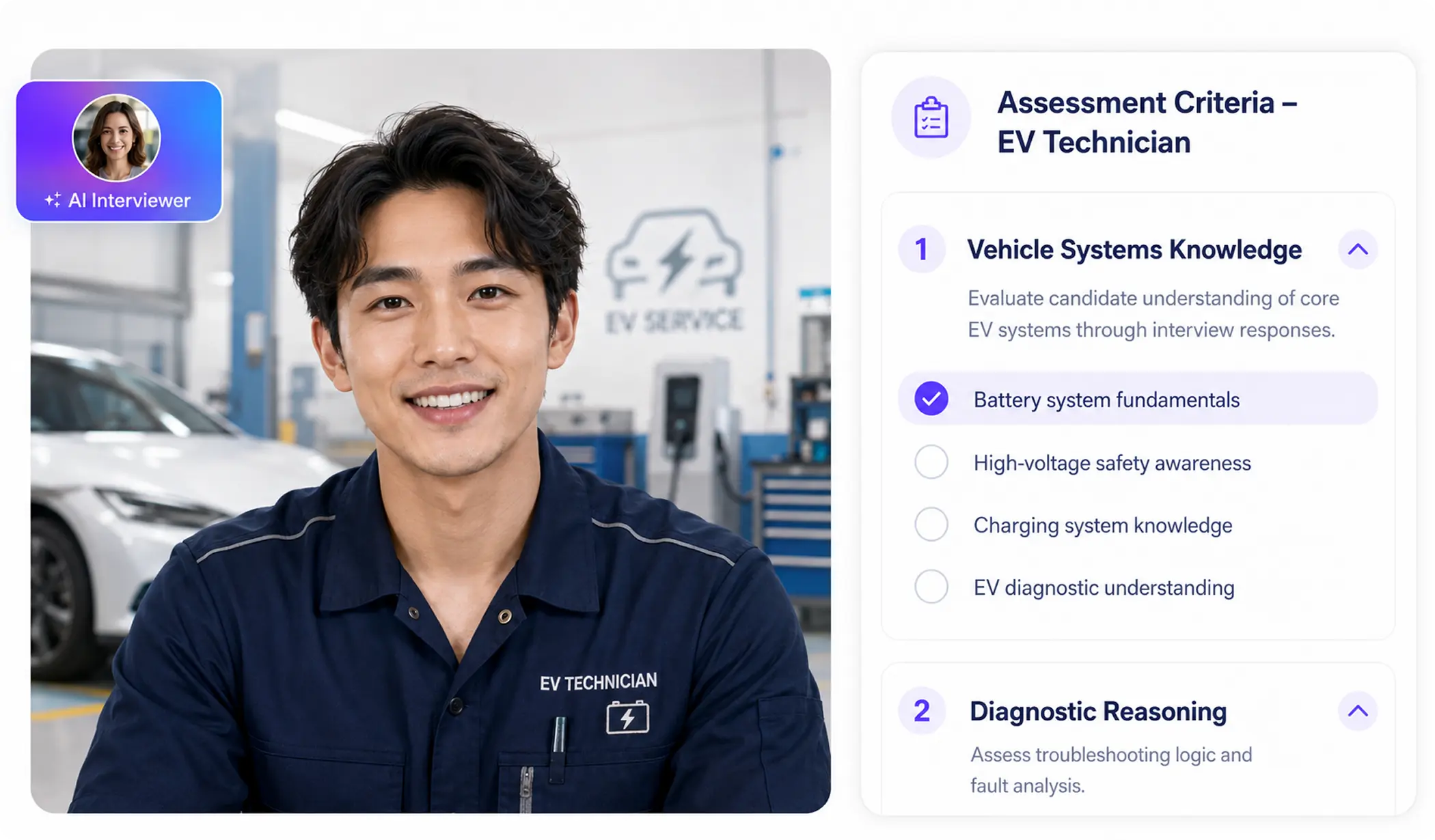
System Knowledge
Vehicle Systems Knowledge
Assess candidates’ understanding of engine, transmission, braking, electrical, cooling, and drivetrain systems across common vehicle types.
Safety Readiness
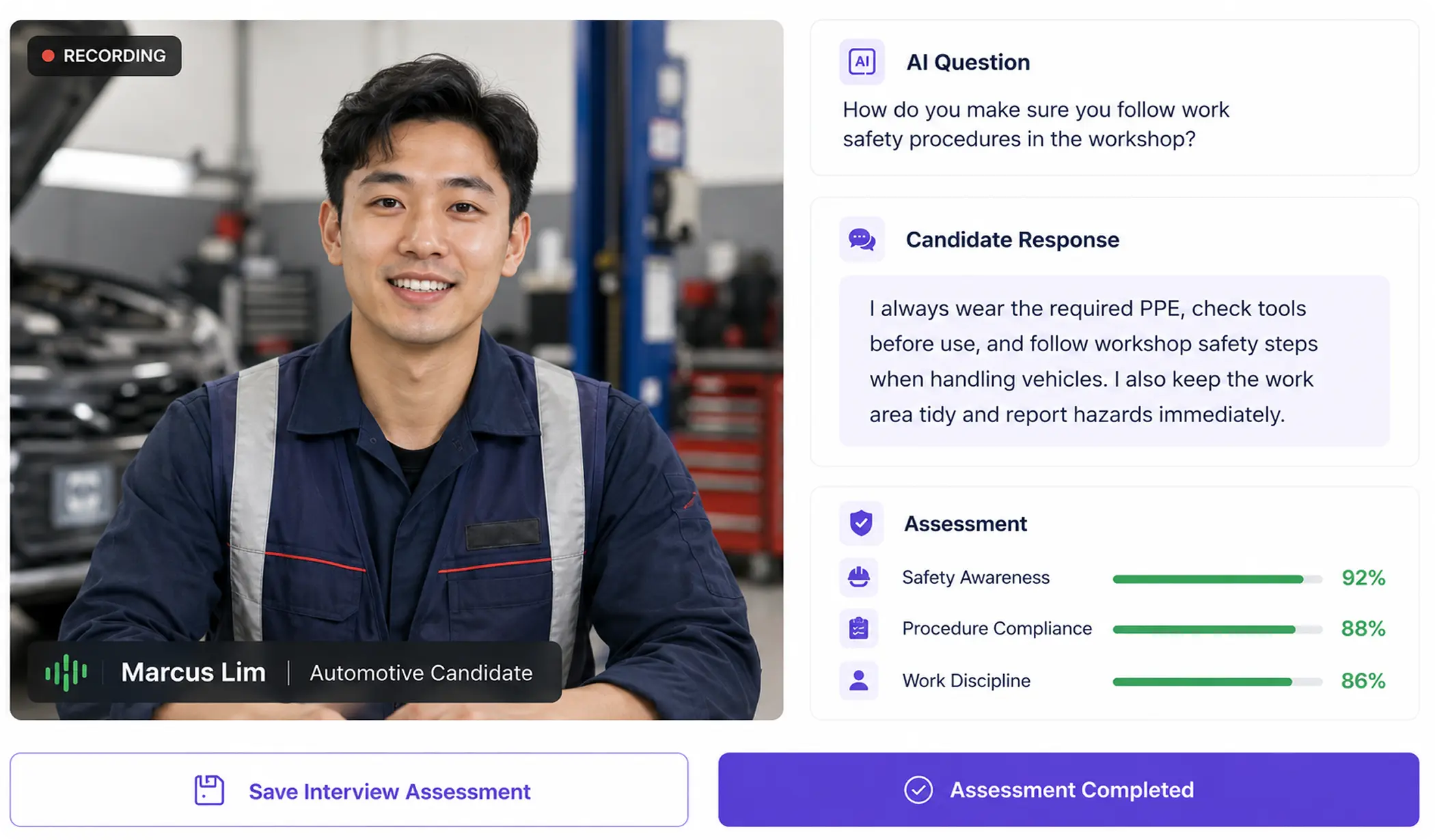
Workshop Safety
Assess whether candidates use tools, lifts, batteries, and PPE safely while responding appropriately to workshop hazards.
Example Automotive Assessment Questions
Use role-specific interview questions to understand how candidates diagnose vehicle
issues, explain repair procedures, and apply automotive technical knowledge.
issues, explain repair procedures, and apply automotive technical knowledge.
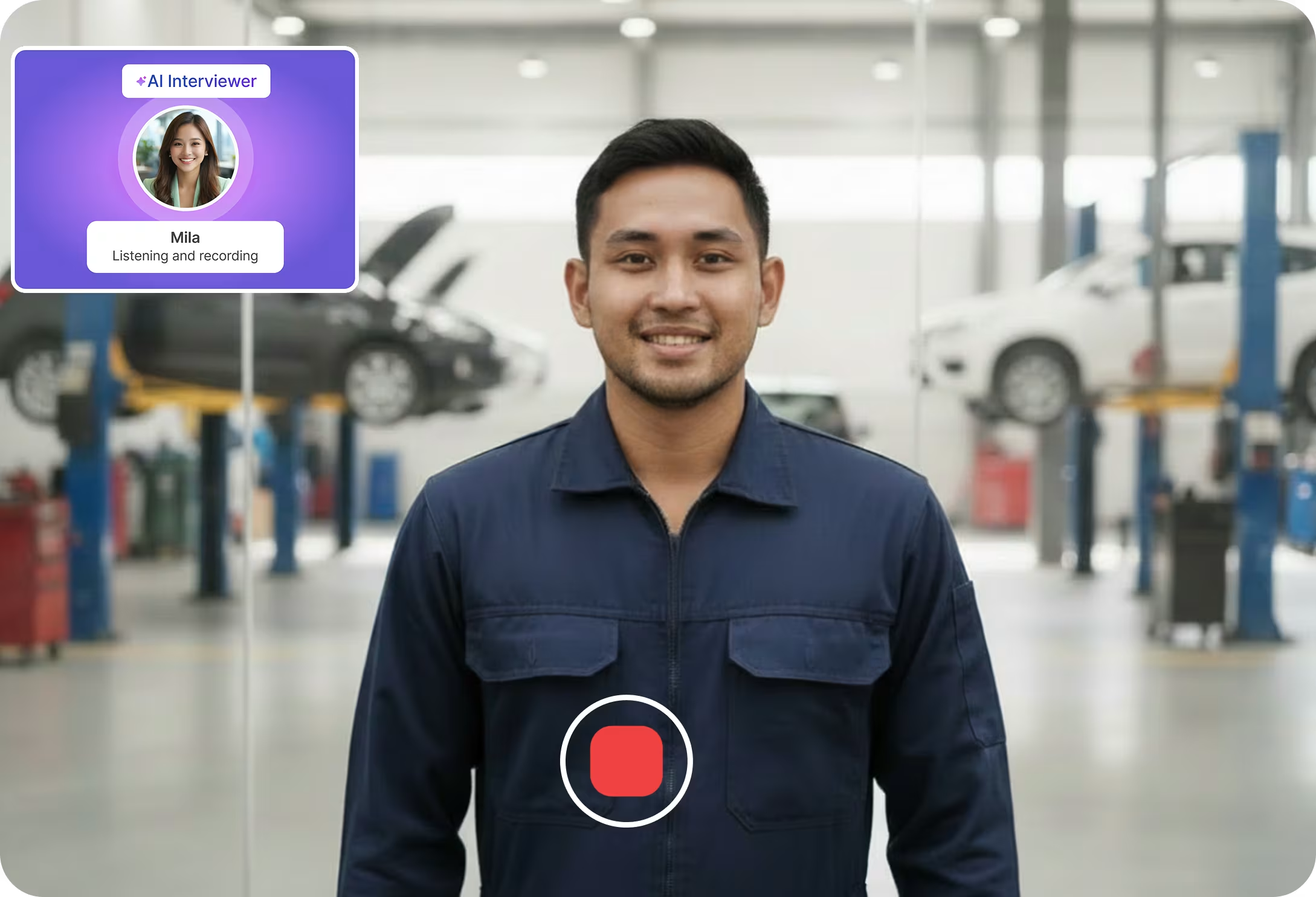
Role: EV Technician
QUESTION
“You identify a possible high-voltage system issue, but the initial diagnostic result is unclear. What steps would you take next?”

Transcript
REAL-TIME ANALYSIS
AI Interview:
12.45
“You identify a possible high-voltage system issue, but the initial diagnostic result is unclear. What steps would you take next?”
Candidate
13:02
“I would stop work, isolate the vehicle, follow the manufacturer’s high-voltage safety procedure, wear the required PPE, and verify that the system is de-energized.”
Candidate
13:05
“I would then review diagnostic codes and service information, inspect relevant connectors and interlocks, and escalate to a certified high-voltage technician if the result remains unclear.”

SKILLS ASSESSED
Safety awareness
Technical judgment
Procedure discipline
Escalation

Bad signal
- Continues working without isolating the high-voltage system
- Replaces parts based only on assumptions or an unclear scan result
- Bypasses interlocks, ignores PPE, or tests components with unsuitable tools

Good signal
- Prioritizes isolation, PPE, and verification before further diagnosis
- Uses OEM procedures, diagnostic codes, and approved testing equipment
- Escalates the issue instead of guessing or bypassing safety controls
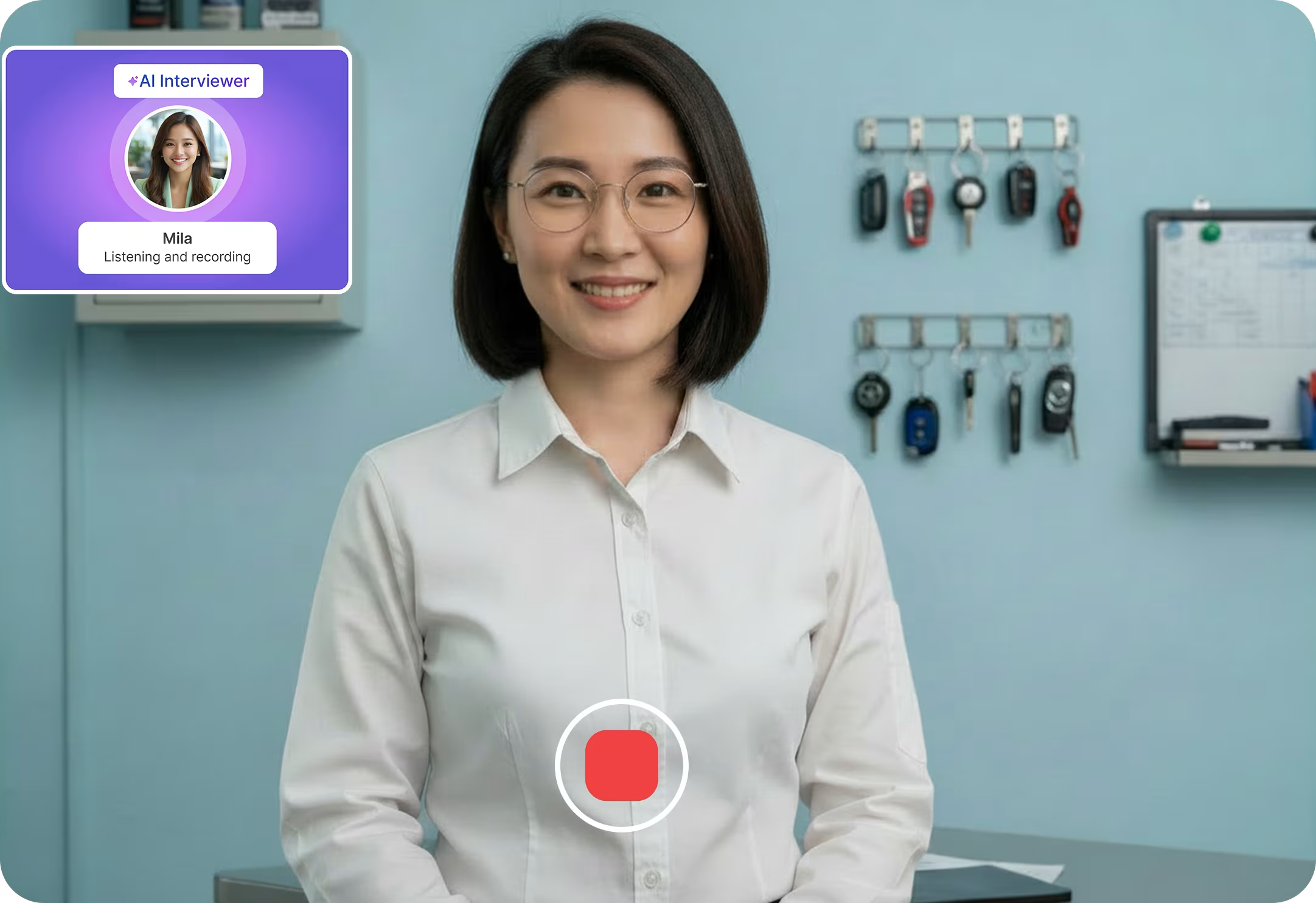
Role: Service Advisor
QUESTION
“A customer is frustrated because a repair is taking longer than expected. How would you explain the delay and agree on the next step?”
Transcript
REAL-TIME ANALYSIS
AI Interview:
12.45
“A customer is frustrated because a repair is taking longer than expected. How would you explain the delay and agree on the next step?”
Candidate
13:02
“First, I would acknowledge the customer’s frustration and explain the specific reason for the delay in clear, non-technical language.”
Candidate
13:05
“Next, I would discuss the available options, such as waiting for the repair, approving an alternative solution, or arranging transportation if available.”
SKILLS ASSESSED
Customer communication
Expectation handling
Complaint response
Escalation
Bad signal
- Blames technicians, suppliers, or the customer for the delay
- Gives vague explanations or promises an unrealistic completion time
- Ends the conversation without confirming an action plan or follow-up
Good signal
- Acknowledges the customer’s frustration without becoming defensive
- Explains the delay honestly and provides a realistic updated timeline
- Confirms the next step and commits to proactive progress updates
Candidate Reports for Automotive Hiring Managers
Give service, workshop, collision, and branch managers structured screening context before
live interviews or practical assessments.
live interviews or practical assessments.

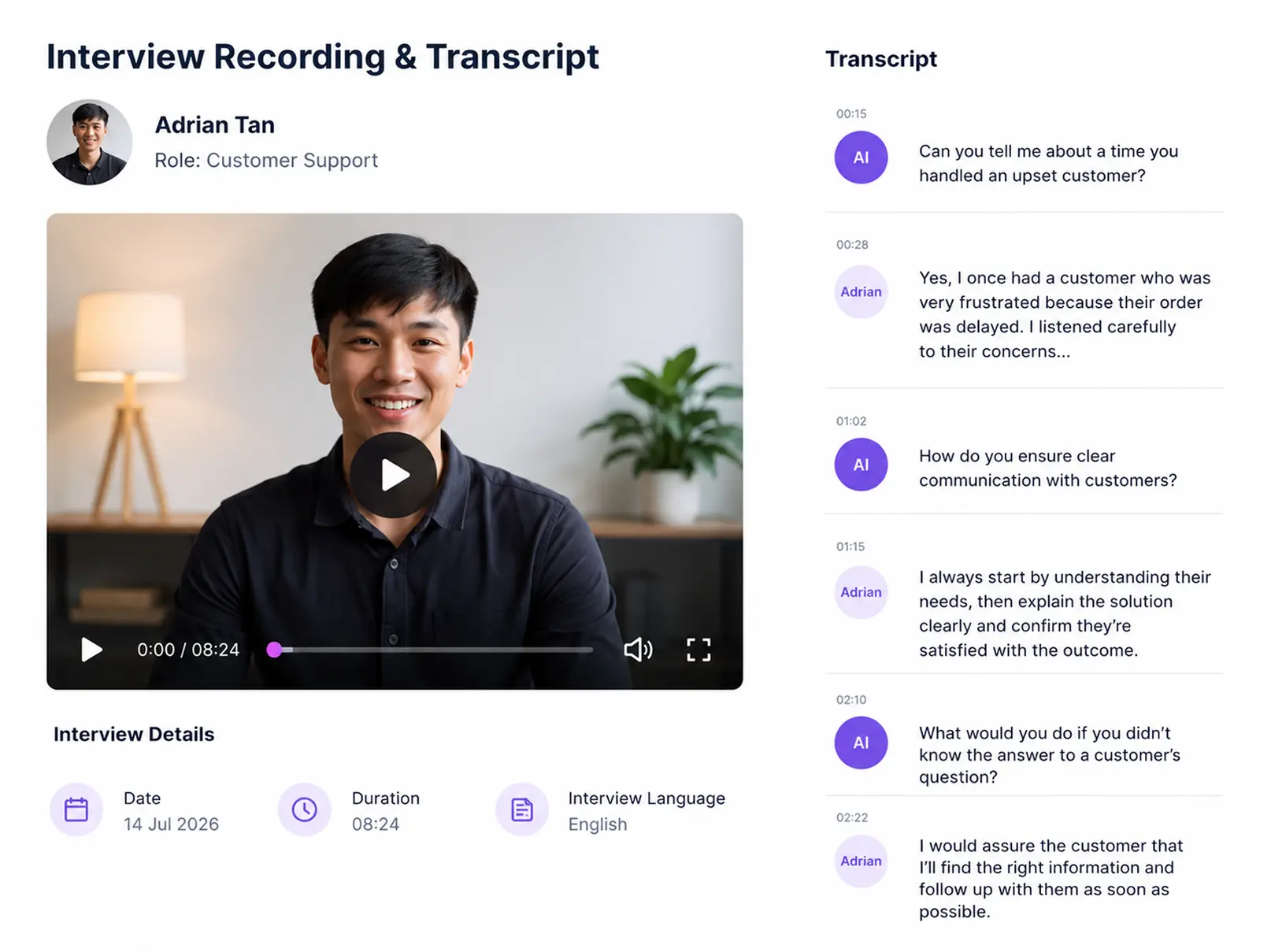
Interview Summary

Review relevant experience, availability, response quality, and automotive role-readiness signals.

Transcript and Recording
Revisit the candidate’s complete responses without asking managers to join every first-round interview.

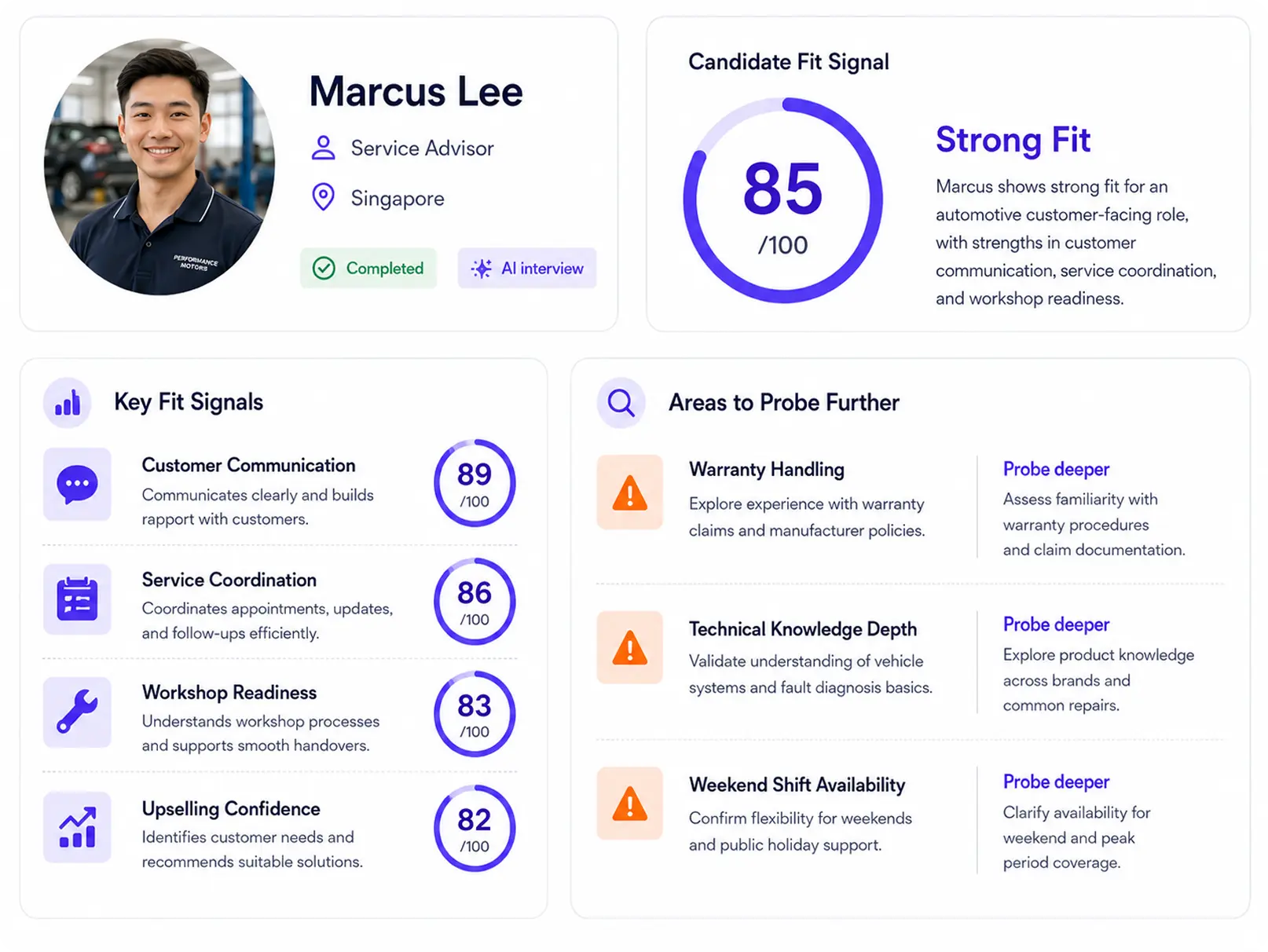
Candidate Fit Signal
Identify promising signals, unclear areas, and topics that require deeper manager follow-up.

Candidate Shortlist
Compare candidates side by side using the same criteria to identify the most qualified candidate for an automotive role.


Features That Make Automotive Screening Easier
Our automotive recruiting software includes features that reduce repetitive screening work while
keeping recruiters and hiring managers in control of who moves forward.
keeping recruiters and hiring managers in control of who moves forward.

Custom Automotive Questions
Generate and edit role-specific questions based on the job description, technician level, workshop environment, and required automotive skills.

Simultaneous Interviews
Let multiple candidates complete AI video interviews independently without recruiters repeating the same first-round technical screening calls.

Bulk Interview Invites
Send interview invitations to many automotive candidates at once through WhatsApp and email without messaging each candidate manually.

Automated Readiness Checks
Collect stated certifications, tool access, shift availability, weekend schedules, and pay expectations before manager review.
Hiring Automation for Automotive Candidate Screening
Our automotive hiring software automates resume screening, candidate outreach, interview reminders, and
early-stage assessments for technical and dealership roles.
early-stage assessments for technical and dealership roles.
Automotive Hiring Workflows Used by KitaHQ Customers
See how companies use KitaHQ to screen candidates faster and review results more clearly.

Management Trainee Hiring
DRB-HICOM uses KitaHQ to screen candidates for its ELITE Management Trainee program across the automotive business.

Dealer Leadership Hiring
MSK Group screens candidates for Network Head and Marketing Head roles across its automotive retail and distribution network.

Multi-Role Automotive Hiring
PT JBA Indonesia uses KitaHQ to screen candidates for procurement and IT product roles within its automotive operations.
Before and After Using Automotive Hiring Software
See how automotive teams reduce manual screening, repeated readiness checks, and first-round
interview work with a more automated hiring workflow.
interview work with a more automated hiring workflow.

Before Using KitaHQ

Review technician and service advisor resumes manually, making shortlisting too slow.

Recheck certifications, tools, shift availability, and weekend schedules for every candidate.

Repeat the same screening questions across service, diesel, collision, EV, and customer-facing roles.

Summarize interview notes and candidate feedback manually after every screening.

Struggle to compare candidates clearly based on technical fit and role readiness.


After Using KitaHQ

Screen automotive resumes faster using role-based criteria for technical, service, and sales roles.

Automate interview invitations, reminders, and follow-ups to keep candidates moving forward.

Run structured AI video interviews for technical, basic-fit, and customer-facing screening.

Access interview recordings, transcripts, summaries, and candidate insights in one place.

Compare automotive candidates using consistent scores, summaries, and structured reports.
Where KitaHQ Fits in Your Hiring Workflow
Best-Fit Automotive
Hiring Use Cases

Role-specific screening for automotive technical positions
Teams that need structured interviews to assess automotive candidates more objectively
Teams that want clearer first-round outputs before manager review
Where Humans Are
Still Required
- Verify ASE certifications, EPA Section 609 credentials, and other required automotive licenses
- Conduct hands-on automotive skills tests and technical demonstrations
- Evaluate culture fit with dealership managers and leadership teams
- Make final hiring decisions and issue job offers


Automotive Recruiting Software FAQs
What hiring tools are used by automotive dealerships?
Automotive dealerships usually use separate tools for job posting, applicant tracking, screening, interview scheduling and manager review. KitaHQ fits the screening layer: candidates complete AI video interviews on their own time, while recruiters and hiring managers review candidate reports, Interview Reports, transcripts and recordings before deciding the next step.
How can dealerships screen sales and service-adviser candidates faster?
Dealerships can use KitaHQ for structured early-stage screening with role-relevant questions, AI video interviews and candidate reports. This helps recruiters compare communication, availability, customer-facing judgement and follow-up points without scheduling every first-round conversation live.
Does KitaHQ replace recruiter or hiring-manager decisions?
No. KitaHQ supports early-stage screening and report generation. Recruiters and hiring managers review candidate responses, apply company policies and decide who moves forward.
Can KitaHQ help with technician and service-team hiring?
Yes. KitaHQ can collect structured first-round responses for technician, service-adviser, parts and branch-support candidates. Licence, hands-on, MVR and background verification remain human-led or handled by specialist providers.
How is automotive hiring software different from a general ATS, DMS, or recruitment agency?
A general ATS organizes applicants, while a DMS manages dealership operations. Automotive hiring software focuses on role-specific screening, structured interviews, and candidate scorecards for automotive positions. Integrations vary by vendor.
What features should companies look for in automotive recruitment software?
Our automotive hiring software includes role-specific screening criteria, bulk CV screening, structured interviews, candidate scorecards, and other features that make automotive recruitment faster and easier to manage.
Don't Let Top Talent Speed Past
Automate screening for dealerships and service centers with our recruitment software
for the automotive industry. Start hiring with KitaHQ.
Schedule Your Call