.avif)
KitaHQ Trust Center
Responsible AI Built Around Human Judgment
KitaHQ helps hiring teams screen applicants faster and conduct structured AI video interviews while maintaining human oversight. The platform handles time-consuming tasks such as screening CVs, recording candidate responses, and highlighting relevant skills. Recruiters retain full control over every hiring decision.
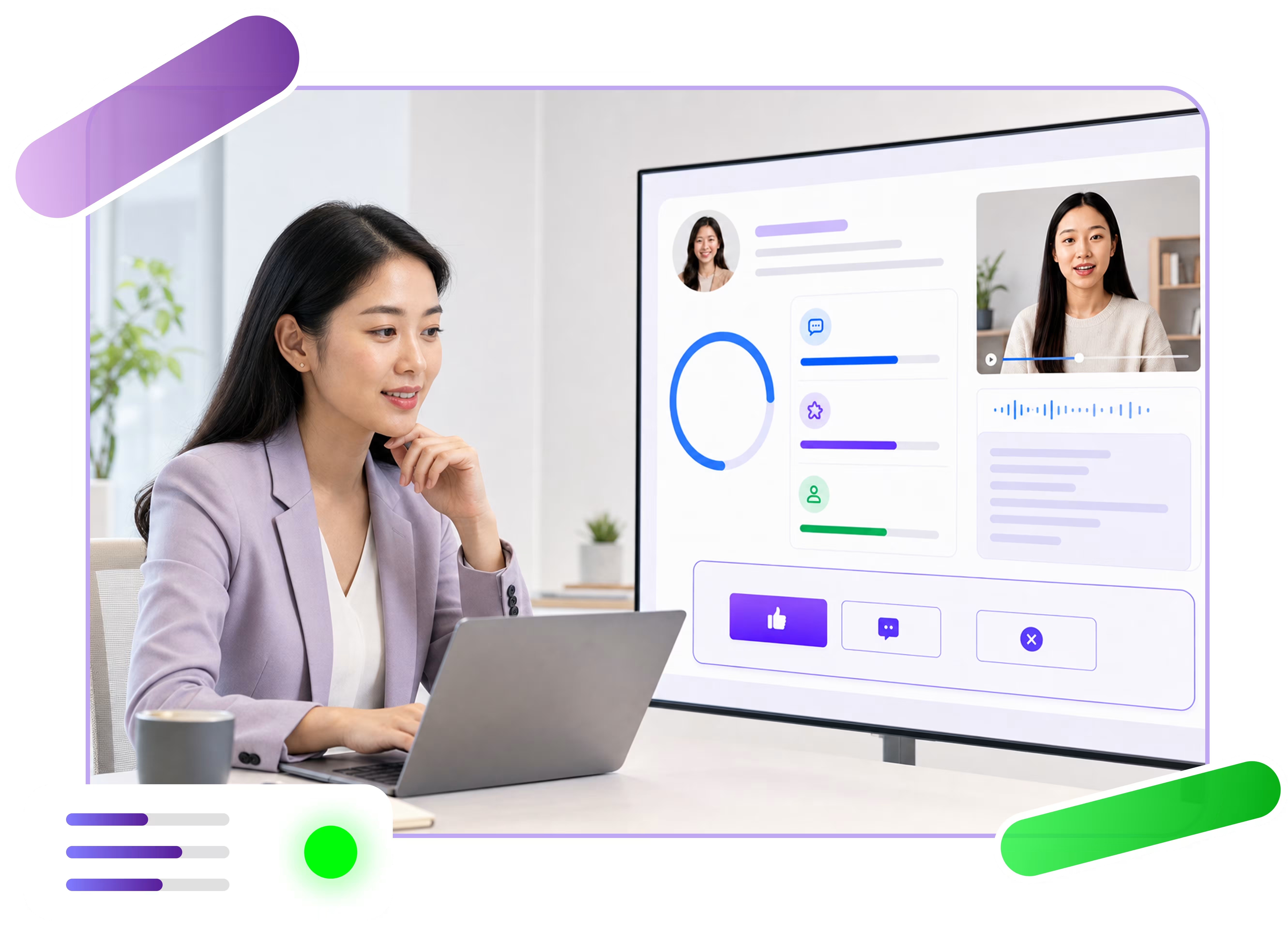
What Our AI Does: Structured Screening & Interviewing
KitaHQ automates early-stage recruitment tasks so your team can focus on evaluating real candidate potential.

Screens Resumes & Applications
Parses candidate CVs directly against your role requirements.
Records & Transcribes Responses
Captures audio and video during interviews and converts responses into clean, searchable text.
Runs Two-Way AI Video Interviews
Asks core interview questions and poses adaptive follow-up questions when a response needs more depth or context.
Evaluates Answer Content
Scores candidate answers against job-relevant rubrics configured by your team.
Delivers Clear Decision Signals
Provides candidate fit scores, response summaries, and side-by-side rankings for quick review.
Automates Admin Workflows
Triggers interview invitations, reminders, and scheduling requests based on your team's rules.
What Our Outputs Mean: Decision Support, Never Auto-Rejections
Scores and rankings indicate alignment with the criteria configured for a particular role.
Our scores show how closely a candidate’s experience matches your job criteria, they are not black-box
predictions or automated decisions.
predictions or automated decisions.
Prioritization Signals
Use alignment scores to quickly decide who to review first alongside full recordings, transcripts, and resumes.
Zero Automated Rejections
KitaHQ never rejects candidates behind your back. Every advancement or rejection requires explicit recruiter confirmation.
Job-Related Assessment Design: Zero Biometric Profiling
KitaHQ evaluates candidates strictly on the substance of their answers, keeping visual and vocal bias completely out of the equation.
No Trait or Demographic Analysis
The system is explicitly engineered to ignore appearance, facial expressions, tone, accent, age, gender, and race.
Content-Focused Evaluation
AI models measure what candidate say and demonstrate against your specific scoring criteria.
Two-Way AI Interviews with Standardized Evaluation
Our AI interviewer helps employers provide a more consistent interview experience while digging into the details that matter.
Adaptive Questions, Uniform Criteria
While follow-up questions dynamically adapt based on candidate depth, every applicant is graded against the exact same core criteria.
Employer Governance
Your team maintains full control over core questions, evaluation rubrics, and accommodation pathways.
Human Responsibility and Automation
Scores and rankings indicate alignment with the criteria configured for a particular role.

Human Control & Auditability
Automation handles scheduling and routine follow-ups, but your hiring team stays in the driver's seat.
Full Transparency
Authorized recruiters can inspect complete audit logs, assessment rationale, and raw candidate evidence at any time.
Human Accountability
Your team controls final hiring decisions and communications, while KitaHQ operates strictly as your software provider.
Using AI Outputs Responsibly
AI insights are most effective when paired with real human judgment and context.
Review the Whole Picture
Always cross-check summary scores against full transcripts and recordings before making key decisions.
Account for External Factors
Audio quality, background noise, or accents can impact transcription accuracy, making recruiter oversight essential.
Candidate Support
Applicants have direct pathways to request accommodations or report technical issues.
Strict Data Privacy: Zero Model Training
We protect candidate and enterprise data with uncompromising privacy standards.
Zero AI Model Training
We never use candidate data, resumes, or interview recordings to train our own models or third-party AI systems.
Enterprise Encryption
All candidate media and application data are encrypted in transit and at rest.
Responsibilities in Practice: Shared Accountability
Responsible hiring works best when each party has a clear role.

KitaHQ
Delivers secure technology, maintains data safeguards, and provides full technical and limitation documentation.

Employers
Sets job criteria, issues required disclosures, reviews candidate evidence, and makes all final hiring decisions.

Candidates
Submits authentic responses in their own words, requests accommodations directly from employers, and reports platform glitches to support@kitahq.com
Related Information and Intended Links

Responsible AI


Fair Hiring Practices

Security

Candidate Guide
Country-Specific Responsible AI Information
The sections below explain how confirmed KitaHQ practices relate to selected laws and frameworks. Employers remain responsible for determining which obligations apply to their recruitment process and configuration.

United States

Responsible AI expectations in the United States combine federal employment and civil-rights law with state and local AI requirements. KitaHQ supports transparent, reviewable use by explaining AI analysis before the interview, using recruiter-configured job-related criteria, retaining identifiable assessment and workflow records, and allowing recruiters to inspect and disregard the AI-assisted assessment.
KitaHQ supports employer governance through AI-use transparency, recruiter review and identifiable assessment and workflow records designed to help employers prepare for applicable obligations under Colorado’s Automated Decision-Making Technology Act. Employers remain responsible for determining applicability and providing any required interaction notice, adverse-outcome explanation, access or correction process, meaningful human review and reconsideration.
Other rules may impose different duties. Where the Illinois Artificial Intelligence Video Interview Act applies, the hiring employer is responsible for the required AI-use explanation, candidate consent, sharing and deletion requirements and any applicable sole-reliance reporting.
KitaHQ supports these responsibilities through candidate-facing AI-use information, a recorded checkbox selection, authorised access controls and its documented data-handling process.
New York City may require an independent bias audit, published audit information and advance candidate notice when the applicable AEDT definition is met. Federal and California employment-discrimination rules continue to apply to employer decisions.
KitaHQ supports employer governance through AI-use transparency, recruiter review and identifiable assessment and workflow records designed to help employers prepare for applicable obligations under Colorado’s Automated Decision-Making Technology Act. Employers remain responsible for determining applicability and providing any required interaction notice, adverse-outcome explanation, access or correction process, meaningful human review and reconsideration.
Other rules may impose different duties. Where the Illinois Artificial Intelligence Video Interview Act applies, the hiring employer is responsible for the required AI-use explanation, candidate consent, sharing and deletion requirements and any applicable sole-reliance reporting.
KitaHQ supports these responsibilities through candidate-facing AI-use information, a recorded checkbox selection, authorised access controls and its documented data-handling process.
New York City may require an independent bias audit, published audit information and advance candidate notice when the applicable AEDT definition is met. Federal and California employment-discrimination rules continue to apply to employer decisions.

United Kingdom
UK guidance for responsible AI in recruitment emphasizes safety, transparency, fairness, accountability, contestability and appropriate human involvement. KitaHQ explains what its AI does and its relevant limitations, enables recruiters to inspect and disregard AI-assisted assessments, makes employer-controlled workflow automation and final hiring accountability clear, and does not use candidate data to train KitaHQ or third-party AI models.
KitaHQ supports meaningful human review by allowing authorised recruiters to inspect relevant candidate evidence, review the AI-assisted assessment and disregard it. The assessment is decision-support information rather than a prediction of future job performance. Where a significant decision is based solely on automated processing, the employer must provide applicable safeguards, including clear information, a route to make representations or challenge the outcome, and meaningful human intervention.
KitaHQ supports meaningful human review by allowing authorised recruiters to inspect relevant candidate evidence, review the AI-assisted assessment and disregard it. The assessment is decision-support information rather than a prediction of future job performance. Where a significant decision is based solely on automated processing, the employer must provide applicable safeguards, including clear information, a route to make representations or challenge the outcome, and meaningful human intervention.

Canada
Canadian privacy and human-rights guidance emphasizes meaningful transparency, appropriate purposes, safeguards, accountability and monitoring for harmful outcomes. KitaHQ supports these principles by explaining AI use, limiting assessment claims to configured job-related criteria, enabling recruiter review, making employer accountability clear and retaining evidence that can be reviewed.
Employers remain responsible for their criteria, accommodations and hiring outcomes. Provincial rules may add requirements, including disclosures in applicable job postings or additional privacy and human-rights obligations.
Employers remain responsible for their criteria, accommodations and hiring outcomes. Provincial rules may add requirements, including disclosures in applicable job postings or additional privacy and human-rights obligations.

Australia
Australia’s AI guidance emphasizes governance, risk management, transparency, human oversight, privacy, security and contestability. KitaHQ supports these principles through clear AI-use explanations, criteria-based assessments, recruiter review, documented limitations, privacy information and security controls.
Employers remain responsible for deciding whether the workflow and assessment criteria are appropriate for the role, addressing accommodation needs and reviewing outcomes before relying on them.
Employers remain responsible for deciding whether the workflow and assessment criteria are appropriate for the role, addressing accommodation needs and reviewing outcomes before relying on them.

New Zealand
New Zealand privacy guidance emphasizes privacy impact assessment, transparency, accuracy, security and appropriate human review when AI outputs may affect people. KitaHQ explains the information it processes, the purpose of AI-assisted assessment, known limitations and the employer’s responsibility for recruitment decisions.
Candidates can use the employer contact for accommodation, review or application questions and privacy@kitahq.com for questions about KitaHQ’s own processing. Candidate data is not used to train KitaHQ or third-party AI models.
Candidates can use the employer contact for accommodation, review or application questions and privacy@kitahq.com for questions about KitaHQ’s own processing. Candidate data is not used to train KitaHQ or third-party AI models.

Singapore
Singapore’s Model AI Governance Framework emphasizes transparent, explainable, fair and human-centric deployment supported by clear governance and stakeholder communication. KitaHQ reflects these principles by explaining AI use and limitations, supporting recruiter review while the employer’s authorised hiring team makes final hiring decisions, and providing candidates with privacy, employer and technical contact routes.
KitaHQ supports customer security review through documented controls and an internal mapping to selected security-related criteria within the AICPA Trust Services Criteria used in SOC 2 examinations. Available control evidence can be provided through the appropriate customer security-review process. Employers remain responsible for their recruitment criteria and deployment decisions.
KitaHQ supports customer security review through documented controls and an internal mapping to selected security-related criteria within the AICPA Trust Services Criteria used in SOC 2 examinations. Available control evidence can be provided through the appropriate customer security-review process. Employers remain responsible for their recruitment criteria and deployment decisions.

Malaysia
Malaysia’s National Guidelines on AI Governance and Ethics emphasize fairness, reliability, safety, privacy, inclusivity, transparency, accountability and human benefit. KitaHQ supports these themes through criteria-based assessment, clear disclosure of AI assistance, recruiter responsibility, privacy information, security controls and candidate support routes.
KitaHQ’s transparency, criteria-based assessment, recruiter-review and candidate-support practices support selected themes in Malaysia’s National Guidelines on AI Governance and Ethics. Where automated decision-making or profiling uses personal data, employers remain responsible for assessing applicable transparency, human-review, sensitive-data and impact-assessment expectations and for providing any additional candidate communication required for their use.
KitaHQ’s transparency, criteria-based assessment, recruiter-review and candidate-support practices support selected themes in Malaysia’s National Guidelines on AI Governance and Ethics. Where automated decision-making or profiling uses personal data, employers remain responsible for assessing applicable transparency, human-review, sensitive-data and impact-assessment expectations and for providing any additional candidate communication required for their use.

Indonesia
Indonesia’s AI Ethics guidance emphasizes inclusivity, humanity, security, accessibility, transparency, credibility, accountability and personal-data protection. KitaHQ supports these principles by explaining AI-assisted processing, evaluating answer content against job-related criteria, keeping employers responsible for decisions and providing privacy and technical-support routes.
KitaHQ does not use candidate data to train KitaHQ or third-party AI models. Employers remain responsible for lawful criteria, recruitment decisions and any additional notice or review process required for their deployment.
KitaHQ does not use candidate data to train KitaHQ or third-party AI models. Employers remain responsible for lawful criteria, recruitment decisions and any additional notice or review process required for their deployment.

Germany and the European Union
EU rules treat certain recruitment and candidate-evaluation uses of AI as high-risk. KitaHQ supports transparent and reviewable use by explaining the system’s purpose, using recruiter-configured job-related criteria, documenting limitations, preserving assessment and workflow records, and enabling recruiters to inspect and disregard AI-assisted outputs.
KitaHQ provides controls supporting selected EU requirements for transparency, human oversight, limitation documentation and reviewable records. Employers remain responsible for their deployer obligations where applicable, including lawful use, workplace consultation, candidate information, data-protection assessments and review or contestability routes.
KitaHQ provides controls supporting selected EU requirements for transparency, human oversight, limitation documentation and reviewable records. Employers remain responsible for their deployer obligations where applicable, including lawful use, workplace consultation, candidate information, data-protection assessments and review or contestability routes.
United States
Designed to support employer compliance with federal civil rights laws and state/local AI regulations (including Colorado SB26-189, Illinois AI Video Interview Act, and NYC Local Law 144). Built around mandatory candidate disclosures, explicit consent checkboxes, audit-ready activity logs, and complete recruiter discretion to override AI insights.
United Kingdom
Built around ICO automated recruitment guidance and UK GDPR standards. Empowers recruiters to inspect raw candidate evidence, verify or disregard AI scores, and maintain clear human oversight over every hiring outcome without training AI models on candidate data.
Canada
Aligns with Privacy Commissioner AI principles by providing clear candidate notices, restricting evaluations strictly to employer-defined job criteria, and keeping employers fully accountable for final selection decisions.
Australia
Supports OAIC privacy guidelines and national AI ethics principles through transparent candidate disclosures,
objective criteria scoring, robust encryption, and full recruiter oversight.
objective criteria scoring, robust encryption, and full recruiter oversight.
New Zealand
Built in accordance with the Privacy Act 2020 by enforcing explicit processing disclosures, transparent candidate data boundaries, and clear candidate accommodation routes.
Singapore
Follows the Model AI Governance Framework and SOC 2 security standards. Delivers transparent, explainable scoring signals to human hiring teams while protecting candidate privacy under PDPA guidelines.
Malaysia
Aligns with National AI Governance & Ethics Guidelines and PDPA rules by enforcing explicit consent disclosures, job-matched assessment rubrics, and recruiter-controlled decision workflows.
Indonesia
Built to support Law No. 27/2022 (UU PDP) and Circular No. 9/2023 on AI Ethics. Evaluates response content without using candidate data for model training, keeping final employment authority entirely with local hiring managers.
Germany and the European Union
Built to support high-risk AI obligations under the EU AI Act (Annex III) and GDPR. Provides built-in system transparency, mandatory human oversight controls, full assessment records, and direct pathways for candidate review and contestability.
Questions or Concerns

Questions about personal data processing, privacy rights or our Privacy Notice.

Questions about platform access, functionality, errors or technical issues.

Contact the hiring employer. Employers control hiring decisions, application status updates and accommodations. Employers are responsible for decisions and communications.