%20(1).png)

June 22, 2026
Technician Hiring Challenges and How Recruiters Can Screen Better
Learn common technician hiring challenges and how recruiters can improve early screening with CV review, structured questions, AI video interviews, and human review.
.png)
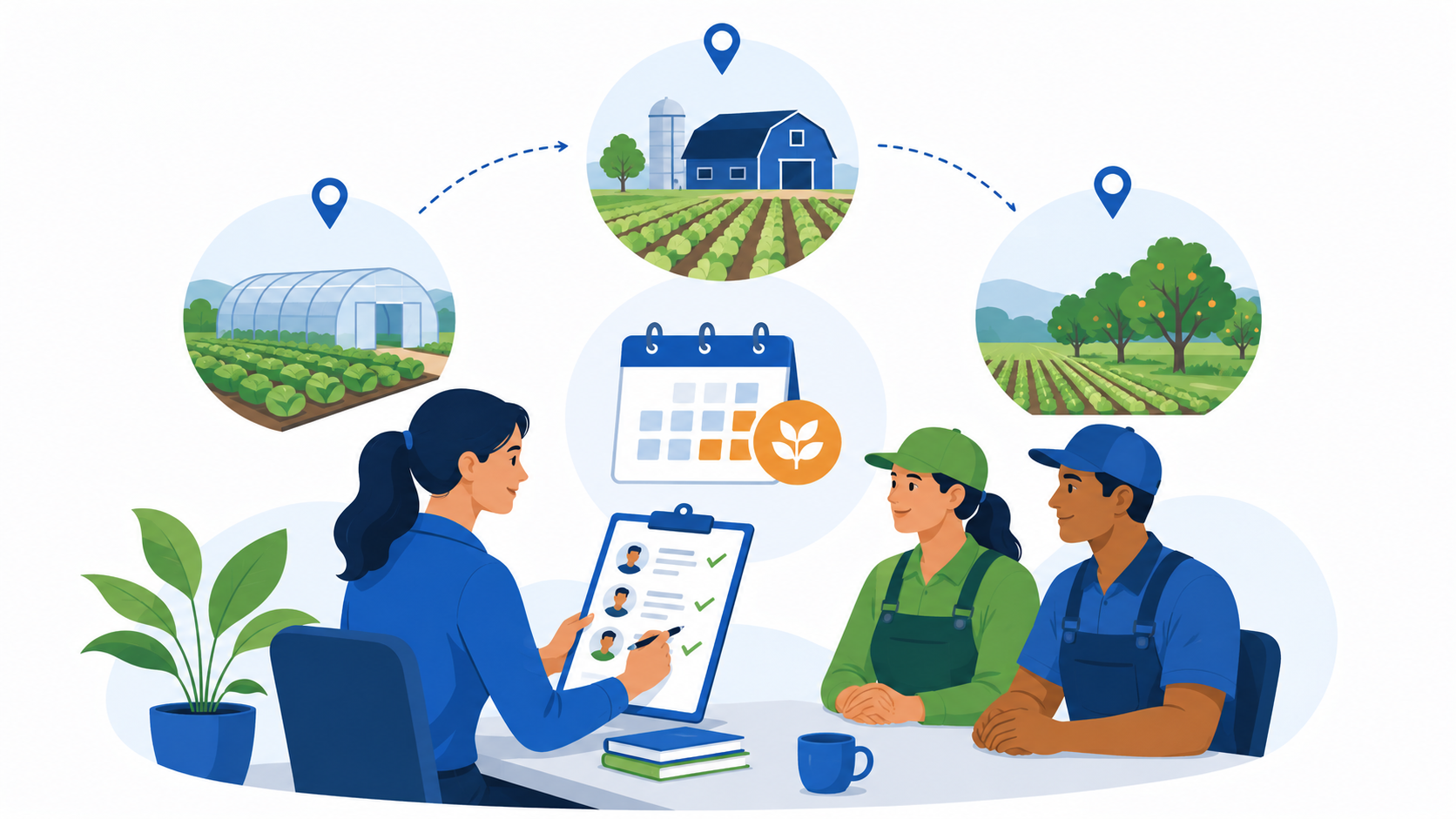
Agribusiness hiring is not just high-volume hiring with more seasonal workers.
The workflow is more complicated because teams often hire across farms, plants, warehouses, field locations, distribution points, or sales territories at the same time. A candidate who looks suitable for one site may not fit another because of location, shift availability, transportation, crop cycle, production schedule, language needs, or working conditions.
This is where many agribusiness recruitment challenges begin. The team may have enough applicants, but not enough structure to decide who should move forward first.
A recruiter may be screening field workers, production staff, quality assurance staff, farm support teams, sales farmers, field buyers, and market development officers in the same hiring cycle. Each role needs different signals. Field roles may require outdoor work readiness and reliability. Production roles may need process discipline and shift fit. Sales or buyer roles may need communication, relationship management, and basic agribusiness understanding.
When all those candidates are screened with the same generic questions, hiring teams create noise instead of clarity.
Many hiring teams try to solve agribusiness recruitment by sourcing more candidates.
That helps only if the screening workflow can keep up.
A better approach is to separate the hiring process into five screening stages:
This structure matters because seasonal and multi-site hiring usually fails when everyone jumps directly from “applicant received” to “manager interview.” That creates unnecessary calls, inconsistent notes, and late-stage rejection for issues that could have been checked earlier.
Seasonal hiring does not break at one point. It usually breaks through a chain of small delays.
The recruiter receives many applicants, but the CVs are inconsistent. Some candidates mention farm or field experience clearly, while others do not. Some may be available immediately, but only for certain shifts or locations. Others may have relevant experience, but the team does not discover communication or reliability concerns until after a manager has already spent time interviewing them.
The same pattern appears in other high-volume, multi-location hiring environments. PT Sejahtera Mitra Solusi, a staffing team recruiting across 147 cities, previously relied on manual phone screening before using KitaHQ. The company reported faster time-to-hire, less screening time, and higher recruiter productivity after adopting AI resume screening and AI video interviews.
The industry is different, so this should not be framed as agribusiness proof. The useful lesson for agribusiness is the workflow pattern: when hiring is distributed, repetitive, and time-sensitive, screening needs structure before candidates reach managers.
For seasonal and multi-site agribusiness hiring, managers should not be the first people to discover basic mismatches.
Recruiters should screen for these signals earlier:
A candidate may be qualified but unavailable for the actual worksite. Before moving them forward, confirm whether they can work at the required farm, plant, warehouse, field location, or sales territory.
Useful screening questions:
Seasonal hiring often depends on exact timing. A candidate who can start too late may not be useful for a harvest, planting, production, or peak distribution window.
Useful screening questions:
Agribusiness roles often need practical exposure, not just general employment history. A candidate with farm, field, production, quality, warehouse, or route-based experience may be more ready than someone with only unrelated work experience.
Useful screening questions:
Some agribusiness roles involve outdoor work, repetitive tasks, early hours, physical activity, production targets, or site-based discipline. These expectations should be made clear before the manager interview.
Useful screening questions:
Agribusiness teams often rely on handoffs between field teams, supervisors, QA teams, logistics teams, and sales or buyer teams. Miscommunication can slow down work or create operational risk.
Useful screening questions:
Not every role needs deep technical evaluation, but many agribusiness roles need common sense, escalation judgment, and task prioritization.
Useful screening questions:
See also: AI Screening Interviews vs Human Interviews: What Each One Should Be Used For
Strong answers usually include:
Red flags to review carefully:
These signals should not replace human review. They help recruiters decide which candidates are ready for the next hiring step and which answers need follow-up.
A farm worker, production staff member, QA candidate, and sales farmer should not be evaluated with the same questions.
Some questions can be shared, such as availability and location fit. But role-specific questions should be different. Otherwise, the screening process becomes too generic to help managers make decisions.
Local flexibility is useful, but completely different screening standards create comparison problems.
If one site manager values availability, another values prior experience, and another values communication style, recruiters may struggle to explain why one candidate is stronger than another. Shared criteria help teams compare candidates more consistently.
Availability should not be treated as a final-stage detail.
In seasonal hiring, start date, shift, site, and travel constraints can decide whether a candidate is usable. These should be checked before the manager interview.
Managers should review candidates who have already passed basic screening.
If managers need to re-check every CV, repeat every availability question, and discover every mismatch themselves, the hiring process is not really saving time.
AI can support screening, structure interviews, summarize responses, and help recruiters compare candidates. It should not make final hiring decisions.
Human recruiters and hiring managers still need to review the context, check requirements, assess fit, and decide who moves forward.
A stronger workflow for seasonal and multi-site hiring can look like this:
This workflow keeps the process educational and practical. It does not remove human review. It simply reduces repetitive screening work before managers get involved.
KitaHQ supports agribusiness teams that need a more structured way to screen candidates before manager review.
For seasonal and multi-site hiring, KitaHQ can help recruiters use AI resume screening to review CVs against role criteria, run AI video interviews without live scheduling, assess role-specific responses through AI interview assessment, and prepare candidate reports or interview reports for recruiter and hiring manager review.
This is most relevant when the hiring process involves repeated screening across field, farm, production, quality, operations, or sales roles. It helps teams create a more consistent early-stage screening workflow while keeping final hiring decisions with people.
Agribusiness recruitment challenges are rarely caused by one problem alone.
Seasonal demand, multi-site hiring, mixed role requirements, inconsistent screening, and late manager involvement all create pressure at the same time. The solution is not only to find more candidates. It is to build a clearer screening workflow before candidates reach hiring managers.
Recruiters should define role-specific criteria, check site and shift fit early, separate role families, use consistent interview questions, and send managers candidates with enough context to review confidently.
AI candidate screening and AI video interviews can support that workflow, but they work best when paired with clear human review, practical role criteria, and honest boundaries around what technology should and should not decide. For teams hiring repeatedly across farms, sites, plants, warehouses, or sales territories, KitaHQ’s agribusiness recruitment software shows how early-stage screening can help recruiters structure resume review, first-round interviews, interview assessment, and candidate reports before manager review.
.avif)
KitaHQ is an AI hiring software that helps teams screen faster, run AI video interviews, and evaluate candidates consistently.