%20(1).png)
June 22, 2026
Best Insurance Recruitment Software for Candidate Screening
Compare the best insurance recruitment software by hiring workflow, from ATS and sourcing tools to AI candidate screening and AI video interviews.
.png)
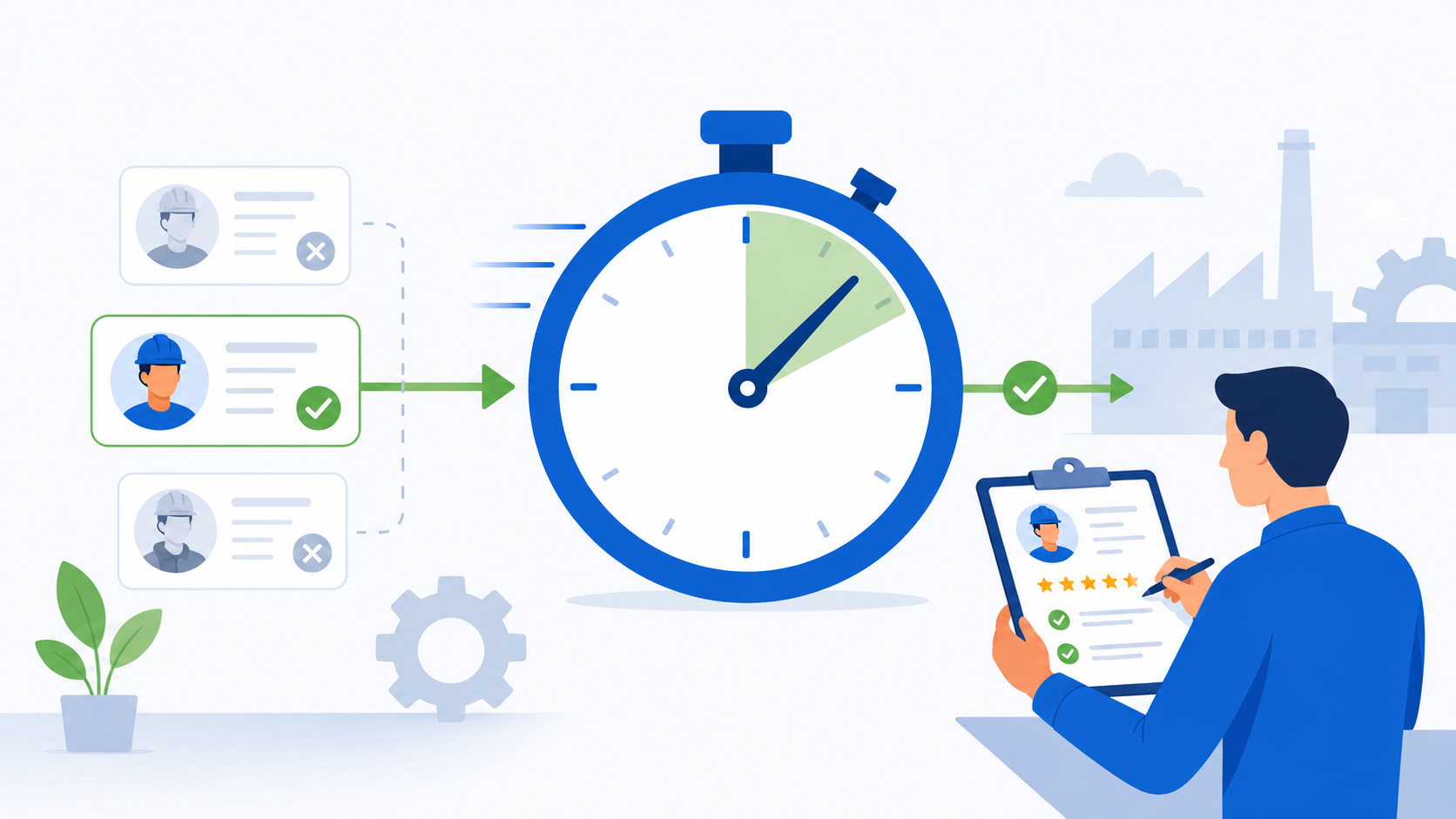
In manufacturing hiring, technical evaluators are often line managers, supervisors, engineers, quality leads, or maintenance leaders. They are not full-time interviewers. They already have production targets, safety responsibilities, quality checks, and daily operational issues to handle.
The problem starts when every candidate needs their input too early.
A supervisor may be asked to review resumes that do not show relevant machine exposure. A quality lead may be pulled into interviews before the candidate’s shift availability is clear. A maintenance manager may spend time speaking with candidates who cannot explain basic troubleshooting steps.
This creates a costly hiring bottleneck. Technical evaluators spend time repeating basic screening questions instead of validating the candidates who are actually worth deeper review.
The goal is not to remove technical evaluators from the hiring process. The goal is to protect their time.
A better manufacturing technical assessment hiring workflow should answer one practical question:
“What must a technical evaluator assess personally, and what can be structured before the candidate reaches them?”
Not every signal in manufacturing hiring needs a technical evaluator from the beginning.
Some information can be checked by recruiters. Some can be collected through AI candidate screening. Some can be assessed through structured AI video interviews. Some must still be reviewed by a qualified human evaluator.
The mistake is treating all hiring signals as if they require the same level of technical review.
For example, a production supervisor does not need to be the first person to ask whether a candidate can work night shifts, has worked in a factory environment, or understands the importance of PPE. Those checks can happen earlier.
But the same supervisor should still be involved when the team needs to validate machine-specific experience, practical judgment, or readiness for the actual production environment.
Here is a simple way to divide the work.
This structure keeps technical evaluators focused on the parts of hiring where their judgment matters most.
AI candidate screening and AI video interviews are useful in manufacturing hiring when they create structure before human review.
They should not be used to make final hiring decisions. They should not replace hands-on tests. They should not replace license, certification, employment, or compliance checks.
Their value is in reducing repetitive early work.
AI resume screening can help recruiters review candidate profiles at scale and surface backgrounds that appear more relevant to the role before recruiter review. This is useful for factory, warehouse, technician, and quality roles where the first question is often whether the candidate has enough relevant exposure to justify deeper review.
AI video interviews can then help recruiters ask the same structured questions to every candidate. Candidates can complete interviews on their own time, which helps when hiring across shifts, sites, or time zones. For roles that need more structured evaluation, AI interview assessment can help organize candidate answers around role-specific criteria such as safety awareness, SOP discipline, quality judgment, troubleshooting approach, and communication.
The output should be a clearer AI candidate report for recruiter review and hiring manager review. Candidate reports can include interview summaries, transcripts, recordings, strengths, concerns, and suggested follow-up areas, giving technical evaluators more context before they join the process.
For manufacturing technical assessment hiring, this means technical evaluators can review fewer candidates with better context. Instead of asking every candidate, “Have you used this kind of machine before?” or “What would you do if quality rejects increase?”, the evaluator can first review the candidate’s response, transcript, and assessment summary.
That changes the evaluator’s role from basic screener to technical validator. For teams comparing early-stage screening workflows, KitaHQ’s manufacturing recruitment software page explains how this fits into a broader manufacturing hiring process.
A useful workflow should reduce unnecessary interviews without hiding important context from managers.
Here is a practical structure manufacturing teams can use.
Start by listing the signals that matter for the role.
For a line operator, the signals may include:
For a quality control role, the signals may include:
For a maintenance technician, the signals may include:
Do not start with generic interview questions. Start with the work.
Some signals help decide whether a candidate should move forward. Other signals confirm whether the candidate can perform safely and effectively in the role.
For example:
Screening signals can be collected earlier. Validation signals should stay with technical evaluators.
Manufacturing roles often depend on judgment, not just experience.
A candidate may have worked in a factory before but still make poor decisions under pressure. Another candidate may have less experience but show strong safety discipline and escalation habits.
Scenario-based questions help reveal this earlier.
Examples:
These questions do not replace technical assessment. They help decide who deserves technical assessment time.
What Strong Answers and Red Flags Look Like
Technical evaluators should not enter interviews with only a resume.
A stronger handoff should include:
This helps evaluators spend less time gathering basic information and more time probing the right issues.
KitaHQ’s manufacturing workflow supports candidate reports that include screening summaries, transcripts, recordings, fit signals, and shortlists for hiring manager review.
A Simple Technical Evaluator Handoff Template
Before sending a candidate to a technical evaluator, recruiters should be able to answer five questions:
This keeps the handoff focused. Technical evaluators should not receive a generic “please interview this candidate” request. They should receive candidate reports that make the next conversation sharper.
For manufacturing and technical hiring, the useful proof point is not that AI replaces technical experts. It is that teams can collect role-specific answers before senior reviewers spend time on deeper evaluation.
PT Benderang Hidup Indonesia used KitaHQ to screen technical and engineering candidates through structured interview questions before technical reviewers spent time on deeper evaluation. PT SCG Indonesia also used KitaHQ to support screening for industrial and manufacturing-related candidates with role-specific questions before recruiter or manager review.
A separate PT Sejahtera Mitra Solusi case study shows the same workflow logic in high-volume staffing. After replacing repetitive manual screening with AI-supported screening steps, the team reduced daily screening time by 75%, cut average time-to-hire by 50%, and increased recruiter productivity by 2x.
Because this is a staffing case study rather than a manufacturing case study, the results should be read as a workflow example, not a guaranteed manufacturing outcome. The relevant lesson is that structured early screening can reduce repetitive review work before managers or evaluators spend time on deeper interviews.
A Practical Workflow for Manufacturing Technical Assessment Hiring
Here is a simple workflow manufacturing teams can adopt.
Define what matters for the role before screening begins.
For example, a QC inspector scorecard may include:
Use resume screening to identify candidates whose background appears relevant.
This should help recruiters prioritize candidates, not automatically reject every imperfect profile. Some candidates may have transferable experience that still deserves review.
Use AI video interviews to ask consistent role-specific questions before manager interviews.
This helps collect comparable responses from candidates without live scheduling, especially when applicants are applying across different shifts, locations, or regions.
Summarize candidate responses, strengths, concerns, transcripts, and recordings so recruiters and hiring managers can review faster.
This gives technical evaluators a better starting point.
Technical evaluators should receive a shortlist with clear context, not a pile of resumes.
The handoff should answer:
The technical evaluator, hiring manager, and recruiter should still decide who moves forward.
The screening workflow should reduce repetitive work, not remove accountability.
Manufacturing hiring becomes slower when technical evaluators are asked to review candidates before the basic fit is clear. A better workflow protects their time by moving early checks earlier: resume relevance, shift readiness, factory or warehouse exposure, safety awareness, and scenario-based judgment.
This is where AI resume screening, AI video interviews, and candidate reports can support the process. Instead of asking supervisors or technical managers to start from a resume alone, recruiters can first collect structured candidate responses, review fit signals, and prepare candidate reports with summaries, transcripts, recordings, strengths, and concerns.
For manufacturing teams, KitaHQ can help structure early-stage screening before technical evaluator review, while keeping hands-on validation and final decisions with the hiring team. Recruiters can use AI candidate screening to prioritize relevant profiles, AI video interviews to ask consistent role-specific questions, and candidate reports to give hiring managers clearer context before deeper assessment.
The goal is not to replace technical evaluators, hands-on tests, or final hiring decisions. It is to make sure technical experts spend their time where their judgment matters most: validating technical fit, assessing practical capability, and making stronger hiring recommendations.
.avif)
KitaHQ is an AI hiring software that helps teams screen faster, run AI video interviews, and evaluate candidates consistently.