%20(1).png)

August 6, 2026
Ecommerce Hiring Process: A Practical Guide to Building a Team That Can Scale
Build a stronger ecommerce hiring process with eight practical steps for defining roles, screening candidates, running interviews, and scaling responsibly.
.avif)
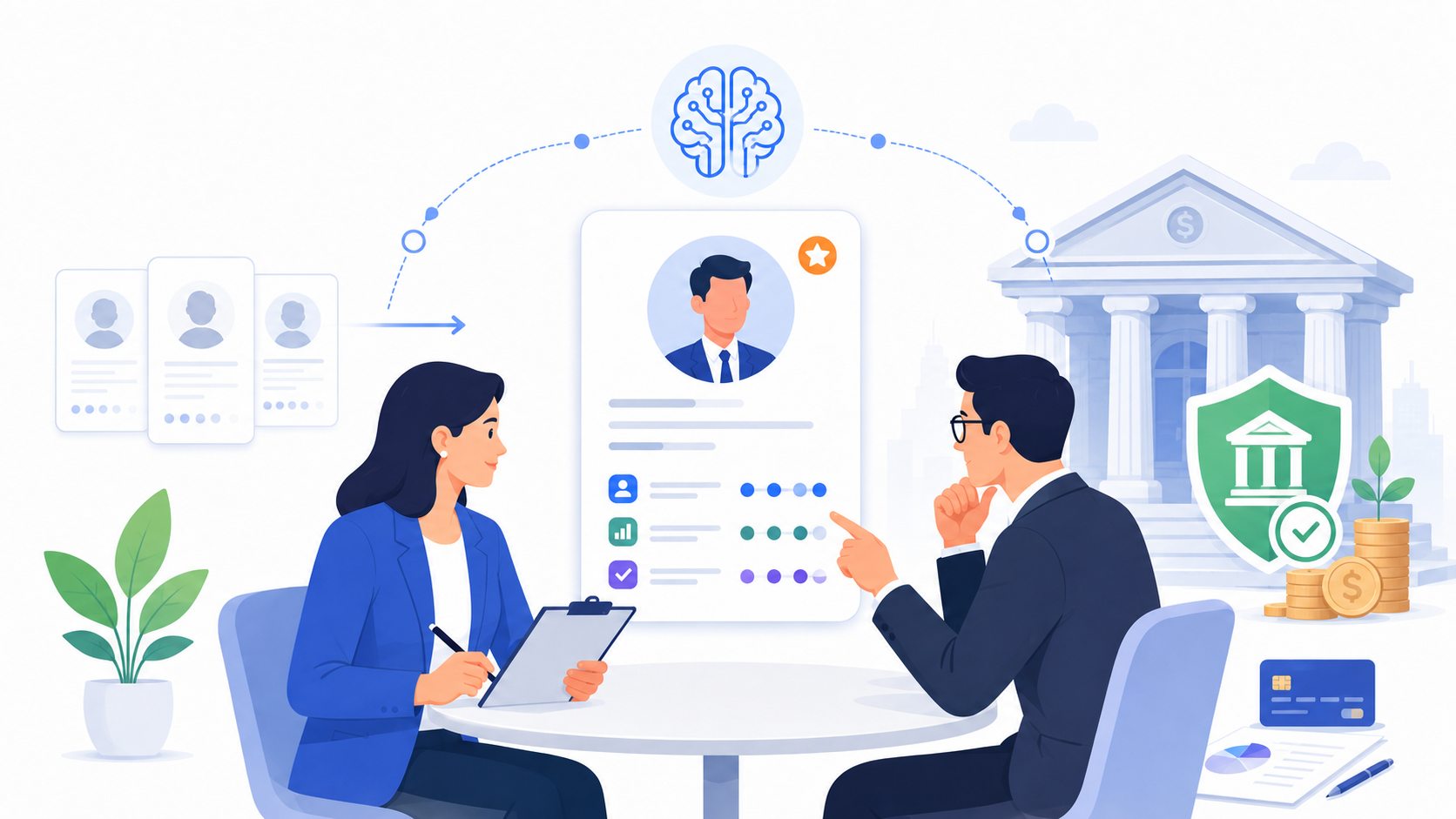
AI in financial services recruitment can help hiring teams move faster, but speed is not the only problem finance recruiters need to solve.
In banking, insurance, lending, consumer finance, and branch-based financial services, hiring teams are not just screening for experience. They also need to understand whether candidates can communicate clearly, follow procedures, handle customer trust, explain products correctly, and escalate issues when something looks wrong.
That is why AI adoption in finance recruitment should not be framed as replacing recruiters, hiring managers, or verification teams.
Financial services hiring carries a different level of risk from many other industries.
A poor hire in a finance role may not only affect productivity. They may also affect customer trust, product explanation quality, documentation accuracy, risk escalation, and how consistently procedures are followed.
This is especially true for roles such as:
Many of these roles are not purely technical. They require a mix of communication, product knowledge, procedural awareness, customer handling, and judgment.
That is where AI can help, but only if the workflow is designed properly.
The mistake is using AI as if it can “approve” candidates for finance roles. It should not. The better approach is to use AI to collect and organize early hiring signals so recruiters and hiring managers can review candidates with more context.
AI works best in financial services recruitment when it supports repeatable, early-stage work.
That usually includes:
For finance teams, this can help recruiters reduce manual screening work when many applicants apply for similar branch, sales, service, or operations roles.
AI video interviews add another layer. Instead of relying only on CVs, recruiters can ask every candidate the same structured questions and review how they explain products, handle objections, respond to customer scenarios, or escalate risk.
This does not remove human judgment. It gives humans more consistent information to review.
In financial services recruitment, AI should not replace the parts of hiring that require accountability, verification, or final judgment.
This distinction matters because financial services hiring cannot rely on an AI score alone.
A candidate may score well in a structured interview but still require manual review. Another candidate may have a weaker CV but show strong customer judgment in an AI video interview. A third may require extra checks before moving forward.
AI should help recruiters see these signals earlier. It should not decide the outcome.
A safer AI adoption model is to separate the hiring workflow into three layers: AI-supported, human-reviewed, and verification-owned.
That review layer is the important part. It helps finance recruiters avoid making decisions from scattered notes, incomplete interview memories, or inconsistent interviewer judgment.
Juara Gadai is a useful example because it shows AI used for finance hiring volume, not as a replacement for human review.
The company was hiring across 30 branches in Indonesia for roles such as admin, frontliner, customer service, area manager, and technician. Its case study says one recruiter processed 400+ candidates per month in KitaHQ, with AI resume screening and AI video interviews helping the team increase interview capacity and reduce time-to-hire. These results should be treated as a customer example, not a guaranteed outcome for every finance hiring team.
The important point is not simply that the process became faster.
The stronger lesson is that AI helped structure the early hiring workflow. Juara Gadai used AI resume screening to evaluate more candidates in the same amount of time, and AI video interviews to run interviews in bulk without being limited by manual scheduling.
For financial services teams with branch hiring needs, this is the practical use case: AI helps recruiters handle volume and consistency, while humans still review candidates and decide who moves forward.
An AI score should never be treated as the final answer. It should be a signal for review.
A high score may still require verification. A low score may still deserve human review if the candidate has relevant experience, a strong referral, or a non-traditional background.
AI works better when the rubric is clear.
Before using AI candidate screening or AI video interviews, finance teams should define what good looks like for each role. For example, “good communication” for a collections role may look different from “good communication” for a banking sales role.
Questions like “Tell me about yourself” or “What are your strengths?” do not reveal much about finance role readiness.
Better questions test product explanation, customer handling, escalation judgment, documentation awareness, and responsible selling.
Examples of Better AI Video Interview Questions for Finance Roles
Generic questions usually produce weak signals. Finance teams should use role-specific prompts that reveal judgment, communication, and process awareness.
These questions make AI video interviews more useful because recruiters are not just collecting answers. They are collecting reviewable signals.
Borderline candidates are exactly where human review matters most.
AI can help organize the information, but recruiters should still look at context. A candidate may have the right service mindset but limited finance exposure. Another may have finance experience but weak customer communication.
AI can support screening. It should not be positioned as a replacement for license checks, employment verification, background checks, fraud checks, sanctions checks, or compliance approval.
This distinction should be clear in internal SOPs, recruiter training, and vendor evaluation.
Finance hiring is not one workflow.
A teller, bancassurance advisor, relationship officer, claims officer, and collections agent need different screening criteria. AI adoption should reflect those differences.
Before using AI in financial services recruitment, check whether the workflow answers these questions:
KitaHQ is a fit for financial services teams that want to improve early-stage screening without removing recruiter or hiring manager review.
It can help teams:
This is useful for finance teams hiring repeatable roles at scale, especially when recruiters need to reduce manual screening work while still giving hiring managers structured candidate information.
KitaHQ is not a replacement for human hiring judgment. It is also not a replacement for license verification, employment checks, background checks, fraud checks, sanctions checks, or compliance review.
The best fit is a finance hiring software where AI helps structure early screening, and humans remain accountable for decisions.
For finance teams hiring repeatable roles across branches, sales, customer service, collections, lending, insurance, or operations, KitaHQ can support the early screening layer before recruiter and hiring manager review.
Explore finance recruitment software to see how KitaHQ supports structured early-stage screening for financial services teams.
Industry: Banking
KitaHQ is an AI hiring software that helps teams screen faster, run AI video interviews, and evaluate candidates consistently.