%20(1).png)

August 6, 2026
Ecommerce Hiring Process: A Practical Guide to Building a Team That Can Scale
Build a stronger ecommerce hiring process with eight practical steps for defining roles, screening candidates, running interviews, and scaling responsibly.
.avif)
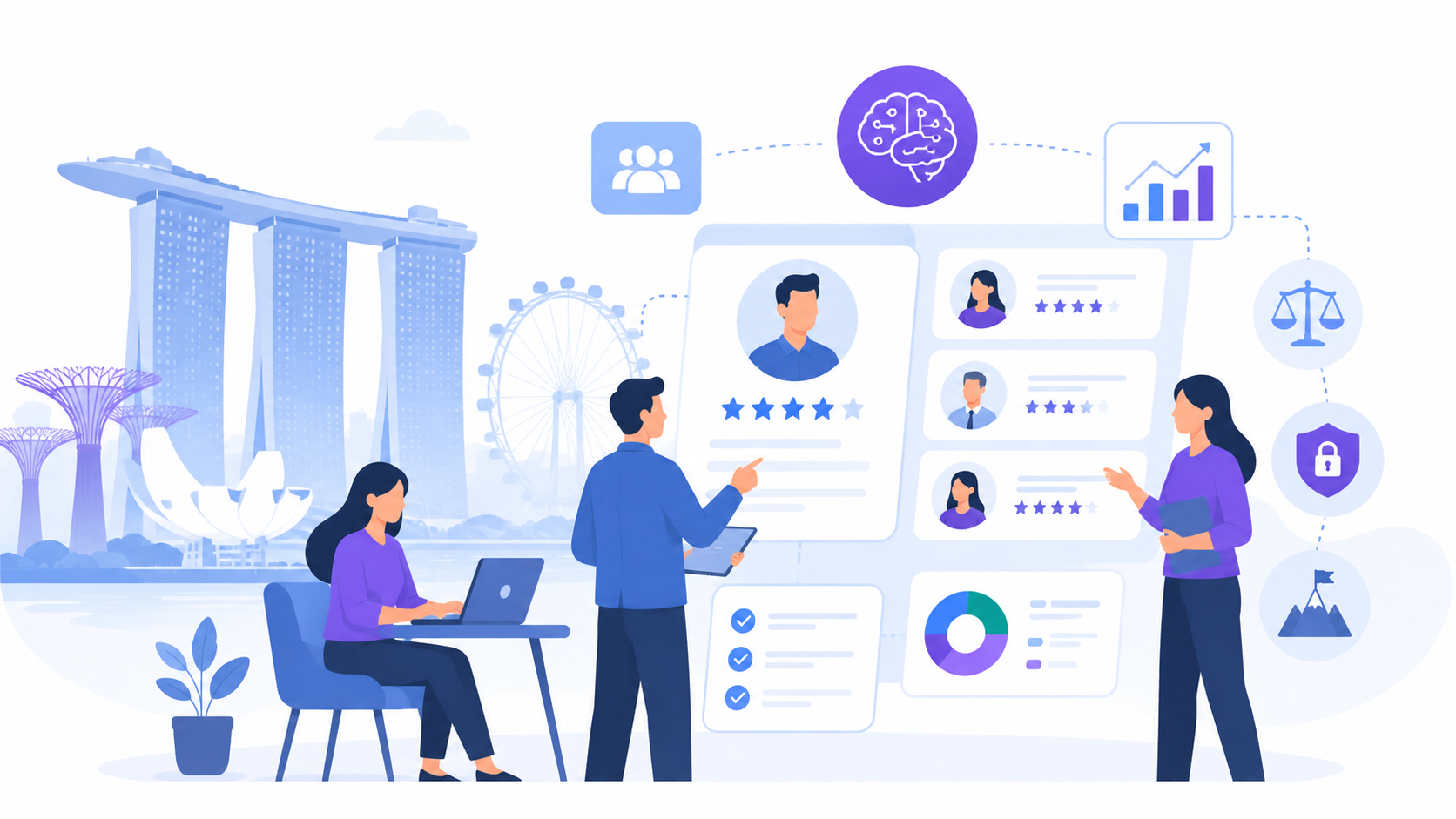
AI is becoming more relevant in recruitment across Singapore, but the biggest shift is not about replacing recruiters. It is about helping hiring teams manage early candidate screening with more structure, speed, and consistency.
This matters because Singapore employers are hiring in a market where skills-based assessment is becoming more important. MOM’s 2025 Job Vacancies report found that academic qualifications were not the main determinant for 79.6% of vacancies, with employers increasingly prioritising skills and competencies over formal qualifications.
That changes what recruitment teams need from technology. Instead of only sorting CVs by keywords or repeating screening calls manually, hiring teams need better ways to review role fit, communication, availability, skills signals, and candidate responses.
This is where AI candidate screening can help, as long as recruiters and hiring managers remain responsible for reviewing candidates and making hiring decisions.
Singapore employers are under pressure to hire faster while still making careful, fair, and job-related decisions.
For many teams, the bottleneck is not always the final interview. It happens earlier, when recruiters need to review many CVs, arrange screening calls, chase candidates, compare inconsistent interview notes, and brief hiring managers with limited context.
AI recruitment tools are becoming more relevant because they can support repetitive screening work such as reviewing CVs, interviewing candidates, and inviting candidates to the next stage.
But the goal should not be to remove recruiters from the hiring process. In Singapore, employers remain responsible for fair and merit-based employment practices regardless of the technology used in hiring.
MOM has stated that employers must comply with the Tripartite Guidelines on Fair Employment Practices even when technological tools are used to support hiring or promotion decisions.
One of the clearest hiring shifts in Singapore is the move from qualification-led hiring to skills-based hiring.
MOM’s 2025 Job Vacancies report found that academic qualifications were not the main determinant for 79.6% of vacancies, with employers increasingly prioritising skills and competencies over formal qualifications.
This changes how hiring teams need to screen candidates, especially when CVs alone do not show communication ability, job readiness, customer handling, or role-specific judgement.
For recruitment teams, this means AI should not only be used to match keywords on resumes. It should help hiring teams structure screening around job-related criteria, role-specific questions, and reviewable candidate responses.
AI adoption in recruitment is becoming more practical because many hiring tasks are repetitive.
TAFEP notes that AI is increasingly used to draft job descriptions, source and screen candidates, schedule interviews, standardise candidate communications, conduct video interviews, and automate parts of the hiring process. But it also makes the boundary clear: employers, not algorithms, remain accountable for fair and compliant hiring decisions.
For Singapore hiring teams, the real trend is not “AI replaces recruiters.” The real trend is that AI is being used to reduce manual workload in areas such as:
This supports recruiters by giving them more time to review candidates, align with hiring managers, and focus on judgement-heavy parts of hiring.
Another emerging challenge is that candidates are also using AI.
As generative AI tools become more common, resumes and cover letters can look more polished, keyword-optimised, and similar to the job description. This does not mean AI-assisted resumes are automatically bad. But it does make CV-only screening less reliable.
Hiring teams may need to look beyond whether a CV “sounds right” and collect more direct signals, such as:
This is a stronger reason to discuss AI video interviews. The trend is not simply “video interviews are popular.” The trend is that hiring teams need better ways to validate candidate fit beyond polished application documents.
See also: Best AI Candidate Screening Software for Singapore Hiring Teams
As AI becomes more common in recruitment, fair hiring accountability is becoming a bigger concern.
TAFEP’s guidance is clear: employers, not algorithms, remain accountable for fair, transparent, and compliant hiring decisions. Fair hiring means assessing candidates based on merit, job-related requirements, and consistent criteria.
MOM also states that regardless of the technological tools used to aid hiring or promotion decisions, employers must comply with the Tripartite Guidelines on Fair Employment Practices.
For Singapore hiring teams, this means AI recruitment tools should be evaluated based on whether they help create a more structured and reviewable screening process, not whether they promise to “remove bias” or “choose the best candidate.”
AI recruitment tools may process personal data such as CVs, interview responses, transcripts, recordings, and screening reports. That makes data handling a core part of vendor evaluation, not just an IT concern.
Singapore’s PDPC advisory guidelines explain how the PDPA applies when organisations use personal data to develop or deploy AI systems, including systems that assist human decision-makers through recommendations or predictions. The guidelines also discuss consent, notification, accountability, protection, retention, and service provider obligations.
For recruitment teams, this means AI tools should be reviewed for:
This is a real Singapore-relevant trend because AI adoption in hiring increases the importance of data governance.
AI can make screening more consistent when every candidate is assessed against the same job-related criteria. But AI can also repeat or amplify poor inputs if the criteria are vague, biased, or unrelated to the role.
TAFEP explains that fair hiring means assessing candidates on merit, based on job-related requirements, and applying those criteria consistently to all candidates. It also warns that AI tools can repeat bias from past data or make it hard to understand how a score or recommendation was formed if they are not set up and checked properly.
For hiring teams, this means AI recruitment tools should be configured around:
Avoid using AI to screen based on vague ideas like “culture fit” without defining what that means in job-related terms. A better approach is to define observable behaviours, role requirements, and competencies before launching the screening process.
AI recruitment tools may process sensitive candidate information, including CVs, interview responses, transcripts, recordings, and screening reports.
That means data handling needs to be part of vendor evaluation. Hiring teams should understand how candidate data is collected, stored, accessed, retained, and protected.
Singapore’s PDPC has published advisory guidelines on the use of personal data in AI recommendation and decision systems, providing guidance on how the PDPA applies when organisations use personal data in AI systems.
AI scores can help organise candidate review, but they should not become the hiring decision.
This is one of the biggest risks in AI recruitment. A hiring team may start treating AI-generated scores as final answers instead of review inputs.
That creates problems when:
A safer workflow is to use AI scores as one review input alongside candidate reports, transcripts, recordings, recruiter notes, and hiring manager judgment.
The final decision on who moves forward should remain with recruiters and hiring managers.
AI recruitment can improve candidate experience when it removes scheduling friction and gives candidates flexibility.
But it can also create a poor experience if candidates do not understand the process, cannot access the interview easily, or feel like they are being judged only by a machine.
Hiring teams should make sure candidates know:
KitaHQ’s AI video interview software lets candidates start interviews from a web link with no app required, complete interviews on desktop or mobile, and receive invites through WhatsApp and email.
That kind of candidate-friendly setup matters because recruitment automation should not make candidates feel removed from the process.
See also: 5 Best AI Recruiting Software for Singapore Companies in 2026
KitaHQ helps Singapore hiring teams structure early-stage candidate screening with AI resume screening, AI video interviews, AI interview assessments, candidate reports, and recruitment automation.
It is most useful when the problem is not sourcing alone, but screening candidates more consistently before recruiter or hiring manager review.
With KitaHQ, Singapore hiring teams can:
Mind Stretcher used KitaHQ to support AI candidate screening across education roles, helping candidates complete interviews on their own time while recruiters reviewed clearer candidate information before deciding who should move forward.
For Singapore and regional hiring workflows, KitaHQ also supports multilingual interviews, mixed-language responses, English interview reports, SGD-based pricing, and Singapore-based regional support. This makes it relevant for teams hiring across local and Southeast Asian roles where language, communication, candidate experience, and structured review matter.
For example, Boston Scientific used KitaHQ to screen trainee candidates across Indonesia and the Philippines, where candidates could respond in languages they were comfortable with before recruiter review.
AI in recruitment is becoming more practical for Singapore hiring teams, especially in resume screening, AI video interviews, candidate reports, and recruitment automation.
But the strongest use case is not letting AI decide who gets hired. The strongest use case is giving recruiters and hiring managers better screening inputs earlier, so they can spend less time on repetitive admin and more time reviewing candidates thoughtfully.
For teams that want to screen candidates faster while keeping recruiter and hiring manager review in control, KitaHQ supports AI video interviews built for structured, repeatable hiring workflows in Singapore.
KitaHQ is an AI recruitment software that helps companies screen candidates, manage applicants, and keep candidate communication moving in one connected workspace.