%20(1).png)

August 6, 2026
Ecommerce Hiring Process: A Practical Guide to Building a Team That Can Scale
Build a stronger ecommerce hiring process with eight practical steps for defining roles, screening candidates, running interviews, and scaling responsibly.
.avif)
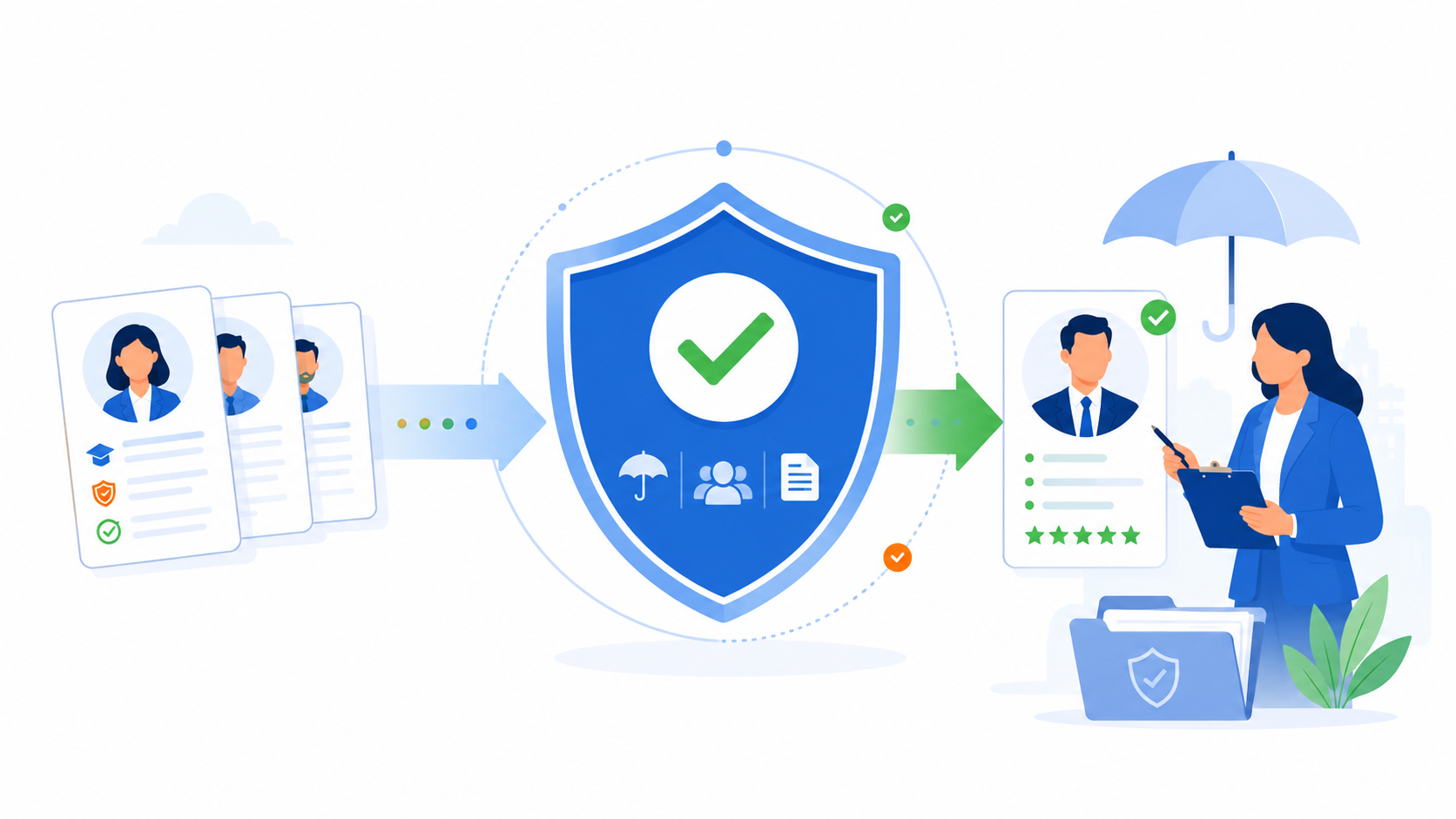
Insurance hiring is not just about finding people who want a sales or service job.
A good insurance candidate may need to explain products clearly, handle objections responsibly, follow up with customers, manage sensitive information, and understand when to escalate a case. For licensed or regulated roles, recruiters also need to check whether candidates have the right readiness, documents, or timeline for certification.
That makes candidate screening difficult.
If the process depends only on CV scanning and manual phone calls, recruiters may spend too much time repeating the same questions. If the process moves too quickly, important risks can be missed: weak customer judgment, vague selling behavior, poor follow-up discipline, or unrealistic expectations about the role.
The best insurance recruitment software depends on the bottleneck you are trying to solve. Some teams need an applicant tracking system. Some need job board distribution. Some need sourcing and CRM. Others need AI candidate screening, structured video interviews, or automated follow-ups.
This guide compares the best insurance recruitment software by use case so hiring teams can choose based on workflow fit, not feature count.
Before comparing vendors, identify the part of the hiring workflow that is slowing you down.
The mistake many insurance teams make is choosing the most feature-heavy system before defining the real workflow issue.
For example, an ATS may help track applicants, but it may not solve repetitive screening calls. A sourcing platform may help find more candidates, but it may not assess whether those candidates can explain policies clearly or handle customer pressure. A video interview platform may improve interview consistency, but it may not replace the need for human review.
For insurance hiring, the best tool is the one that helps recruiters review candidates faster while keeping role-specific screening criteria visible.
KitaHQ is a strong fit for insurance teams that need to screen sales, agent, customer service, claims support, policy admin, renewal, and operations candidates faster without relying on manual phone screens for every applicant.
It supports AI resume screening, AI video interviews, role-based interview assessment, recruitment automation, and candidate reports for recruiter and hiring manager review. This makes it useful when the main problem is not just applicant tracking, but the amount of repetitive screening work recruiters need to complete before managers can confidently review candidates.
For insurance teams, KitaHQ can support early-stage screening around areas such as:
KitaHQ’s AI video interviews allow candidates to complete interviews on their own time, without live scheduling. Recruiters can then review candidate reports, interview transcripts, recordings, scores, summaries, strengths, and concerns before deciding who should move forward.
This is especially useful when insurance teams hire repeatedly across branches, territories, campaigns, or high-volume sales and service roles. Instead of asking every recruiter to run the same phone screen manually, teams can standardize the screening flow and give hiring managers more consistent information to review.
A more directly relevant insurance example is BRI Life, which used KitaHQ to screen bancassurance and insurance sales candidates on customer relationship ability, sales experience, placement readiness, and product-selling judgment before recruiter review. This is the type of workflow where insurance hiring teams need more than CV review: recruiters need to understand how candidates explain products, manage customers, and approach sales conversations before moving them to the next step. For teams comparing tools, this makes KitaHQ most relevant when the hiring bottleneck is early-stage screening, not full ATS replacement.
Best for: Insurance teams that need AI candidate screening, AI video interviews, structured candidate reports, and recruiter review workflows.
May not be the best fit if: You need a full ATS replacement, executive search platform, license verification system, background check provider, sanctions screening tool, or final hiring decision automation.
Wizehire is a good fit for insurance agencies that need help attracting candidates and distributing job posts across many channels.
Its recruiting platform focuses on job posting support, applicant management, and recruiting guidance, which makes it useful when the biggest issue is getting enough qualified applicants into the funnel.
For smaller insurance agencies, this type of platform can be helpful because hiring is often handled by business owners, agency leaders, or small HR teams. They may need structured job posting support, interview guides, and applicant management more than a specialized AI candidate screening workflow.
Best for: Small and growing insurance agencies that need job posting distribution and recruiting guidance.
May not be the best fit if: Your main bottleneck is evaluating large candidate pools through structured AI video interviews or producing detailed candidate reports for manager review.
Loxo is a recruiting platform with a strong sourcing, ATS, CRM, and talent intelligence angle. Its insurance and financial services page positions the platform around sourcing candidates, building pipelines, engaging talent, and tracking progress.
This can make sense for insurance recruiters, recruitment agencies, or executive search teams that need to proactively find agents, underwriters, financial services candidates, or licensed professionals.
Loxo is more relevant when the hiring challenge is talent discovery and relationship management rather than structured screening of inbound candidates.
Best for: Recruitment firms or insurance hiring teams that need sourcing, pipeline building, and recruiting CRM capabilities.
May not be the best fit if: Your main need is high-volume AI candidate screening and structured interview reports for large applicant pools.
Workable is a broad recruiting platform that covers applicant tracking, job posting, AI-assisted screening, interview kits, scorecards, assessments, and one-way video interviews.
For insurance companies that need a general hiring system across many departments, Workable may be useful as a broader ATS. It can help manage job openings, hiring stages, team collaboration, and candidate communication.
The tradeoff is that broad ATS platforms are often designed for many industries and workflows. Insurance teams may still need to configure their own screening criteria for agent roles, service roles, claims support, policy admin, and renewal teams.
Best for: Teams that need a general ATS with broad recruiting workflow coverage.
May not be the best fit if: You need insurance-specific AI candidate screening workflows or deeper structured evaluation for customer-facing insurance roles.
Manatal positions itself as AI recruitment software for HR teams, recruitment agencies, and headhunters. It combines ATS and CRM capabilities with AI-assisted candidate matching and profile enrichment.
For insurance recruitment agencies, this can be helpful when managing multiple clients, candidate pipelines, and sourcing workflows. It is also useful when recruiters need a centralized system for tracking candidate relationships and client hiring activity.
However, insurance employers that mainly need to reduce repetitive screening work may need to evaluate whether Manatal’s workflow gives enough depth around video interviews, role-specific scoring, and candidate reports.
Best for: Recruitment agencies and headhunters managing insurance or financial services candidates across clients.
May not be the best fit if: Your team needs structured AI video interviews and screening reports as the core workflow.
VidCruiter focuses on structured interviewing, interview automation, and candidate evaluation. It is relevant for teams that want to standardize interviews and reduce inconsistent evaluation across hiring teams.
For insurance hiring, structured interviews can be valuable because recruiters and managers often need to evaluate communication, judgment, customer handling, and sales behavior. A structured interview platform can help ensure candidates are reviewed against the same criteria.
VidCruiter may be a strong option for organizations that already have a defined hiring process and want to improve interview structure across teams.
Best for: Teams that want structured interview management and formalized candidate evaluation.
May not be the best fit if: You need one platform focused on AI resume screening, AI video interviews, recruitment automation, and candidate reports for early-stage insurance screening.
HireVue is an established platform for video interviewing, assessments, and skill validation. It is often considered by larger organizations that need enterprise-grade interview and assessment workflows.
For insurance enterprises with high applicant volume across regions or business units, HireVue may be useful when the company already has mature HR operations and needs standardized assessment infrastructure.
The likely tradeoff is complexity. Smaller insurance teams or teams focused mainly on repeatable early-stage candidate screening may not need the full enterprise assessment stack.
Best for: Large enterprises that need video interviewing and assessment workflows across multiple hiring teams.
May not be the best fit if: You want a simpler AI candidate screening workflow for insurance sales, agent, service, or operations hiring.
Zoho Recruit is an ATS and recruitment CRM for corporate HR teams and staffing agencies. It can support sourcing, tracking, automation, resume parsing, candidate management, and integrations with the broader Zoho ecosystem.
For insurance teams already using Zoho products, Zoho Recruit may be attractive because it can fit into an existing business software stack. It is also useful for teams that need basic ATS and CRM capabilities rather than a specialized screening layer.
Best for: Teams already using Zoho or looking for an ATS and recruitment CRM.
May not be the best fit if: You need insurance-focused AI candidate screening and structured AI video interview reports as the main workflow.
Quick Decision Guide: Which Tool Fits Your Insurance Hiring Problem?
For insurance teams, the safest buying decision is to separate “pipeline management” from “screening quality.” A general ATS may help manage applicants, but it may not solve repeated screening calls or inconsistent first-round evaluation.
Insurance hiring often fails when recruiters only check general experience and availability. A candidate may look good on paper but still struggle in customer-facing situations.
For better shortlisting, screen for role-specific signals.
Assess whether the candidate can explain products clearly, handle objections, follow up consistently, and sell responsibly without overpromising.
Useful screening questions include:
Assess follow-up discipline, customer relationship management, and ability to handle objections around price, trust, or coverage.
Useful screening questions include:
Assess judgment, empathy, process discipline, and escalation behavior.
Useful screening questions include:
Assess accuracy, document handling, attention to detail, and comfort with repetitive administrative work.
Useful screening questions include:
This does not replace license checks, background verification, sanctions screening, or final hiring judgment. It gives recruiters a clearer first-round view before deciding who should move forward.
The best insurance recruitment software depends on your hiring bottleneck.
Choose a job posting platform if you need more applicants. Choose a sourcing or CRM platform if you need to build candidate pipelines. Choose a broad ATS if you need to manage the full hiring process across departments.
But if your biggest problem is repetitive screening, inconsistent candidate evaluation, and slow recruiter follow-up, prioritize AI candidate screening and AI video interviews.
For insurance teams hiring agents, sales, customer service, claims support, policy admin, and renewal roles, KitaHQ is a strong fit when the priority is early-stage screening. It helps recruiters standardize first-round questions, automate reminders, and review structured candidate reports before deciding who moves forward.
The goal is not to remove human judgment. The goal is to give recruiters and hiring managers better information earlier, so they can spend less time repeating basic screening and more time reviewing the candidates who are most likely to fit the role.
Industry: Banking
KitaHQ is an AI hiring software that helps teams screen faster, run AI video interviews, and evaluate candidates consistently.