%20(1).png)

August 6, 2026
Ecommerce Hiring Process: A Practical Guide to Building a Team That Can Scale
Build a stronger ecommerce hiring process with eight practical steps for defining roles, screening candidates, running interviews, and scaling responsibly.
.avif)
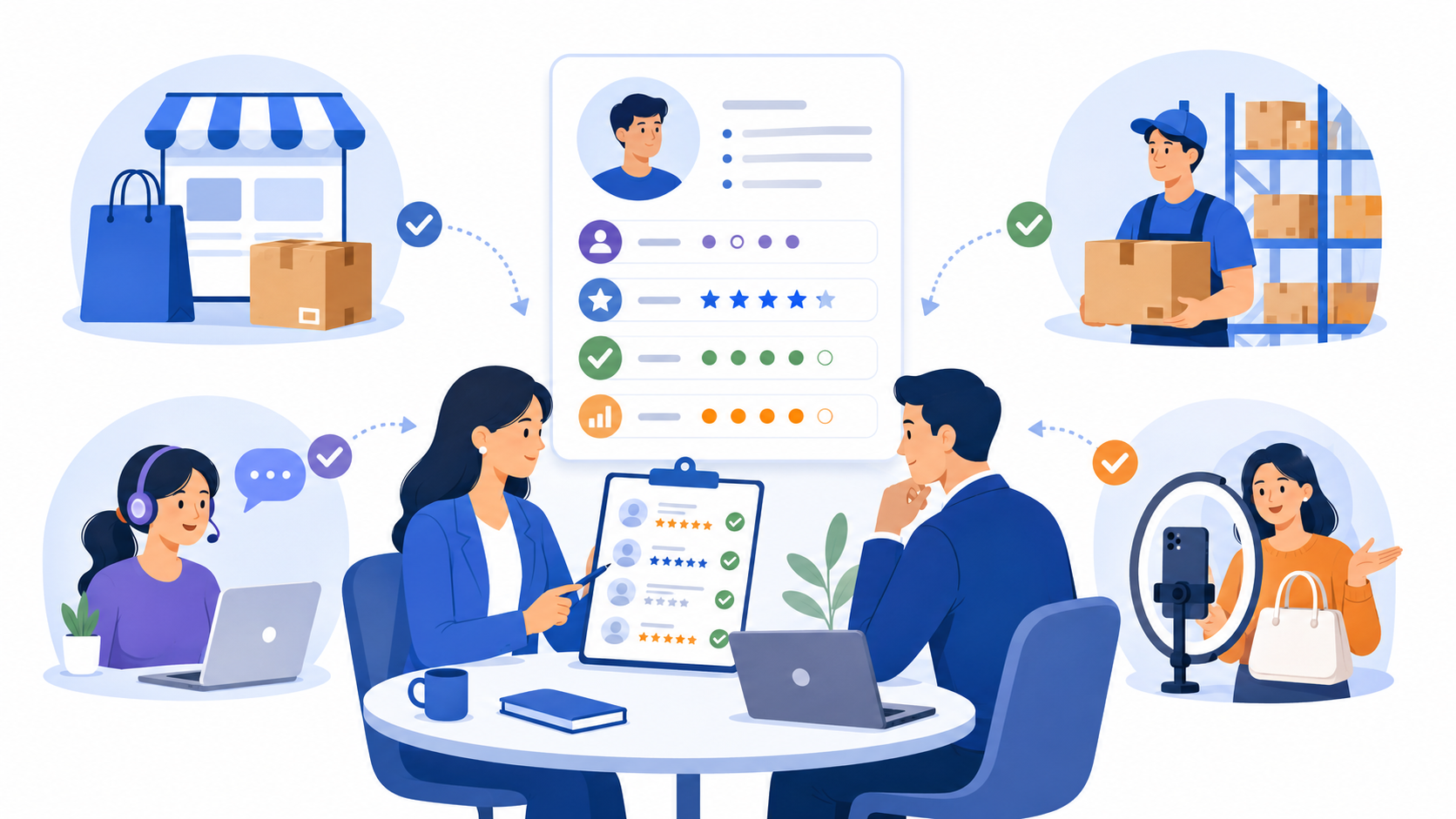
Ecommerce interview questions for employers should help hiring teams understand whether candidates can handle the real situations behind each role, not just give general answers about experience or motivation.
For ecommerce teams, this can mean asking warehouse candidates about order accuracy, customer support candidates about refund pressure, marketplace admins about platform updates, or live sellers about product claims during a campaign.
The challenge is choosing questions that match the role. A structured interview process helps employers assess technical readiness, problem-solving, communication, and speed before moving candidates to the next hiring stage.
Before choosing questions, define what the role can realistically affect.
For example, a warehouse packer may not control stock planning, but they can affect picking accuracy, packing quality, handoff speed, and issue reporting. A marketplace chat support agent may not decide refund policy, but they can affect response tone, clarification quality, escalation timing, and customer trust.
A useful ecommerce interview question should test one of five things:
For teams that need to turn these questions into a repeatable screening workflow, KitaHQ’s ecommerce recruitment software supports early-stage screening across warehouse, customer support, marketplace, live streamer, pricing, and ecommerce operations roles.
Use this article for the question set, then use the ecommerce solution page to see how these interviews can fit into a structured early-stage screening workflow.
Use this table to decide what each ecommerce role should be assessed on before choosing the questions.
Marketplace roles often sit between customers, product listings, promotions, pricing, and operations. Candidates need to be detail-oriented, calm, and comfortable working with platform rules or marketplace workflows.
What this tests:
Customer handling, tone, escalation judgment, and ability to take practical next steps.
Strong answer signs:
The candidate acknowledges the customer’s concern, avoids blaming others, checks the order status, explains the next step clearly, and escalates if needed.
Follow-up question:
What would you do if the customer keeps asking for a refund before you have confirmation from the logistics or warehouse team?
What this tests:
Attention to detail, urgency, and coordination with the right team.
Strong answer signs:
The candidate explains that they would verify the issue, pause or flag the listing if required by the workflow, inform the relevant team quickly, document the mistake, and avoid making unapproved changes if pricing ownership sits elsewhere.
Follow-up question:
How would you prevent the same mistake from happening in the next campaign?
What this tests:
Product communication, honesty, and ability to avoid over-promising.
Strong answer signs:
The candidate checks the available product information, avoids inventing claims, gives a clear answer based on confirmed details, and escalates unclear questions to the right person.
Follow-up question:
What would you do if the customer wants an immediate answer but the product team has not replied yet?
What this tests:
Prioritization under pressure.
Strong answer signs:
The candidate prioritizes urgent order issues, payment problems, time-sensitive campaign questions, and high-impact complaints while keeping communication clear.
Follow-up question:
How would you make sure lower-priority customers are not ignored?
Warehouse and fulfillment roles affect the customer experience even when they never speak directly to customers. A small picking, packing, or stock handoff mistake can lead to returns, delays, and support tickets.
What this tests:
Accuracy, issue reporting, and willingness to pause before making a mistake.
Strong answer signs:
The candidate does not guess. They check the SKU or item details, report the mismatch, follow the warehouse process, and avoid sending the wrong item just to move faster.
Follow-up question:
What would you do if the team lead is busy and the order is marked urgent?
What this tests:
Process discipline under time pressure.
Strong answer signs:
The candidate explains how they check order details, organize tasks, avoid rushing critical steps, and ask for help when volume exceeds capacity.
Follow-up question:
What part of packing should never be skipped, even when the team is behind?
What this tests:
Responsibility, reporting habits, and quality control.
Strong answer signs:
The candidate reports the damage, separates the damaged item, follows replacement or escalation steps, and avoids hiding the issue to protect speed.
Follow-up question:
How would you communicate the issue if it may delay the order?
What this tests:
Accountability and problem recovery.
Strong answer signs:
The candidate stops the process, checks both orders, informs the relevant team, and fixes the issue before shipment if possible.
Follow-up question:
What habits help reduce this type of mistake?
Ecommerce customer support candidates need more than friendliness. They need to stay calm, write clearly, clarify the problem, avoid over-promising, and know when to escalate.
What this tests:
Clarification, empathy, and next-step communication.
Strong answer signs:
The candidate acknowledges the issue, asks for relevant details, checks payment status or transaction information, explains the next step, and avoids blaming the customer.
Follow-up question:
How would you respond if the customer becomes angry because they need the item urgently?
What this tests:
Policy handling and customer communication.
Strong answer signs:
The candidate explains the policy respectfully, checks whether there are valid exceptions, avoids making unauthorized promises, and escalates if the case is sensitive.
Follow-up question:
How do you keep the conversation polite when the answer is not what the customer wants?
What this tests:
Public communication, composure, and escalation.
Strong answer signs:
The candidate avoids arguing publicly, acknowledges the issue, moves the conversation to a private channel when appropriate, and ensures the case is followed up.
Follow-up question:
What should you avoid saying in a public reply?
What this tests:
Prioritization and customer impact judgment.
Strong answer signs:
The candidate considers urgency, customer impact, order risk, and response expectations rather than simply handling messages in random order.
Follow-up question:
How would you manage customer expectations if you cannot solve all three immediately?
Live selling candidates need to explain products clearly while staying calm and engaging in real time. They may need to answer objections, respond to complaints, repeat product details, and keep the audience interested without making misleading claims.
What this tests:
Objection handling, confidence, and product explanation.
Strong answer signs:
The candidate stays calm, explains the product value clearly, avoids attacking the viewer, and connects the price to relevant features or benefits.
Follow-up question:
How would your answer change if many viewers start agreeing with the comment?
What this tests:
Composure, clarity, and complaint handling.
Strong answer signs:
The candidate does not become defensive. They clarify what the viewer means, explain confirmed product information, correct misunderstandings, and avoid claims that are not supported by product details.
Follow-up question:
When should this issue be escalated after the live session?
What this tests:
Honesty, communication, and ability to avoid false claims.
Strong answer signs:
The candidate says they would not guess, would check with the right source, and would give viewers a clear next step.
Follow-up question:
How do you keep the live session moving while waiting for the answer?
What this tests:
Engagement, adaptability, and sales communication.
Strong answer signs:
The candidate might explain product benefits differently, answer common objections, highlight use cases, interact with viewers, or adjust the presentation style without becoming pushy or misleading.
Follow-up question:
How would you know whether the issue is the product, the offer, or your communication style?
In retail and ecommerce-adjacent hiring workflows, structured AI video interviews can help teams review customer-facing, warehouse, inventory, and live commerce candidates without relying only on live scheduling. For example, BilaBila Mart used KitaHQ to screen retail and warehouse candidates on customer handling, shift fit, product knowledge, point-of-sale judgment, warehouse safety, and stock accuracy. MYDIN also used KitaHQ to screen retail and operational candidates across inventory, supply chain, live commerce, project, and administrative roles before further review.
The relevant takeaway for ecommerce employers: use role-specific questions to compare how candidates explain products, handle pressure, report issues, and follow process before deciding who should move to recruiter or hiring manager review.
See also: AI Video Interview Questions Employers Can Use for Structured First-Round Review
Ecommerce operations support roles often handle product uploads, pricing coordination, campaign preparation, admin tasks, affiliate support, or internal handoffs. These roles require accuracy and follow-through.
What this tests:
Ownership, urgency, and coordination.
Strong answer signs:
The candidate identifies what is missing, prioritizes the most urgent items, informs the right team, follows up clearly, and avoids letting incomplete information go live without escalation.
Follow-up question:
How would you decide which missing details matter most?
What this tests:
Checking habits and attention to detail.
Strong answer signs:
The candidate uses a checklist, batches similar tasks, verifies important fields, double-checks before publishing, and asks for clarification when instructions are unclear.
Follow-up question:
What information should always be checked before a listing is published?
What this tests:
Communication and accountability.
Strong answer signs:
The candidate gives a clear status update, explains what is pending, states who they are waiting on, and gives the next follow-up time.
Follow-up question:
How would you handle it if the delay affects a campaign launch?
What this tests:
Prioritization and escalation.
Strong answer signs:
The candidate considers deadline, business impact, dependency, customer impact, and whether they need a manager to clarify priorities.
Follow-up question:
What would you do if both teams insist their task is more urgent?
This table helps employers avoid using the same question set for every candidate. It also helps recruiters explain to hiring managers why a candidate was strong, borderline, or not ready for the role.
Interview questions are only useful if the team knows how to score the answers. Without a scoring guide, two interviewers may hear the same answer and reach different conclusions.
A simple ecommerce interview rubric can use three scoring levels:
Then score candidates against the same criteria:
For high-volume ecommerce hiring, this rubric can be turned into AI interview assessment. Recruiters can ask the same role-specific questions, review answers against the same criteria, and share candidate reports with hiring managers for review.
This works best when the team has already agreed on what each role should prove in the first round. For example, warehouse candidates may need to show accuracy and issue reporting, while live selling candidates may need to show product explanation, objection handling, and calm communication. Humans should still review the reports and decide who moves forward.
A live seller, warehouse picker, marketplace admin, and customer support agent should not be assessed with the exact same question set. They may share some soft skills, but the risks and daily tasks are different.
Past experience matters, but it does not always show how a candidate will handle pressure. Add scenario questions that reflect real ecommerce situations.
If recruiters do not know what a strong answer looks like, screening becomes subjective. Create a simple scoring guide before interviews begin.
A candidate may give a polished first answer. Follow-up questions reveal whether they can explain their reasoning, handle edge cases, and stay consistent.
Interviews can reveal communication, judgment, readiness, and problem-solving. They should not replace formal checks such as employment, identity, credential, background, or compliance verification when those checks are required.
The best ecommerce interview questions for employers help reveal how candidates would handle real work situations, not just how well they describe their experience.
For marketplace, warehouse, customer support, and live selling roles, questions should match the daily risks of the job, from platform accuracy and order handling to customer pressure and product explanation.
When paired with a clear scoring rubric, these questions help recruiters and hiring managers compare candidates more consistently.
For teams hiring ecommerce roles at volume, ecommerce recruitment software with AI resume screening and AI video interviews can make structured screening easier to run while keeping final hiring decisions with the right people.
Industry: Banking
KitaHQ is an AI hiring software that helps teams screen faster, run AI video interviews, and evaluate candidates consistently.