.webp)

August 6, 2026
Ecommerce Hiring Process: A Practical Guide to Building a Team That Can Scale
Build a stronger ecommerce hiring process with eight practical steps for defining roles, screening candidates, running interviews, and scaling responsibly.
.avif)
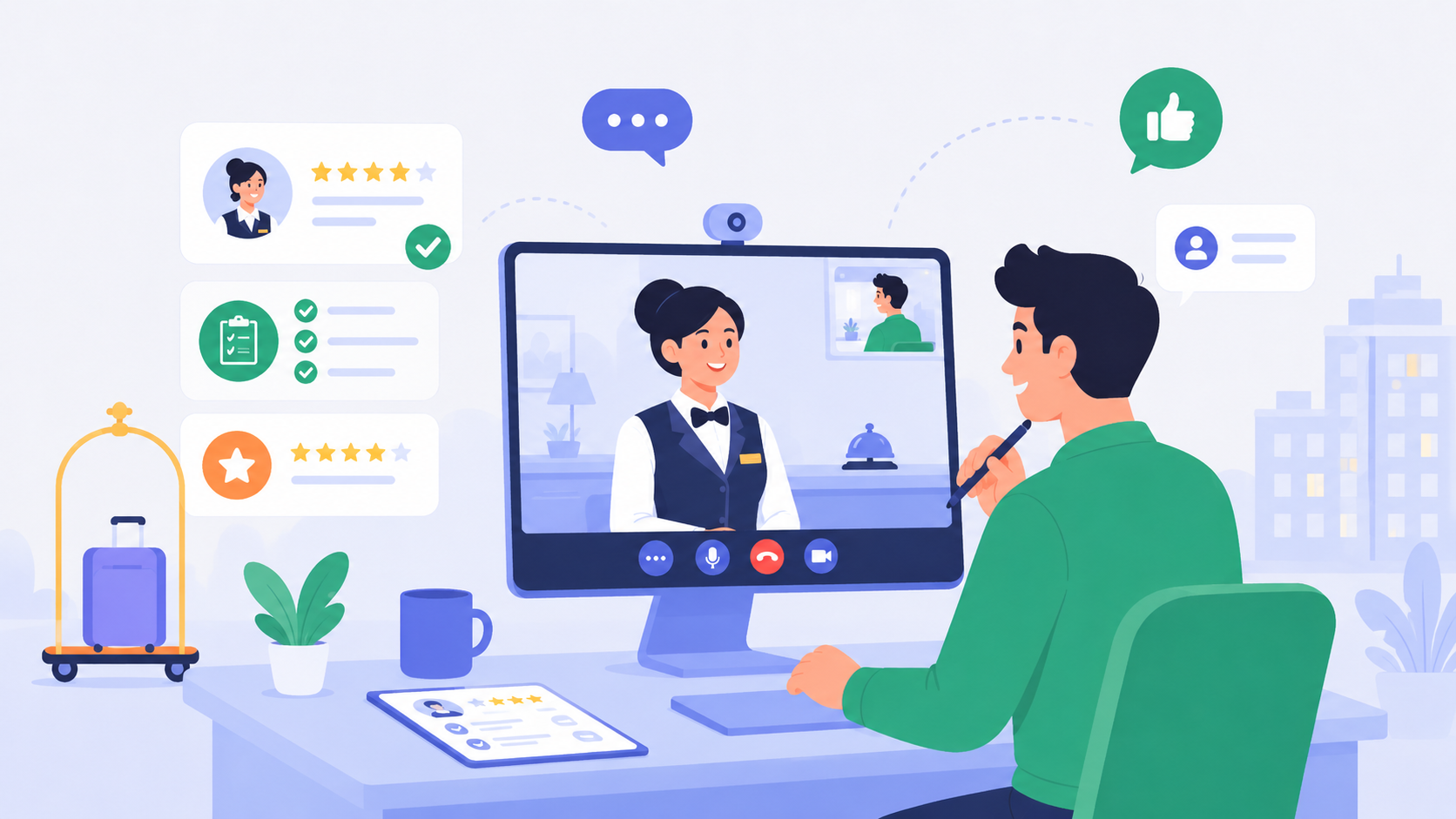
Hiring hospitality candidates is not only about checking whether someone has worked in a hotel, restaurant, resort, or event venue before. In hospitality, a candidate may look suitable on paper but still struggle with guest-facing judgment, shift fit, or service communication. Hospitality hiring moves fast. A hotel may need room attendants before peak season. A restaurant may need servers before a new outlet opening. An event venue may need guest-facing staff for a busy weekend.
The challenge is that many important hospitality signals do not appear clearly on a CV. That is why recruiters need more than a generic interview script. They need hospitality interview questions that reveal how candidates think, communicate, and respond in real service situations.
This guide gives recruiters practical hospitality interview questions and a candidate screening checklist to use before sending candidates to hiring managers.
The goal is not to make the final hiring decision at this stage. The goal is to confirm whether each candidate has enough role fit, availability, communication ability, and service judgment to move forward.
Before asking detailed interview questions, recruiters should know what they are trying to screen for.
This keeps the checklist practical. Recruiters do not need to judge everything alone, but they should prepare enough information so manager interviews are faster and more focused.
Use this checklist when reviewing hospitality candidates before manager interviews.
For recruiter review, it helps to sort candidates into three simple next steps:
For high-volume hospitality hiring, this checklist can also be turned into structured screening questions inside AI video interviews, so recruiters can compare candidates more consistently before sending candidate reports to hiring managers.
Use these hospitality interview questions to assess specific candidate signals, not just general personality fit.
These questions are especially useful because many hospitality skills are hard to judge from a CV alone. Service judgment, language confidence, and guest communication usually become clearer when candidates answer realistic scenarios.
Different hospitality roles need different screening signals. Use this table to adjust your screening by role.
Not every hospitality role needs the same level of screening. A front desk candidate may need stronger language and complaint-handling review. A room attendant may need more focus on SOP discipline, cleanliness standards, and coordination with supervisors. An event crew candidate may need stronger crowd-flow judgment and flexible schedule fit.
Use the checklist to decide whether a candidate is ready for manager review, not to make the final hiring decision. If the candidate meets the basic requirements but has one unclear area, add a follow-up question for the hiring manager. If several areas are unclear, run another screening step before moving the candidate forward.
Before moving a hospitality candidate to the next step, check whether you have enough information for a useful manager interview.
If the answer is mostly “yes,” the manager interview can focus on validation, team fit, and final decision-making. If several answers are “no,” the recruiter may need another screening step before sending the candidate forward.
AI candidate screening is most useful when hospitality recruiters need to review many candidates consistently before manager interviews. The goal is not to replace recruiter or hiring manager judgment. The goal is to make early screening clearer, faster, and easier to review.
For hospitality roles, AI candidate screening can help with:
Recruiters can use AI resume screening to review hospitality CVs against criteria such as relevant experience, guest-facing exposure, shift history, role fit, and location fit. This is useful when many applicants apply for similar roles across hotels, restaurants, resorts, or venues.
Instead of asking every candidate different questions, recruiters can use AI video interviews to ask the same role-specific questions across candidates. This helps make the first screening step more consistent.
Hospitality screening should not rely only on written CVs. AI video interviews help recruiters review how candidates explain guest-facing situations, respond under pressure, and communicate next steps.
Recruiters can use AI interview assessment to review candidate responses against role-specific criteria, such as service recovery, escalation awareness, shift readiness, communication clarity, or SOP judgment.
AI candidate reports can help hiring managers review summaries, strengths, concerns, transcripts, recordings, and suggested follow-up areas before speaking with candidates.
For high-volume hospitality hiring, recruitment automation can help teams manage interview invites, reminders, re-invites, and rejection messages so candidates move through the early screening workflow with less manual follow-up.
TGV Cinemas used KitaHQ to support screening for guest-facing and cinema operations roles, helping recruiters review service communication and shift-fit signals before manager review.
A hospitality candidate screening checklist should help recruiters do more than sort CVs. It should help the team check role fit, availability, service judgment, communication ability, language confidence, and manager-review readiness before candidates move to the next hiring step.
For hospitality teams hiring across hotels, restaurants, resorts, leisure venues, and events, AI candidate screening can make early screening more structured. Recruiters can review candidates more consistently, while hiring managers receive clearer candidate reports before deciding who should move forward.
The best process is not AI making hiring decisions. It is a clearer screening workflow where AI helps organize early candidate information, and recruiters and hiring managers decide who moves forward.
For teams that want to connect this checklist to a broader hiring workflow, KitaHQ’s hospitality recruitment software supports AI resume screening, AI video interviews, interview assessment, candidate reports, and recruitment automation for early-stage hospitality screening.
Industry: Banking
KitaHQ is an AI hiring software that helps teams screen faster, run AI video interviews, and evaluate candidates consistently.