%20(1).png)

August 6, 2026
Ecommerce Hiring Process: A Practical Guide to Building a Team That Can Scale
Build a stronger ecommerce hiring process with eight practical steps for defining roles, screening candidates, running interviews, and scaling responsibly.
.avif)
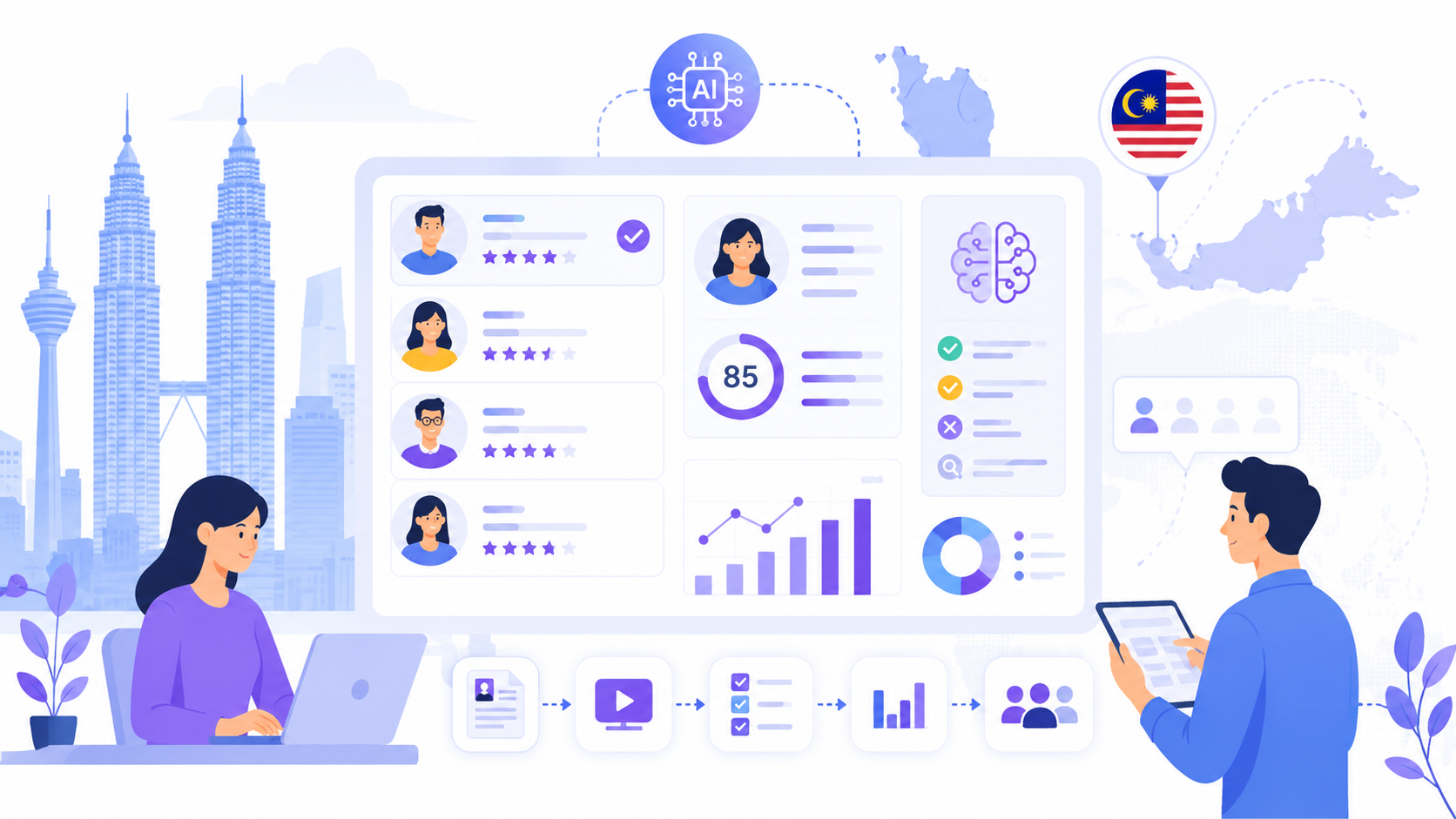
AI recruitment is still in the early stages of adoption in Malaysia, but candidate screening is already one of the clearest areas of change.
According to Hays Malaysia, only 17% of employers were using AI minimally throughout the recruitment process, while 29.8% were still exploring its potential and 39.4% had no plans to use AI in recruitment yet. But among employers that already use AI, the top use case is resume screening and shortlisting, used by 54.3%, followed by candidate assessment and ranking at 33.7%.
This shows that AI is not replacing recruiters in Malaysia. Instead, it is starting to reshape the repetitive parts of early-stage screening, from reviewing resumes to collecting first-round candidate responses and preparing clearer candidate reports for human review.
AI is changing candidate screening by helping hiring teams handle repetitive screening work earlier in the process.
Instead of relying only on manual resume review, phone screening, or unstructured first-round interviews, recruiters can use AI recruitment tools to organize candidate information, screen applicants against role criteria, and create reports that support human review.
In Malaysia, this is especially relevant for companies hiring across multilingual and high-volume roles. Retail, education, customer service, operations, hospitality, logistics, and frontline hiring teams often need to assess many candidates quickly.
At the same time, they may need to understand communication ability, language fit, shift readiness, role expectations, and basic job fit before inviting candidates to a live interview.
AI can support this by making early-stage screening more consistent. For example, candidates for the same role can be screened against the same criteria. Interview questions can be structured around the job requirements.
Recruiters and hiring managers can review summaries, scores, transcripts, and recordings instead of relying only on memory from phone calls or scattered interview notes.
This does not remove the recruiter from the process. It changes where the recruiter spends time. Instead of manually repeating the same screening steps for every applicant, recruiters can spend more time reviewing stronger-fit candidates, comparing context, and deciding who should move to the next stage.
AI is most useful in candidate screening when it helps recruiters identify role-relevant signals earlier. Instead of waiting until a live interview to discover whether a candidate fits the role, hiring teams can collect structured information before manager review.
AI resume screening can help recruiters compare candidates against role-specific criteria, such as experience, skills, qualifications, location fit, or job requirements.
This is useful when recruiters receive many resumes for the same role. Instead of reading every CV from scratch, the team can create screening criteria and use AI to organize candidates into a more reviewable shortlist.
However, resume screening should not be treated as a final decision. Resumes can be incomplete, inflated, or written in different formats. AI can help structure the first review, but recruiters still need to check whether the candidate’s background actually matches the hiring need.
Many Malaysian hiring teams still rely on phone screening or manual first-round interviews to ask the same basic questions repeatedly.
AI video interviews can help collect first-round responses without live scheduling. Candidates can complete interviews on their own time, while recruiters review the responses later.
This helps hiring teams understand how candidates answer job-related questions. For high-volume roles, it can also reduce the time spent coordinating interview slots for candidates who may not be ready for the role.
Some roles require more than resume fit. For customer-facing, teaching, sales, service, support, and frontline roles, hiring teams may need to understand how candidates communicate.
AI video interviews can help recruiters assess communication earlier by capturing candidate responses, transcripts, and recordings. This does not mean AI should judge personality or make subjective assumptions. It means recruiters can review how candidates explain their experience, respond to job-related questions, and communicate in a format closer to the actual work context.
For Malaysian employers hiring across Bahasa Malaysia, English, Mandarin, or mixed-language environments, this can be especially useful when language and communication expectations are part of the role.
Generic screening often misses what actually matters for the role.
For example, a retail role may require shift readiness, customer interaction, product explanation, and outlet reliability. A teacher role may require classroom communication, subject confidence, and language ability. A warehouse role may require SOP discipline, physical work readiness, and safety awareness.
AI can help hiring teams screen candidates against role-specific criteria instead of using the same generic questions for every position.
This makes screening more relevant to hiring managers. Instead of receiving a shortlist based only on resume keywords, managers can review candidate reports that reflect the actual responsibilities of the role.
Malaysia’s hiring environment is multilingual. Depending on the role, candidates may need to communicate in Bahasa Malaysia, English, Mandarin, or a combination of languages.
AI-supported screening can help hiring teams collect candidate responses in the language that matters for the role. This is useful when language ability is not just a nice-to-have, but part of the job requirement.
See also: Top Video Interview Software in Malaysia: Buyer Guide
AI can make candidate screening faster and more structured, but it should not replace human hiring judgment.
Hiring decisions involve context. A candidate may have a non-linear career path, transferable skills, location constraints, salary expectations, or personal circumstances that are not fully captured by a resume score or interview summary. Recruiters and hiring managers still need to review candidate information, compare tradeoffs, and decide who should move forward.
Human review also matters because AI outputs can be incomplete or overly confident. A score or ranking may look objective, but it depends on the criteria, data, prompts, and system design behind it. If the criteria are unclear or biased, the output may reflect those issues.
This is why AI candidate screening should be designed as a decision-support process, not an automated decision process.
A better approach is:
This keeps AI in the right role: supporting faster and more consistent screening, while leaving hiring decisions to people.
AI recruitment tools can help hiring teams, but they also create risks if used without clear policies and human oversight.
Hays Malaysia found that 57.4% of respondents believe AI-powered resume screening can be biased and needs to be addressed before use. The same report also noted that 26.6% of employers using AI in recruitment were not actively assessing bias in their AI recruitment tools.
That means Malaysian employers should not treat AI screening as a shortcut that removes responsibility. They need to understand what the tool does, what data it uses, how results are reviewed, and where human judgment remains necessary.
Bias can appear when screening criteria are poorly defined, when historical hiring data reflects past patterns, or when recruiters rely too heavily on rankings without reviewing the underlying candidate context.
To reduce this risk, hiring teams should define role-relevant criteria clearly, avoid irrelevant assumptions, and review outputs regularly. AI should help apply structure, not reinforce unfair shortcuts.
Candidate screening involves personal information, including resumes, contact details, interview responses, recordings, transcripts, and assessment results.
Malaysian employers should understand how candidate data is collected, stored, accessed, retained, and protected. They should also check whether the recruitment software provider uses encryption, access controls, and clear privacy practices.
Data privacy is especially important when AI tools process candidate information across multiple roles, teams, or locations.
Candidate ranking can be useful, but it can also create false confidence.
A ranked shortlist may help recruiters prioritize review, but it should not be treated as the final answer. Hiring teams should review candidate reports, interview responses, transcripts, and recordings before deciding who moves forward.
The question should not be: “Who did AI rank first?”
The better question is: “Does the candidate information support moving this person to the next stage?”
See also: How to Reduce Time-to-Hire With Better Candidate Screening
KitaHQ is AI recruitment software for Malaysian companies that helps hiring teams reduce manual screening tasks. Here are some of its features:
KitaHQ is also used by Malaysian companies such as Jaya Grocer, Valiram, Tealive, and DRB-HICOM Berhad, making it relevant for employers hiring across retail, operations, frontline, education, and high-volume roles.
For example, BilaBila Mart uses KitaHQ to screen retail associates across locations such as Ipoh, Penang, and Klang Valley, as well as warehouse associates in Bahasa Malaysia. This helps the hiring team manage candidate screening across different locations and role types without relying only on manual first-round calls.
Another example is Fairview Education Group, which uses KitaHQ to hire Mandarin teachers. Through KitaHQ’s AI video interviews, candidates can respond in Mandarin, while hiring teams can review candidate reports in English or in the original interview language. This is especially useful when language ability is an important part of the screening process.
See also: Best Hiring Tools for Malaysian SMEs That Need Faster Candidate Screening
AI is starting to transform candidate screening in Malaysia, but not by replacing recruiters or making final hiring decisions.
The clearest opportunity is in early-stage screening: helping recruiters review resumes faster, collect first-round candidate responses, assess communication and role fit earlier, support multilingual screening, and prepare clearer candidate reports for hiring manager review.
For Malaysian hiring teams, the right AI recruitment software should make screening more structured and reviewable while keeping human judgment in control. With KitaHQ, recruiters can move candidates from application to shortlist more efficiently.
KitaHQ is an AI recruitment software that helps companies screen candidates, manage applicants, and keep candidate communication moving in one connected workspace.