%20(1).png)

August 6, 2026
Ecommerce Hiring Process: A Practical Guide to Building a Team That Can Scale
Build a stronger ecommerce hiring process with eight practical steps for defining roles, screening candidates, running interviews, and scaling responsibly.
.avif)
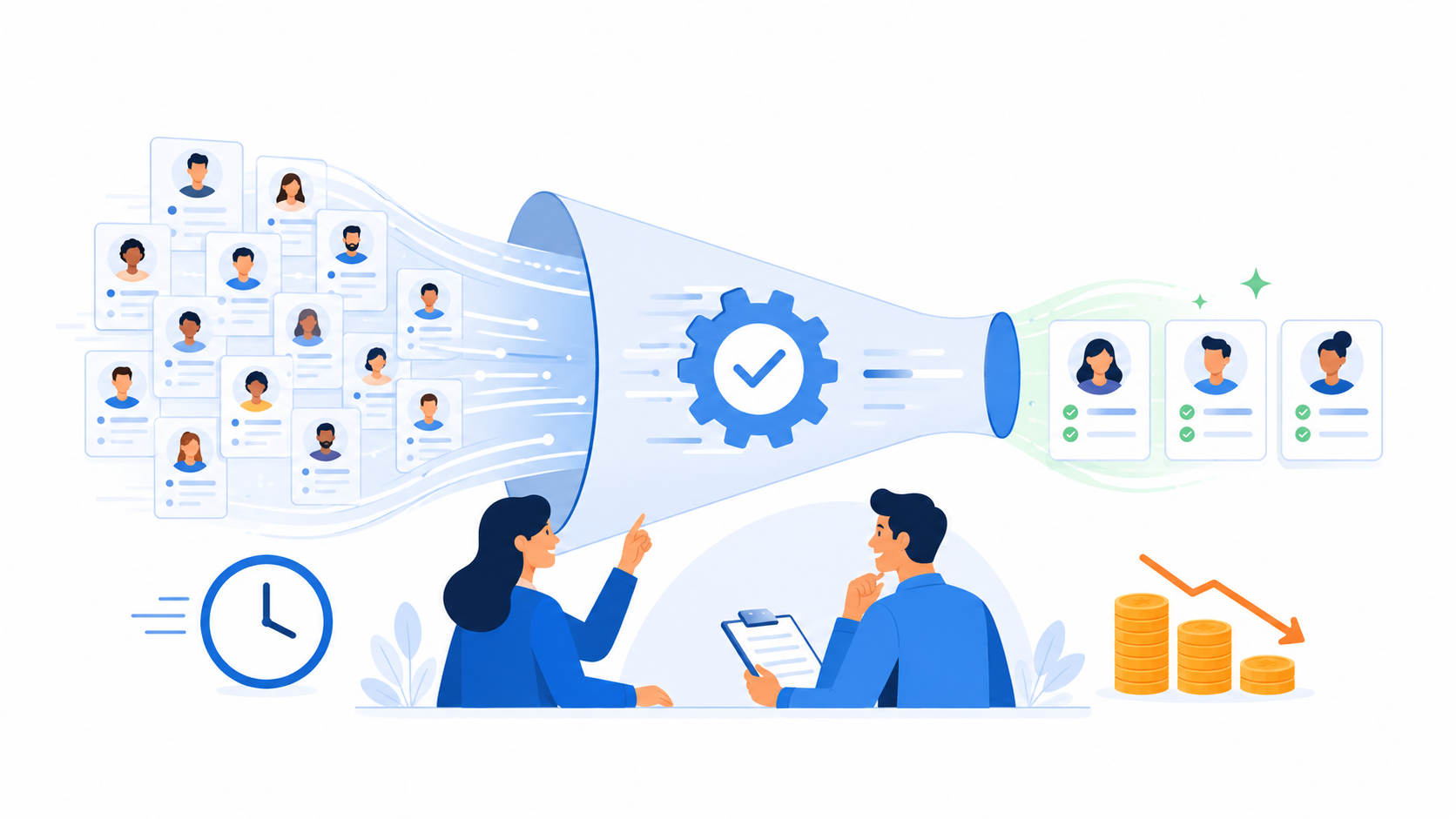
Recruitment automation reduces screening costs by cutting the repetitive work that happens before a recruiter or hiring manager makes a decision. In high-volume hiring, the cost is not just interviews. It is the time spent reviewing resumes, sending invites, chasing candidates, tracking completion, and preparing handoffs for managers.
When hundreds of candidates enter the funnel, those small tasks add up fast. Automation helps recruiters keep the process moving without removing human judgment from hiring decisions.
The goal is to help recruiters spend less time on repetitive screening administration and more time deciding which candidates should move forward.
High-volume hiring creates cost pressure because the same screening actions repeat across a large candidate pool. A recruiter may not notice the cost of one manual email, one calendar follow-up, or one resume review. The cost appears when those actions happen hundreds of times in a short hiring campaign.
Screening cost usually comes from five places:
In high-volume hiring, cost is often hidden inside recruiter time. The team may not pay a separate fee for each manual touchpoint, but every manual touchpoint consumes capacity that could be used for judgment, candidate communication, or hiring manager alignment.
See also: How to Use Automated Interview Invites and Reminders in Candidate Screening
Before automating, hiring teams should understand which parts of screening create the most cost. A simple way to think about it is:
Screening cost = candidate volume x manual touchpoints x average time per touchpoint x recruiter cost of time
This does not need to be a finance-grade formula to be useful. It helps the team see why high-volume hiring becomes expensive even when each task looks small.
For example:
Recruitment automation reduces screening costs when it lowers the number of manual touchpoints or the time required for each touchpoint.
Recruitment automation is most useful when the task is repeatable, rule-based, and part of early-stage screening. This feature is available in KitaHQ to help hiring teams automate interview invites, reminders, re-invites, and rejection messages while keeping recruiter review and judgment in control.
In high-volume hiring, resume review can become the first major bottleneck. Recruiters often need to scan many resumes before they can decide who should move to the next step.
AI resume screening can reduce screening cost by helping recruiters review resumes against predefined role criteria. The hiring team still needs to define what matters for the role. The value is that recruiters spend less time manually sorting every CV and more time reviewing candidates who appear relevant for the next stage.
The cost reduction comes from compressing the manual sorting stage, not from removing human review.
Live first-round screening calls are expensive at volume because they require scheduling, rescheduling, reminders, and recruiter availability. Even a short call can create a long coordination trail.
AI video interviews can reduce screening costs by letting candidates complete structured first-round interviews on their own time. Recruiters can then review scores, summaries, transcripts, and recordings after completion.
This works best when the first-round screen is meant to collect repeatable signals, such as:
The recruiter still decides who should move forward. Automation simply removes the need to schedule every first-round screen live.
See also: How Much Does Recruitment Automation Cost, and Is It Worth It?
Candidate follow-up is one of the most underestimated screening costs. In high-volume hiring, many candidates need reminders before completing the next step. Some miss the first message. Some start but do not finish. Some need a re-invite.
Recruitment automation reduces cost by handling repetitive communication steps such as interview invitations, reminder messages, re-invites for incomplete candidates, next-step messages based on configured workflow rules, and rejection messages.
This reduces the amount of recruiter time spent chasing process completion. It also gives candidates clearer instructions and more consistent follow-up.
Screening cost does not end when a candidate reaches the hiring manager. If the manager receives weak context, the next interview may repeat the first screen. That creates extra time cost for both the team and the candidate.
Candidate reports reduce rework by giving managers clearer context before the next conversation. Reports may include summaries, transcripts, recordings, strengths, and concerns.
The cost reduction comes from a better handoff. Managers can use live interviews for deeper judgment instead of repeating basic screening questions.
See also: AI Recruitment Trends in 2026: What Hiring Teams Should Watch
Juara Gadai saved 25 HR hours per week using KitaHQ and handled 4x hiring volume with support from structured candidate screening. This proof is most relevant for high-volume teams where recruiter time is the main cost constraint. Read the full Juara Gadai story.
Bank Saqu achieved 3x higher onboarding throughput by using KitaHQ in an event hiring workflow. Bank Saqu used KitaHQ to screen sales and customer-facing candidates on product knowledge, customer explanation ability, and readiness to communicate digital banking features accurately. Read the full Bank Saqu story.
These examples should not be treated as guaranteed outcomes for every hiring team. They show the type of cost pressure automation can address: repetitive screening work, high candidate volume, and the need to review clearer candidate information before the next step.
Recruitment automation reduces screening costs in high-volume hiring by removing repeated manual work from early-stage screening. The biggest savings usually come from reducing resume review time, first-round scheduling work, reminder follow-up, candidate tracking, and manager handoff rework.
The right automation workflow is not fully automated hiring. It is a structured screening process where software handles repeatable tasks and humans stay responsible for hiring judgment.
If your team is screening candidates at high volume, KitaHQ can help you automate early-stage recruitment workflows.
Industry: Banking
KitaHQ is an AI hiring software that helps teams screen faster, run AI video interviews, and evaluate candidates consistently.