%20(1).png)

August 6, 2026
Ecommerce Hiring Process: A Practical Guide to Building a Team That Can Scale
Build a stronger ecommerce hiring process with eight practical steps for defining roles, screening candidates, running interviews, and scaling responsibly.
.avif)

An interview assessment scorecard should not be treated as a final number that tells recruiters who to shortlist.
A good scorecard helps recruiters review the quality behind the score: what the candidate said, how clearly they answered, which criteria they met, what concerns remain, and whether the candidate should move forward to the next hiring stage.
This checklist and template can help recruiters review interview results more consistently before shortlisting candidates.
An interview assessment scorecard is a structured tool recruiters use to evaluate candidate interview responses against predefined criteria.
Instead of relying only on memory, gut feel, or unstructured notes, the scorecard helps reviewers compare candidates using the same baseline. It usually includes assessment criteria, rating scales, written notes, and a shortlisting recommendation.
For early-stage hiring, a scorecard is especially useful when recruiters need to compare many candidates quickly without losing sight of role fit and answer quality.
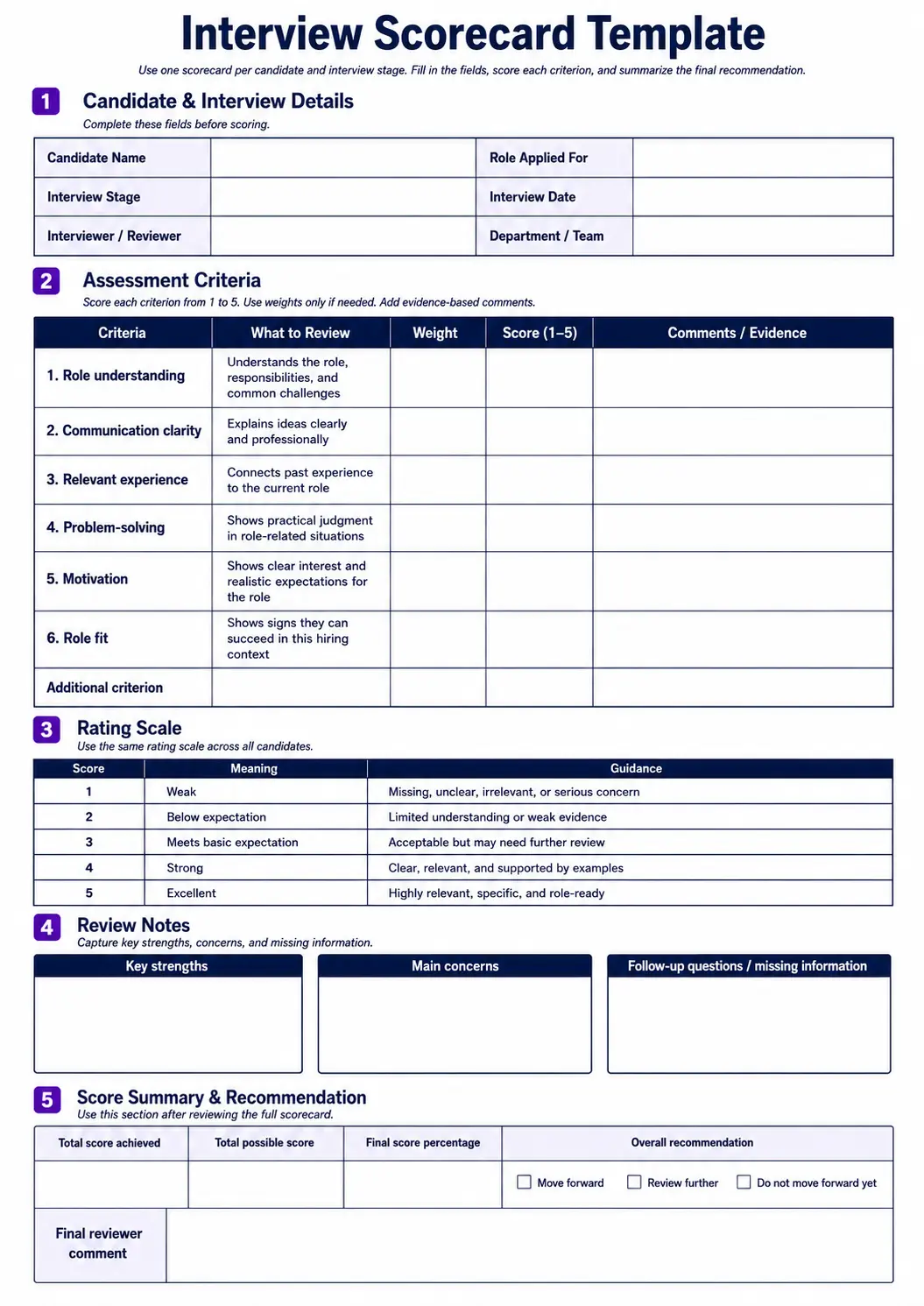
Recruiters can adapt the scorecard template below for different roles, hiring stages, and evaluation needs. Each part helps clarify what was reviewed, why a score was given, and whether the candidate should move forward.
Start with basic candidate and interview information so the scorecard is easy to track and compare later. This is especially useful when several recruiters, hiring managers, roles, or interview stages are involved.
Assessment criteria define what the recruiter is actually reviewing in the interview. Use role-related criteria that can be observed from the candidate’s answers, instead of vague labels like “good attitude” or “nice personality.”
A rating scale helps reviewers score candidates more consistently. Define what each score means so different reviewers do not interpret the same number differently.
See also: Scenario-Based Interview Assessment: How to Evaluate Real Job Situations
Review notes explain the reason behind the score. They should be specific enough to help another recruiter or hiring manager understand what the candidate said, showed, or failed to clarify.
Weak notes:
Stronger notes:
Good review notes make the scorecard easier to discuss with hiring managers.
The final section connects the scorecard to a hiring action. Recruiters should use the full scorecard, not only the final score, to decide whether the candidate should move forward, need further review, or not move forward yet.
After the scorecard is filled in, recruiters should review whether the scores are supported by clear evidence. The goal is to understand whether the candidate should move forward, not simply who received the highest number.
Check these four areas before shortlisting:
If these four areas are clear, recruiters can use the shortlisting decision section of the scorecard to decide whether the candidate should move forward, need further review, or not move forward yet.
The same scorecard structure can be adapted for different roles. What changes is the criteria recruiters choose to review.
This section should not be used as a fixed template for every job. Recruiters should adjust the scorecard based on the role requirements, must-have skills, and hiring stage.
See also: 5 Types of Talent Assessments and When to Use Each One
A scorecard can improve consistency, but only when it is used carefully. Here are common mistakes to avoid.
KitaHQ is an AI recruitment software for candidate screening that helps hiring teams run structured early-stage screening before deeper human interviews. KitaHQ’s AI interview assessment can assess candidate responses against standard or custom criteria.
This helps hiring teams compare candidates more consistently, especially when many candidates are being reviewed across roles, branches, locations, or hiring managers. Recruiters can use the scorecard and candidate report to understand the evidence behind each assessment, instead of relying only on memory or unstructured notes.
KitaHQ supports recruiter and hiring manager review. It does not make final hiring decisions for the team.
An interview assessment scorecard is useful only when recruiters review the evidence behind the score.
Before shortlisting, recruiters should check whether the scorecard uses role-relevant criteria, whether the score is supported by clear answers, whether strengths and concerns are documented, and whether the candidate is ready for the next step.
A good scorecard does more than organize interview feedback. It gives recruiters a practical checklist for making clearer, more consistent, and more role-relevant shortlisting decisions.
Industry: Banking
KitaHQ is an AI hiring software that helps teams screen faster, run AI video interviews, and evaluate candidates consistently.