%20(1).png)

August 6, 2026
Ecommerce Hiring Process: A Practical Guide to Building a Team That Can Scale
Build a stronger ecommerce hiring process with eight practical steps for defining roles, screening candidates, running interviews, and scaling responsibly.
.avif)
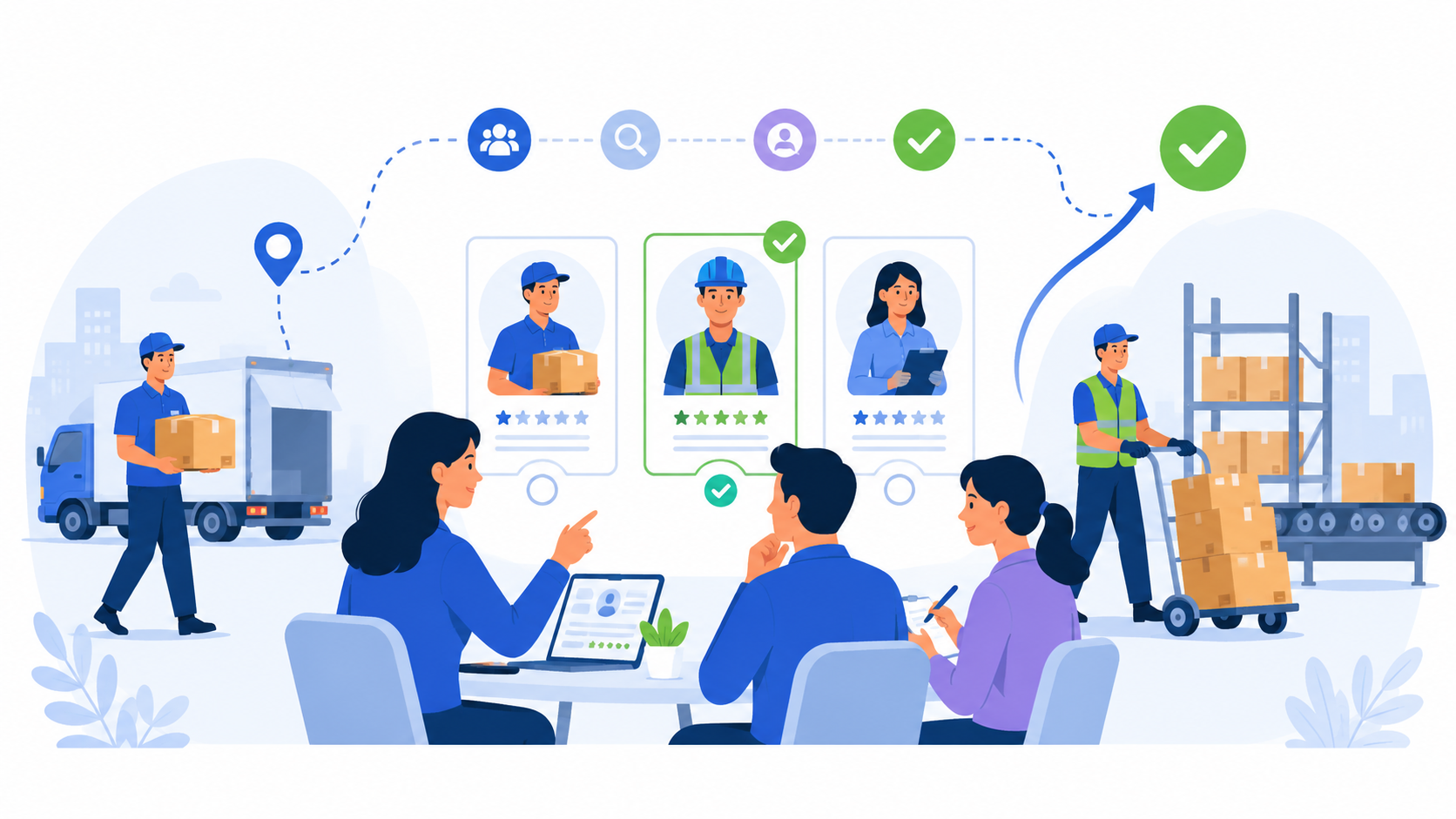
Logistics recruitment challenges often look like a sourcing problem on the surface. Teams need more delivery riders, warehouse staff, operations coordinators, routing support, QA, and customer experience candidates across different hubs, warehouses, delivery zones, and operating teams.
But for many logistics teams, delays start after candidates apply. Recruiters still need to check availability, location fit, route or site readiness, work-condition fit, communication, and basic role exposure before manager review.
That makes logistics hiring a screening problem as much as a sourcing problem. A faster workflow should help the team separate qualified, available, and operationally ready candidates from weak fits without turning every first-round check into a live scheduling bottleneck.
Logistics roles can attract many applicants, especially for delivery, warehouse, support, and entry-level operations positions. The challenge is not always getting applications. It is reviewing them quickly enough and separating candidates who are ready for the role from those who are unlikely to match the requirements.
Recruiters often spend too much time asking the same basic questions:
When this work is fully manual, screening becomes slow even when the role itself is repeatable.
In logistics, a candidate can look suitable on paper but still be a poor fit for the actual work setup.
For delivery roles, route expectations, device readiness, customer handling, and on-the-ground problem solving may matter. For warehouse roles, shift fit, attendance reliability, process discipline, and physical work expectations may matter more. For operations roles, communication, escalation judgment, and coordination across teams may become the stronger signals.
A generic screening process can miss these differences. If every logistics candidate is screened with the same broad questions, hiring managers may receive shortlists that look acceptable but do not match the real operating environment.
Quick role-specific screening map
Many logistics candidates are not sitting at a desk all day. They may be working shifts, moving between locations, handling deliveries, or applying outside standard office hours.
When every early interview depends on live scheduling, the process can become slower than the hiring need. Recruiters wait for availability. Candidates miss calls. Managers ask for updates. Strong candidates may move on before the team completes basic screening.
This is where a structured interview process without live scheduling can help. Candidates can complete interviews on their own time, while recruiters still receive comparable responses for review.
Logistics hiring often involves multiple recruiters, supervisors, hubs, warehouses, or operating teams. Without a shared screening standard, each team may define “qualified” differently.
One recruiter may focus on experience. Another may focus on availability. A supervisor may prioritize route familiarity. Another may care more about customer handling or SOP discipline.
This creates inconsistent shortlists. It also creates more work for hiring managers because they have to repeat basic screening questions instead of focusing on deeper validation.
A common logistics hiring problem is discovering basic mismatches after manager time has already been used.
Examples include:
Not every mismatch can be caught at the beginning. But many obvious issues can be flagged earlier if the screening workflow asks the right questions and documents the answers clearly.
Logistics hiring can spike during seasonal demand, expansion, new site openings, campaign periods, or sudden backfill needs. During these periods, recruiters are under pressure to move faster while still protecting hiring quality.
The risk is that teams start skipping structure. They may reduce screening depth, rely too heavily on quick phone calls, or send weak shortlists to managers just to keep the pipeline moving.
A better strategy is not to make screening heavier. It is to make screening more structured, repeatable, and easier to review.
See also: 6 Challenges of Hiring at Scale and How AI Tools Solve Them
A faster logistics hiring process should be structured around handoffs, not just speed.
Here is a practical workflow:
The same principle applies when logistics hiring spans different role types and locations. PT Tri Adi Bersama used KitaHQ to screen logistics and operations candidates across courier, customer experience, quality assurance, and data-related roles before recruiter review. Tiong Woon Crane & Transport used KitaHQ to screen logistics and transport candidates across technical, apprentice, and administrative roles before hiring manager review.
The workflow lesson is simple: when logistics hiring spreads across roles, sites, and operating teams, recruiters need a structured way to review role-fit signals earlier before manager time is used.
Before adding more tools, hiring teams should identify where the workflow is actually breaking.
The best fix depends on the bottleneck. A team with poor applicant volume may need better sourcing. A team with too many unqualified applicants may need better screening. A team with manager misalignment may need clearer reports and evaluation criteria.
Delivery, warehouse, routing, QA, and operations roles should not use the exact same screening flow. They may share some criteria, but each role needs its own practical signals.
If managers receive candidates before basic availability, role understanding, and work-condition fit are checked, the process becomes slower. Manager interviews should not become the first real screening step.
Resumes can show experience, but they may not show communication, judgment, customer handling, or SOP discipline. For many logistics roles, structured interviews reveal signals that resumes cannot.
During hiring spikes, teams may rush decisions and lose consistency. AI Candidate reports and interview reports help keep the process reviewable, especially when multiple recruiters and managers are involved.
Screening and verification are different. Screening helps teams understand fit and readiness. Verification confirms documents, licenses, employment history, or other formal requirements. Logistics teams should keep those responsibilities separate.
The biggest logistics recruitment challenges are not always caused by a lack of applicants. Many hiring teams struggle because early screening is too manual, interview scheduling is too slow, criteria are inconsistent, and managers receive candidates before basic readiness has been checked.
A faster logistics hiring workflow should help recruiters use AI resume screening to review role exposure earlier, run AI video interviews without live scheduling, apply AI interview assessment to role-specific scenarios, review candidate reports before manager handoff, and use recruitment automation for repetitive invites, reminders, re-invites, and rejection messages.
For teams that want to turn this into a more structured logistics recruitment software workflow, the next step is to connect early screening, structured interviews, candidate reports, manager review, and formal verification boundaries in one process without removing human judgment or final hiring ownership.
Industry: Banking
KitaHQ is an AI hiring software that helps teams screen faster, run AI video interviews, and evaluate candidates consistently.