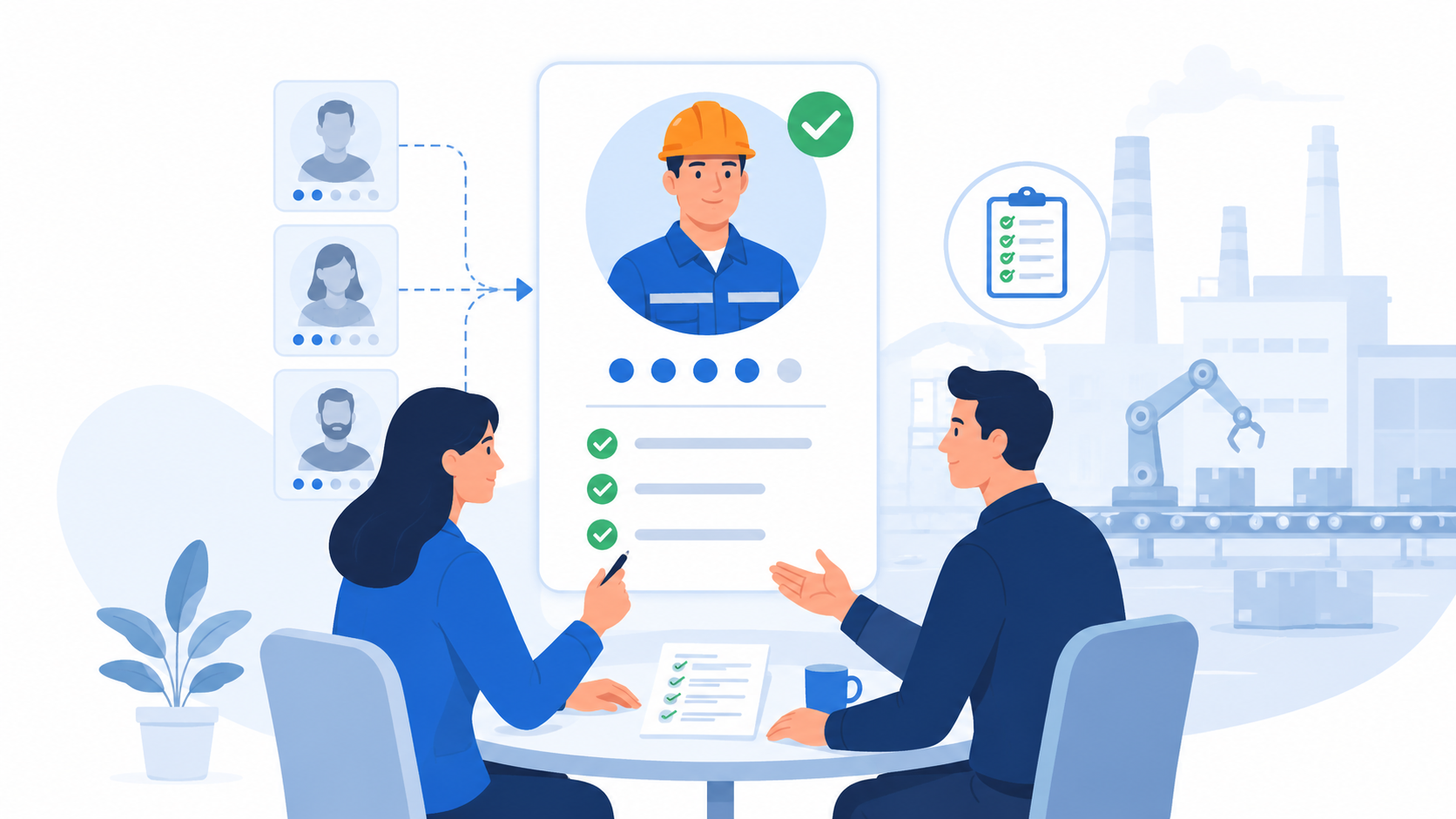
Manufacturing Candidate Screening Checklist for HR Teams

By
Lutfi Maulida
Last updated on
July 1, 2026
Key Takeaways
  • A manufacturing candidate screening checklist should help HR teams check more than CV experience, including shift fit, safety awareness, SOP discipline, and production readiness.
  • Screening criteria should change by role because line operators, warehouse workers, maintenance technicians, and quality inspectors need different readiness signals.
  • AI should support the early screening workflow, while recruiters and hiring managers remain responsible for final hiring decisions, verification, and compliance checks.

A Manufacturing Candidate Screening Checklist helps HR teams review production, warehouse, operator, technician, and quality control candidates more consistently before moving them to the next hiring stage.

Manufacturing hiring is different from many office-based roles because candidate fit is not always clear from a CV. HR teams often need to assess shift readiness, machine or tool familiarity, safety awareness, production discipline, and the ability to follow instructions.

That is why manufacturing screening should not rely only on general interview questions or basic CV checks. A stronger checklist helps HR teams screen candidates based on how manufacturing roles actually work on the floor, in the warehouse, or across production sites.

Why Manufacturing Screening Needs a Different Checklist

Manufacturing candidates can look suitable on paper but still be a poor match for the actual work environment.

A CV may show factory experience, but it may not show whether the candidate can work rotating shifts, follow safety procedures, communicate with supervisors, handle repetitive production tasks, or respond properly when a quality issue appears on the line.

That is why manufacturing candidate screening should not stop at “Do they have relevant experience?”

Recruiters need a checklist that separates:

  • basic role fit
  • shift and location readiness
  • safety awareness
  • SOP and production discipline
  • technical or machine exposure
  • teamwork and escalation habits
  • manager-review readiness

This is especially important when HR teams are hiring across production, packing, warehouse, technician, and quality roles at the same time.

KitaHQ’s manufacturing page positions the product for factory, warehouse, technician, and quality roles, with AI video interviews, bulk CV shortlisting, custom assessments, and candidate reports supporting the screening workflow before manager review.

The Manufacturing Screening Flow HR Teams Should Use

Before sending candidates to hiring managers, use the checklist in four screening layers.

Screening Layer What Recruiters Should Check Why It Matters in Manufacturing
Floor readiness Shift availability, commute, start date, physical work expectations, basic role requirements. Many manufacturing mismatches happen because the candidate cannot realistically work the required shift, site, or pace.
Safety and SOP discipline PPE awareness, hazard reporting, rule-following, escalation habits, attention to instructions. Manufacturing work depends on repeatable processes and safe behavior, not only experience.
Role-specific capability Machine exposure, packing speed, warehouse coordination, maintenance basics, QA inspection, documentation habits. Different factory roles need different screening signals.
Manager-review readiness Strengths, concerns, interview notes, candidate report, suggested follow-up areas. Hiring managers should not spend interviews repeating basic screening questions.

This flow keeps the blog practical. HR does not need to make every technical judgment alone, but recruiters should prepare enough information so manager interviews are sharper and faster.

Manufacturing Candidate Screening Checklist

Use this checklist before moving manufacturing candidates to manager interviews.

Screening Item Check
Candidate meets the basic role requirements
Candidate has relevant production, factory, warehouse, technician, or quality experience
Candidate’s location or commute is realistic for the worksite
Candidate can work the required shift pattern
Candidate is open to overtime, weekend, or peak-season work if required
Candidate’s expected salary fits the role range
Candidate’s start date matches the hiring timeline
Candidate understands basic safety expectations
Candidate can explain how they follow SOPs or work instructions
Candidate knows when to escalate production, machine, safety, or quality issues
Candidate has relevant machine, tool, warehouse, or inspection exposure if required
Candidate can communicate clearly with supervisors or team leads
Candidate shows consistency, reliability, and attention to detail
Candidate’s strengths and concerns are documented
Hiring manager receives a candidate report or interview summary before the next step
Any licence, certification, medical, background, or compliance follow-up is clearly flagged for human review

The final item matters. A screening checklist can help HR identify readiness signals, but it should not replace formal verification, site-specific safety clearance, or final hiring judgment.

Checklist by Manufacturing Role Type

Manufacturing hiring becomes weaker when every candidate is screened with the same generic questions. Use the table below to adjust the checklist based on the role.

Role Type What to Screen Before Manager Review
Line Operator
  • ☐ Can follow production instructions consistently.
  • ☐ Understands output targets without ignoring quality.
  • ☐ Can respond properly to line stoppages or defects.
  • ☐ Has realistic shift availability.
  • ☐ Knows when to report issues to a supervisor.
Packer / Sorter
  • ☐ Pays attention to product condition, labelling, and packing accuracy.
  • ☐ Can handle repetitive tasks without skipping steps.
  • ☐ Understands basic quality checks.
  • ☐ Can work at required pace.
  • ☐ Communicates packing issues clearly.
Warehouse Worker
  • ☐ Understands receiving, picking, packing, or dispatch workflow.
  • ☐ Can coordinate with production or logistics teams.
  • ☐ Follows stock handling instructions.
  • ☐ Reports discrepancies or damaged goods.
  • ☐ Has realistic availability for warehouse shifts.
Forklift Operator
  • ☐ Has required licence or certification flagged for verification.
  • ☐ Understands safe movement around people, goods, and equipment.
  • ☐ Can explain basic loading or unloading precautions.
  • ☐ Reports equipment issues properly.
  • ☐ Does not treat speed as more important than safety.
Maintenance Technician
  • ☐ Has relevant electrical, mechanical, or machine maintenance exposure.
  • ☐ Can explain troubleshooting steps clearly.
  • ☐ Understands preventive maintenance habits.
  • ☐ Knows when to escalate equipment risks.
  • ☐ Can coordinate with production teams during downtime.
Quality Inspector / QC Staff
  • ☐ Understands inspection, sampling, measurement, or defect checks.
  • ☐ Can explain what they do when production pressure conflicts with quality standards.
  • ☐ Documents findings clearly.
  • ☐ Escalates recurring defects.
  • ☐ Shows attention to detail.
Production Supervisor / Line Leader
  • ☐ Can coordinate team members during production pressure.
  • ☐ Balances output, safety, and quality.
  • ☐ Handles attendance or performance issues professionally.
  • ☐ Communicates clearly with managers and operators.
  • ☐ Understands escalation and reporting responsibilities.
Safety Officer / EHS Support
  • ☐ Understands hazard identification and incident reporting.
  • ☐ Can explain PPE expectations.
  • ☐ Knows how to communicate safety reminders without disrupting operations.
  • ☐ Flags unsafe behavior clearly.
  • ☐ Has required certification or training flagged for verification.

This section helps the article stay specific to manufacturing hiring instead of becoming a generic HR checklist.

Screening Questions HR Can Use for Manufacturing Candidates

Recruiters do not need to ask too many questions. The goal is to identify whether a candidate is worth sending to manager review.

Screening Area Example Question Strong Answer Should Show Red Flag to Watch For
Shift readiness “This role may require rotating shifts or overtime during peak production. Can you explain your availability?” Realistic schedule fit, honesty, and readiness for the role’s working pattern. Candidate gives vague availability or avoids discussing shift constraints.
Safety awareness “What would you do if you noticed a coworker skipping a safety step to save time?” Safety-first judgment, escalation awareness, and confidence to follow procedures. Candidate says they would ignore it, follow the shortcut, or avoid reporting the issue.
SOP discipline “Tell me about a time you had to follow detailed work instructions.” Ability to follow process, avoid shortcuts, and ask questions when unclear. Candidate treats SOPs as optional or focuses only on speed.
Production judgment “If output targets are high but defects are increasing, what would you do first?” Quality awareness, problem-solving, and willingness to involve the right team. Candidate prioritizes output without checking quality, safety, or root cause.
Team communication “How do you usually report problems to a supervisor or team lead?” Clear communication, documentation habits, and escalation discipline. Candidate cannot explain how they report issues or waits until the problem becomes serious.
Technical exposure “What machines, tools, warehouse systems, or inspection methods have you used before?” Relevant hands-on exposure without overstating capability. Candidate claims broad experience but cannot explain what they actually used.
Reliability “What helps you stay consistent during repetitive or physically demanding work?” Realistic understanding of manufacturing work and self-management. Candidate shows little awareness of pace, repetition, attendance, or physical expectations.

These questions are useful because they do not only confirm experience. They reveal how the candidate thinks in real manufacturing situations.

What AI Candidate Screening Can Help With

AI candidate screening is useful when HR teams need to review many manufacturing candidates before manager interviews.

For manufacturing roles, it can help recruiters apply the same checklist more consistently across candidates.

1. Review CVs against manufacturing role criteria

AI resume screening can help recruiters review manufacturing CVs against role criteria such as factory experience, machine exposure, warehouse background, quality inspection, shift history, and location fit.

KitaHQ’s AI resume screening page positions the tool around high-volume screening and role-based CV scoring, not only keyword matching.

2. Ask consistent role-specific questions

AI video interviews can help recruiters ask the same screening questions to every candidate applying for the same role. This is useful when hiring across multiple plants, shifts, or locations.

For example, all line operator candidates can be asked the same safety, SOP, and production-pressure questions before manager review. With AI video interviews, candidates can complete the same structured first-round questions on their own time, without live scheduling. Recruiters can then review responses more consistently before deciding who should move forward. 

3. Assess practical responses, not only CV claims

Manufacturing screening should not rely only on written experience. A candidate may list “machine operation” on a CV, but recruiters still need to understand how the candidate communicates, follows instructions, and responds to floor issues.

KitaHQ’s AI interview assessment supports role-specific questions and evaluation criteria, which fits structured manufacturing screening. For example, manufacturing and technical teams such as PT SCG Indonesia and PT Benderang Hidup Indonesia have used KitaHQ to support role-specific screening before recruiter or manager review. 

4. Prepare better candidate reports for hiring managers

Candidate reports help hiring managers review summaries, scores, strengths, concerns, transcripts, and recordings before the next interview. This helps manager interviews focus on validation instead of repeating basic screening.

KitaHQ’s candidate analytics helps hiring teams review candidate summaries, side-by-side comparisons, strengths, concerns, transcripts, and recordings before deciding who should move to the next step. 

5. Reduce repetitive screening admin

When candidate volume is high, recruiters can lose time sending reminders, arranging interviews, and moving candidates between stages manually. AI resume screening helps review CVs against role criteria, while recruitment automation helps with repetitive follow-ups such as interview invites, reminders, re-invites, rejection messages, and hiring manager handoffs. 

The goal is not fully automated hiring. The goal is to make early candidate information easier to collect, compare, and review.

For example, manufacturing and technical teams such as PT SCG Indonesia and PT Benderang Hidup Indonesia have used KitaHQ to support role-specific screening before recruiter or manager review. 

See also: Is AI Recruitment Software Fair for Candidate Screening?

What to Send Hiring Managers Before the Next Interview

Before moving a manufacturing candidate forward, recruiters should prepare a short handoff that helps hiring managers validate the right things instead of repeating the first screen.

A useful handoff can include:

Handoff Item What to Include
Role fit summary Relevant factory, warehouse, technician, or quality experience.
Shift and site readiness Availability, commute, start date, overtime or weekend readiness if required.
Safety and SOP signals How the candidate responded to safety, escalation, and work-instruction questions.
Role-specific strengths Machine exposure, inspection habits, warehouse coordination, maintenance basics, or team leadership signals.
Concerns to validate Gaps, unclear answers, verification needs, or areas the hiring manager should probe.
Screening record Candidate report, interview summary, transcript, recording, or notes for recruiter and hiring manager review.

This keeps the manager interview focused on technical validation, team fit, and final judgment. It also makes clear that the screening checklist supports human review rather than replacing it.

Final Manufacturing Screening Review Before Manager Interviews

Before sending a candidate to the hiring manager, use this final review.

Final Review Item Ready?
Candidate meets the basic role requirements Yes / No
Candidate’s shift availability matches the role Yes / No
Candidate’s commute or location is realistic Yes / No
Candidate has relevant factory, warehouse, technician, or quality exposure Yes / No
Candidate answered role-specific screening questions Yes / No
Candidate showed safety and SOP awareness Yes / No
Candidate can communicate issues clearly to supervisors or team leads Yes / No
Candidate’s strengths and concerns are documented Yes / No
Hiring manager has a candidate report, transcript, recording, or summary Yes / No
Any verification or compliance follow-up is clearly flagged Yes / No

If most answers are “yes,” the manager interview can focus on technical validation, team fit, and final judgment.

If several answers are “no,” the recruiter may need another screening step before moving the candidate forward.

How KitaHQ Supports Manufacturing Candidate Screening

For HR teams hiring factory, warehouse, technician, or quality roles, KitaHQ helps make the screening process more structured before candidates reach hiring managers.

As manufacturing recruitment software, KitaHQ supports recruiters with AI candidate screening to review CVs against role criteria, run AI video interviews without live scheduling, assess responses using role-specific rubrics, and prepare candidate reports for hiring manager review.

This can be especially useful when manufacturing teams deal with:

  • high applicant volume for similar roles
  • urgent shift or production hiring needs
  • multiple factory or warehouse locations
  • repeated screening questions
  • hiring managers who need clearer candidate summaries before interviews

KitaHQ does not replace final hiring decisions, licence checks, employment verification, or site-specific compliance review. Instead, it helps HR teams organize early screening information so recruiters and hiring managers can review candidates with more clarity.