




Screen hospital and clinic roles with repeat hiring cycles.
Healthcare Recruitment Software for Medical Teams
Healthcare recruitment software for clinical, care, and patient-facing roles, combining AI resume screening, AI video interviews, and role-based assessments to find qualified healthcare candidates faster.
Built for hospitals, clinics, and healthcare companies


Where Healthcare Hiring Breaks
Healthcare hiring is about more than experience. Teams need to know if
candidates are ready for the care setting, patient type, shift, and daily workflow.
candidates are ready for the care setting, patient type, shift, and daily workflow.
.svg)
Slow Clinical Review
Healthcare managers often have limited time to review every candidate, causing shortlisting delays when roles need to be filled quickly.

Hidden Patient Skills
Empathy, clear communication, escalation judgment, and patient-safety awareness are critical in healthcare, but rarely appear clearly in a CV.
.svg)
Mixed Clinical Criteria
Different healthcare roles need different screening signals. A nurse, lab technician, caregiver, and patient service officer cannot be assessed with one generic template.
.svg)
Unclear Care Readiness
Healthcare CVs may show experience, but not whether candidates are ready for the actual care setting, patient type, shift pattern, or clinical workflow.
Where KitaHQ Fits in the Healthcare Hiring Process
KitaHQ helps healthcare teams screen candidates earlier, so managers can review role-fit profiles before
clinical interviews.
clinical interviews.

1
Sourcing and Applications
Post job through job boards, referral, career pages, or other applicant sources.

2
Early-Stage Screening
KitaHQ screens resumes, runs AI interviews, assesses candidate responses, and prepares clear reports for review.
.avif)

3
Manager Interviews and Selection
Hiring teams review shortlisted candidates and decide who should get hired.

4
Offer and Onboarding
Manage offers, contracts, employee records, and onboarding through your existing system.
AI Resume Screening for Healthcare Recruitment
Use AI resume screening to reduce unclear care readiness by reviewing candidate profiles against
healthcare role criteria.
healthcare role criteria.

Screen by Care Setting
AI resume screening reviews healthcare candidates based on each role, care setting, and custom criteria, helping teams shortlist qualified candidates faster.

Customize Screening Criteria
Recruiters can customize screening criteria by role, so each healthcare candidate is reviewed against different signals before interviews, helping teams reduce generic shortlisting.
AI Video Interviews for Healthcare Candidate Screening
Use AI video interviews to uncover patient communication, escalation judgment, and role
readiness signals that often do not appear clearly in healthcare CVs.
readiness signals that often do not appear clearly in healthcare CVs.

No Interview Scheduling
Let nurses, caregivers, clinic staff, and patient-facing candidates complete first-round AI video interviews on their own time without manually scheduling screening calls.

Role-Specific Questions
Generate healthcare screening questions from the role title or job description, then adjust them for nurses, caregivers, lab staff, pharmacists, or patient service roles.

Patient-Facing Skill Signals
Assess how candidates explain care situations, communicate with patients, handle pressure, and respond when instructions are unclear or safety concerns appear.
What Healthcare Candidates Can Be Assessed On
Healthcare recruitment software helps recruiters assess multiple criteria based on each role, care
setting, and hospital or clinic hiring needs.
setting, and hospital or clinic hiring needs.
Care Readiness
Assess whether candidates understand the care setting, patient type, daily responsibilities, shift expectations, and work pace required for the role.
Healthcare Workflow Discipline
Assess how candidates follow care routines, documentation steps, patient flow, or clinic procedures within structured healthcare workflows.
Patient Communication
Assess baseline confidentiality and ethics needed to handle sensitive patient scenarios.
Clinical Escalation Judgment
Understand whether candidates know when to act, when to ask for help, and when to escalate unclear, unsafe, or sensitive situations.
Patient Safety Awareness
Review whether candidates can explain safe, careful, and responsible actions when patient impact, medication, samples, or sensitive information may be involved.
Healthcare Role Fit
Customize criteria for different healthcare roles, such as nurse, lab technician, caregiver, pharmacy assistant, clinic admin, or ward support staff.
Example Healthcare Screening Questions
Use role-specific questions to assess care experience, patient communication, and healthcare judgment.
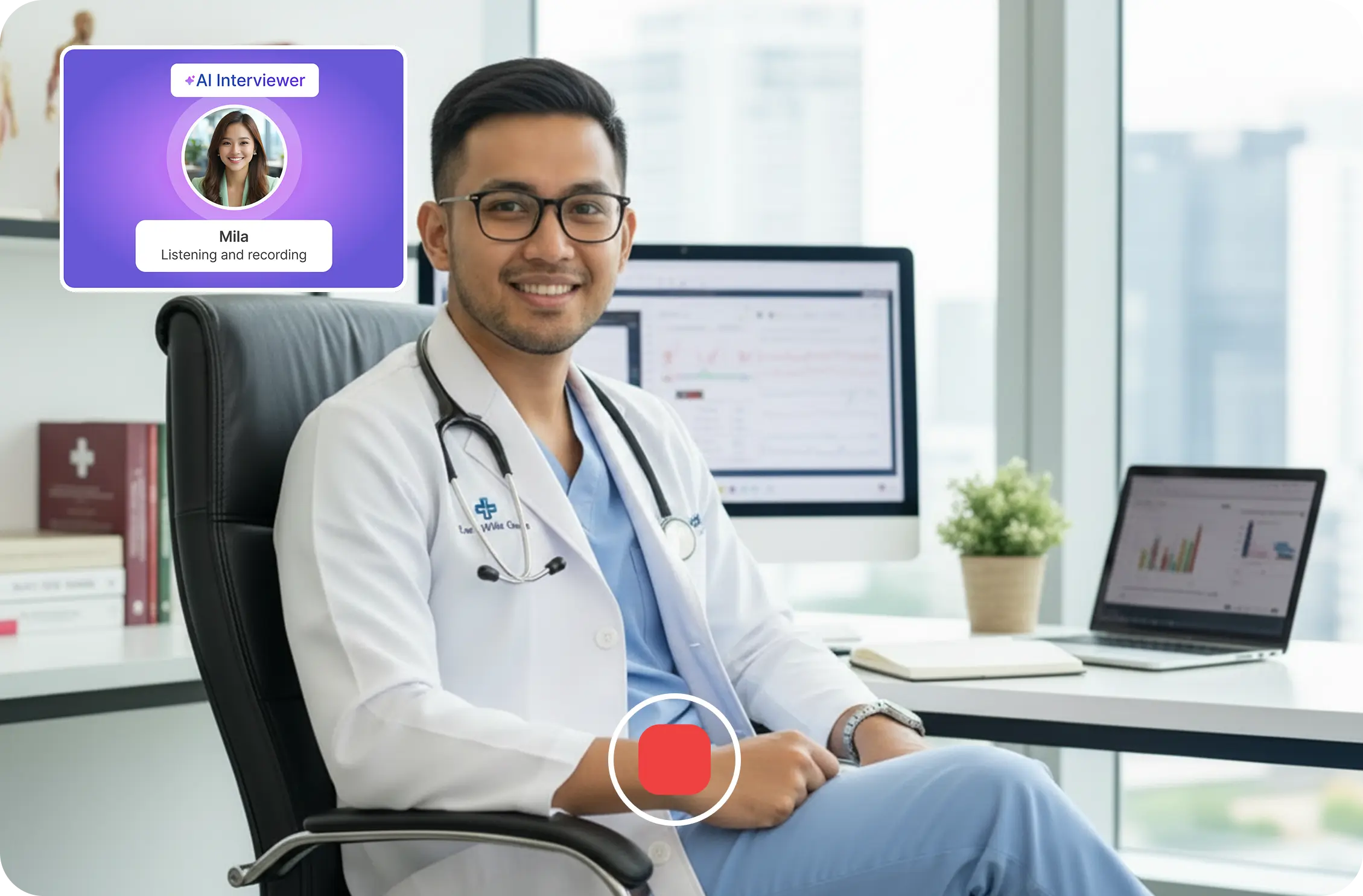
Role: General Practitioner
QUESTION
“Tell us about a time you had to explain a treatment plan or next step to a patient who was worried or confused.”

Transcript
REAL-TIME ANALYSIS
AI Interview:
12:45
“Tell us about a time you had to explain a treatment plan or next step to a patient who was worried or confused.”
Candidate
13:02
“I listened first to understand what the patient was worried about. Then I explained the next steps in simple language and checked whether they understood before continuing.”
Candidate
13:05
“I also explained when they should come back, what symptoms to watch for, and when the case should be escalated or reviewed again.”

SKILLS ASSESSED
Patient communication
Care readiness
Escalation judgment
Clinical workflow

Bad signal
- Gives vague explanations without clear patient communication
- Does not mention when the case should be escalated
- Focuses only on diagnosis without checking patient understanding

Good signal
- Explains medical information in simple, patient-friendly language
- Checks whether the patient understands the next steps
- Knows when to escalate, review, or recommend further care

Role: Midwife
QUESTION
“Tell us about a time you supported a mother or patient while staying alert to signs that needed escalation.”
Transcript
REAL-TIME ANALYSIS
AI Interview:
12:45
“Tell us about a time you supported a mother or patient while staying alert to signs that needed escalation.”
Candidate
13:02
“I tried to keep the mother calm while observing her condition carefully. I explained what I was doing and made sure she understood the next steps.”
Candidate
13:05
““When I noticed a concern that needed further review, I informed the senior clinician and followed the clinic’s escalation process.”
SKILLS ASSESSED
Patient empathy
Maternal care readiness
Escalation judgment
Bad signal
- Focuses only on being friendly without explaining patient safety steps
- Does not mention observation, warning signs, or escalation
- Gives unclear answers about handling worried mothers or patients
Good signal
- Shows empathy while staying alert to patient condition
- Explains next steps calmly and clearly to the patient
- Knows when to involve a senior clinician or doctor
Candidate Reports for Healthcare Hiring Managers
Give healthcare managers structured candidate reports before interviews, so they can review readiness signals faster and focus on the candidates who need deeper evaluation.

Screening Summary
Review a clear summary of the candidate’s answers, role readiness, communication style, and areas that may need follow-up.
Transcript and Recording
Review candidate answers and recordings when managers need more context about patient communication, escalation judgment, or healthcare role readiness.
Candidate Fit Signal
See which candidates show stronger signals for the role, care environment, communication style, and healthcare-specific situations that require closer human review.
Candidate Shortlist
Compare candidates across the same healthcare screening criteria before sharing stronger shortlists with hospital, clinic, or care team managers.
Features That Make Healthcare Screening Easier
Healthcare recruitment software helps teams screen candidates faster while keeping recruiters and
healthcare managers in control.
healthcare managers in control.
Role-Based Healthcare Questions
Create screening questions for different healthcare roles, such as nurses, lab technicians, caregivers, patient service officers, or clinic admins.

Simultaneous AI Interviews
Let multiple healthcare candidates complete AI video interviews at the same time, without recruiters running every first-round call one by one.
Bulk Interview Invites
Send interview invitations to many candidates through WhatsApp and email, so recruiters do not need to message each applicant manually.

No Scheduling Hassle
Candidates can complete interviews on their own time, while recruiters and healthcare managers review responses after the interview is submitted.
Recruitment Automation in
Healthcare Candidate Screening
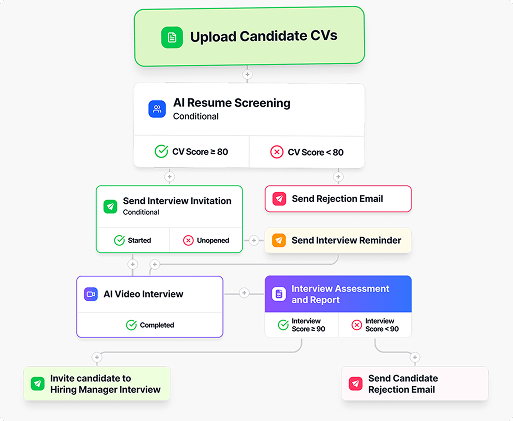
Automate early-stage healthcare screening steps, from candidate
invites and reminders to role-based assessment and manager handoff.
invites and reminders to role-based assessment and manager handoff.
Healthcare Teams Screen Faster with KitaHQ
KitaHQ's healthcare recruitment software helps healthcare teams screen candidates faster and reduce manual hiring tasks.
Used by Healthcare and Business Teams in Real Hiring Workflows
From hospitals to clinics and healthcare providers, KitaHQ helps healthcare teams automate first-round screening and speed up candidate reviews.

Featured

Business Healthcare Sales Hiring
Screen healthcare business associates and sales trainees before interviews.
Featured

Doctor & General Practitioner Hiring
Evaluate doctors and general practitioners with structured screening before interviews.
Featured

Telemedicine Hiring
Recruit telemedicine doctors, specialists, and virtual healthcare professionals more efficiently.
Featured

Infant Care Hiring
Screen pediatric nurses, caregivers, and infant care specialists with a consistent hiring process.

Sales
How Juara Gadai Reduced Time-to-Hire to
2 Days

Juara Gadai used KitaHQ to automate resume screening, AI video interviews, and behavioral assessments, reducing time-to-hire from 5-7 days to just 2 days.

Reduced time-to-hire from 5–7 days to 2 days
Increased interview capacity 6×
Processed 400+ candidates per month with one recruiter
"Before using KitaHQ, screening took a lot of time, interviews were limited, and our evaluation of behavioral fit was still not objective enough."

Angela Gabriella
Senior HR Recruiter, Juara Gadai
Where KitaHQ Fits in Your Hiring Workflow
AI recruitment tools for sales improve high-volume efficiency and keep experts focused on critical decisions.
Fit Cases to
Use KitaHQ

Hiring surges where scheduling first rounds becomes the bottleneck.
Multi-location healthcare hiring needing consistent early screening.
Telehealth teams screening clinicians for remote judgement.
Where Humans Are
Still Required
- Professional registration, license, and certification verification
- Clinical competency and practical skills assessments
- Reference and employment verification
- Final interviews and hiring decisions
How Healthcare Teams Reduce Screening Bottlenecks
Move from manual healthcare candidate screening to a more consistent early-stage review
process before clinical or operations managers spend time in interviews.
process before clinical or operations managers spend time in interviews.

Before Using KitaHQ

Recruiters review every healthcare CV manually

First-round screening takes too much recruiter time

Healthcare managers receive shortlists with limited context

Different roles are screened with generic criteria

Patient-facing skills are found too late

After Using KitaHQ

AI resume screening surfaces stronger profile matches earlier

Candidates complete AI video interviews on their own time

Candidate reports give managers clearer review context

Each healthcare role uses more relevant screening criteria

Readiness signals are reviewed before manager interviews

Looking for Other Hiring Solutions?




Scale Your Healthcare Staffing Effortlessly
Standardize clinical first-rounds and eliminate repetitive screening for every healthcare partner.
Schedule Your Call
Healthcare Recruitmen Software FAQs
Is this a fit for our healthcare hiring?
Fits high-volume or repeatable roles (nurses, clinic support, telehealth clinicians, junior ops leads). Not designed for executive hiring or final-stage decisions.
What do hiring managers actually receive?
Structured scores tied to a hiring scorecard, interview transcript, recording, and a short structured summary, so managers don’t repeat first-round screens.
Where does this sit in the hiring process?
After applications and before hiring manager interviews, replacing most first-round screens for repeatable roles.
What still requires humans or other systems?
License/certification verification, sanctions and fraud checks, employment validation, final decisions.
What is the most common failure case?
When answers become scripted, scoring criteria are vague, or managers don’t trust the scoring. Prevent it with scenario prompts, clear pass/borderline/fail definitions, and regular calibration.
Can this screen telehealth clinicians without overpromising?
Yes, if you focus on early signals like remote reasoning, escalation judgement, confidentiality judgement, and communication clarity. It should not replace clinician-led technical rounds.