%20(1).png)
July 1, 2026
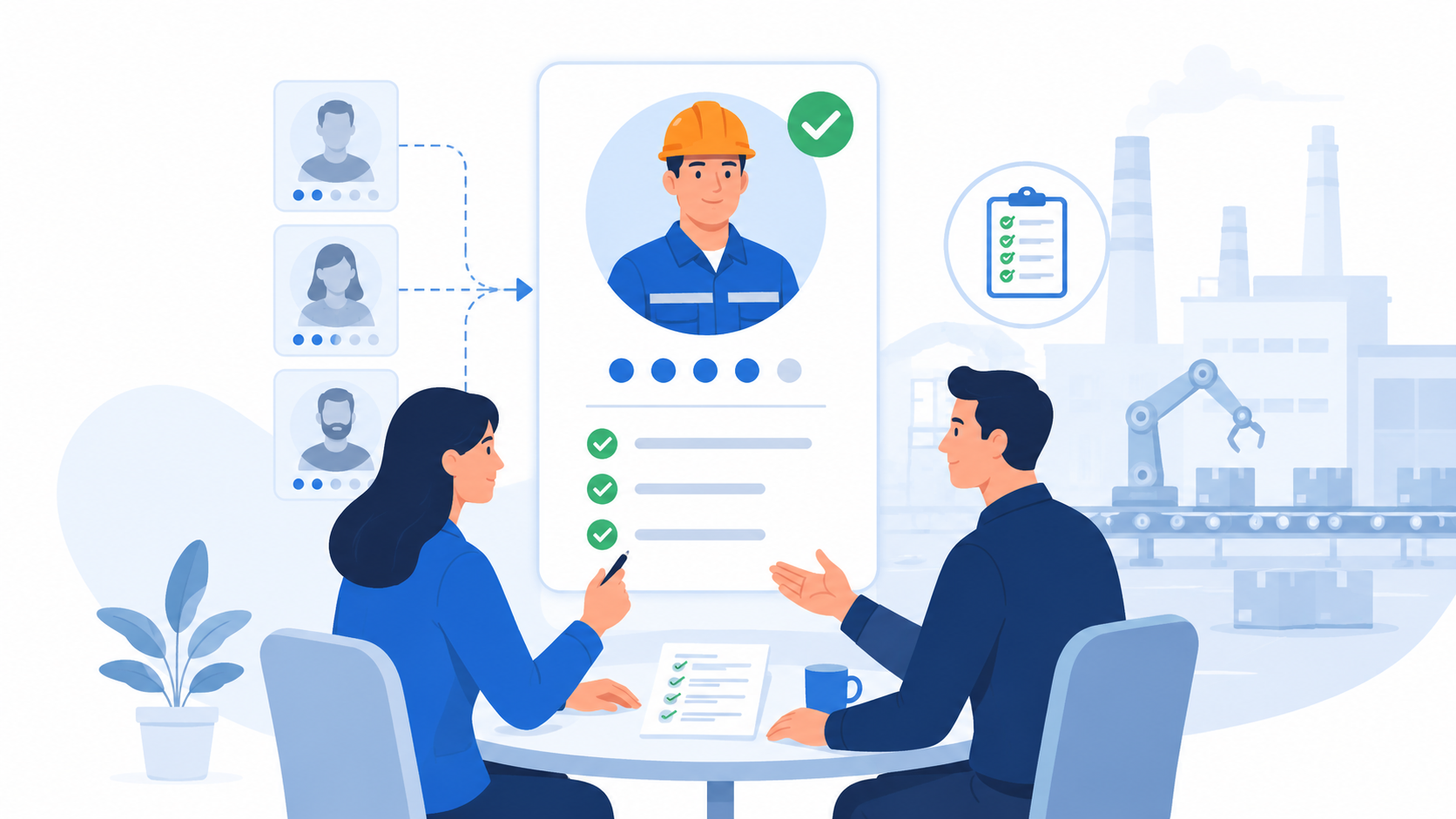
Manufacturing Candidate Screening Checklist for HR Teams
Use this manufacturing candidate screening checklist to review shift fit, safety awareness, SOP discipline, role readiness, and manager handoffs.
.png)

Hiring for hospitality roles is rarely just about finding people with experience.
A front desk candidate may have worked in a hotel before but still struggle with a frustrated guest. A server may sound confident but fail to prioritize during peak hours. A room attendant may understand the task list but miss the urgency of preparing rooms before check-in.
That is why hospitality candidate assessment needs to go beyond CVs and generic interview questions.
Recruiters need a way to understand how candidates communicate, solve service problems, follow procedures, handle pressure, and work across shifts. This is especially important when hiring for hotels, resorts, restaurants, event venues, leisure businesses, and guest-facing operations where service quality depends on daily behavior.
This guide explains how to assess hospitality candidates well, what criteria to use, which questions to ask, and which tools can help make the process more consistent.
A useful hospitality candidate assessment should focus on six areas.
The goal is not to find a perfect candidate. The goal is to separate candidates who can realistically perform in the role from candidates who only interview well.
A practical assessment process can follow this flow:
How to Match Each Assessment to the Right Hiring Stage
This helps recruiters avoid two common problems: moving candidates forward based only on gut feel, or making managers repeat the same early questions again and again.
For high-volume hospitality teams, AI candidate screening and AI video interviews can support the earlier stages of this process. KitaHQ, for example, supports AI video interviews where candidates can complete interviews on their own time, and recruiters can review scores, summaries, transcripts, and recordings after the interview. Recruiters and hiring managers still decide who moves forward.
Use a scorecard to make candidate evaluation more consistent across recruiters, branches, and hiring managers.
Here is a simple version:
This scorecard should be adapted by role. A room attendant, front desk officer, event crew member, and F&B server should not be assessed with exactly the same criteria.
For front desk and guest services roles, assess how candidates handle guest conversations, booking issues, complaints, and unclear requests.
Useful criteria:
Sample question:
“A guest arrives and says their booking cannot be found, but they are sure they already paid online. What would you do first?”
Strong answers usually include staying calm, checking details, asking for confirmation, explaining the next step clearly, and escalating when needed.
Weak answers often sound defensive, blame the system, or fail to explain how the guest will be supported while the issue is checked.
For housekeeping roles, assessment should focus on detail, speed, room-readiness standards, guest impact, and reporting.
Useful criteria:
Sample question:
“You find a room issue during final inspection, but the guest is expected to check in soon. What would you do in the next 10 minutes?”
Strong answers mention reporting the issue, updating the supervisor or front office, following room-readiness standards, and avoiding silent delays.
Weak answers may focus only on finishing the task without communicating the issue.
For F&B roles, candidates need to handle guests, orders, timing, teamwork, and pressure during busy hours.
Useful criteria:
Sample question:
“A guest says their order is wrong during a busy shift, while another table is waiting to be served. How would you handle the situation?”
Strong answers show calm communication, apology where appropriate, quick confirmation, team coordination, and awareness of both guests.
Weak answers either ignore the complaint or focus only on one guest while losing control of the wider service flow.
For event and venue roles, assessment should focus on crowd flow, guest direction, coordination, and fast escalation.
Useful criteria:
Sample question:
“A guest cannot find their assigned seat just before the event starts and is becoming frustrated. Walk me through how you would handle the situation.”
Strong answers usually include checking the ticket, guiding the guest clearly, staying calm, coordinating with the venue team, and avoiding disruption to the event.
Weak answers may be too vague or fail to explain what they would do under time pressure.
Different tools help at different stages of the hiring process. The best setup is usually not one tool alone, but a structured workflow.
KitaHQ fits in the early-stage screening part of this workflow. Hospitality teams can use AI resume screening to review candidate profiles against role criteria, AI video interviews to collect structured answers without live scheduling, and AI interview assessment to evaluate service judgment, communication, reliability, and role readiness against consistent criteria.
After the interview, candidate reports give recruiters and hiring managers summaries, transcripts, recordings, strengths, concerns, and follow-up areas before deciding who moves forward.
Hospitality workflow example: TGV Cinemas used KitaHQ to support screening for guest-facing and cinema operations roles, helping recruiters review service communication and shift-fit signals before manager review.
Initia Group also used KitaHQ to screen restaurant, hospitality, and management trainee candidates on service judgment, operational readiness, and communication before manager review.
These examples show how structured screening can help hospitality recruiters review service communication, shift-fit signals, and role readiness before manager review. They should not be read as a promise of hiring outcomes.
These examples are relevant because hospitality assessment often depends on the same early-stage signals: how candidates communicate, handle service situations, and fit shift-based operations before manager time is spent.
For teams hiring across hotels, venues, restaurants, and guest-facing operations, KitaHQ’s hospitality recruitment software and candidate reports can support a more consistent early-stage review workflow.
See also: How to Improve Your Candidate Screening Process: 10 Practical Ways
Before choosing any assessment tool, ask these questions:
KitaHQ’s candidate analytics feature supports candidate summaries, rubric-based scoring, strengths and concerns, transcripts, recordings, and shareable reports for hiring team review. This makes it more suitable for structured review than for replacing manager judgment.
Assessment tools become more useful when:
Use KitaHQ when the main problem is early-stage hospitality candidate screening at scale. Do not position it as a replacement for hiring manager judgment, final interviews, or required verification.
In these situations, AI candidate screening and AI video interviews can help recruiters collect more structured candidate information before manager interviews.
For hospitality teams, the goal is not to add more steps to the hiring process. The goal is to make early screening clearer before manager interviews.
KitaHQ can help by supporting resume screening, AI video interviews, role-specific interview assessment, and candidate reports for recruiter and hiring manager review.
A strong hospitality candidate assessment process should be practical, role-specific, and consistent.
Rather than relying only on broad personality questions or CV information, recruiters need to understand how candidates respond to real guest interactions, busy shifts, service issues, and team-based situations.
This helps hiring teams evaluate communication skills, service judgment, pressure handling, reliability, teamwork, and overall role readiness more accurately.
Using hospitality recruitment software can make this process more structured, especially when hiring needs increase across multiple roles or locations.
The goal is not to replace human judgment, but to give recruiters and hiring managers clearer candidate data, more consistent evaluation criteria, and a more efficient way to decide which candidates should move forward.
With KitaHQ, hospitality teams can manage candidate assessment more effectively, streamline recruitment workflows, and make better hiring decisions based on structured information rather than scattered notes or inconsistent screening processes.
.avif)
KitaHQ is an AI hiring software that helps teams screen faster, run AI video interviews, and evaluate candidates consistently.