%20(1).png)
July 1, 2026
Manufacturing Candidate Screening Checklist for HR Teams
Use this manufacturing candidate screening checklist to review shift fit, safety awareness, SOP discipline, role readiness, and manager handoffs.
.png)
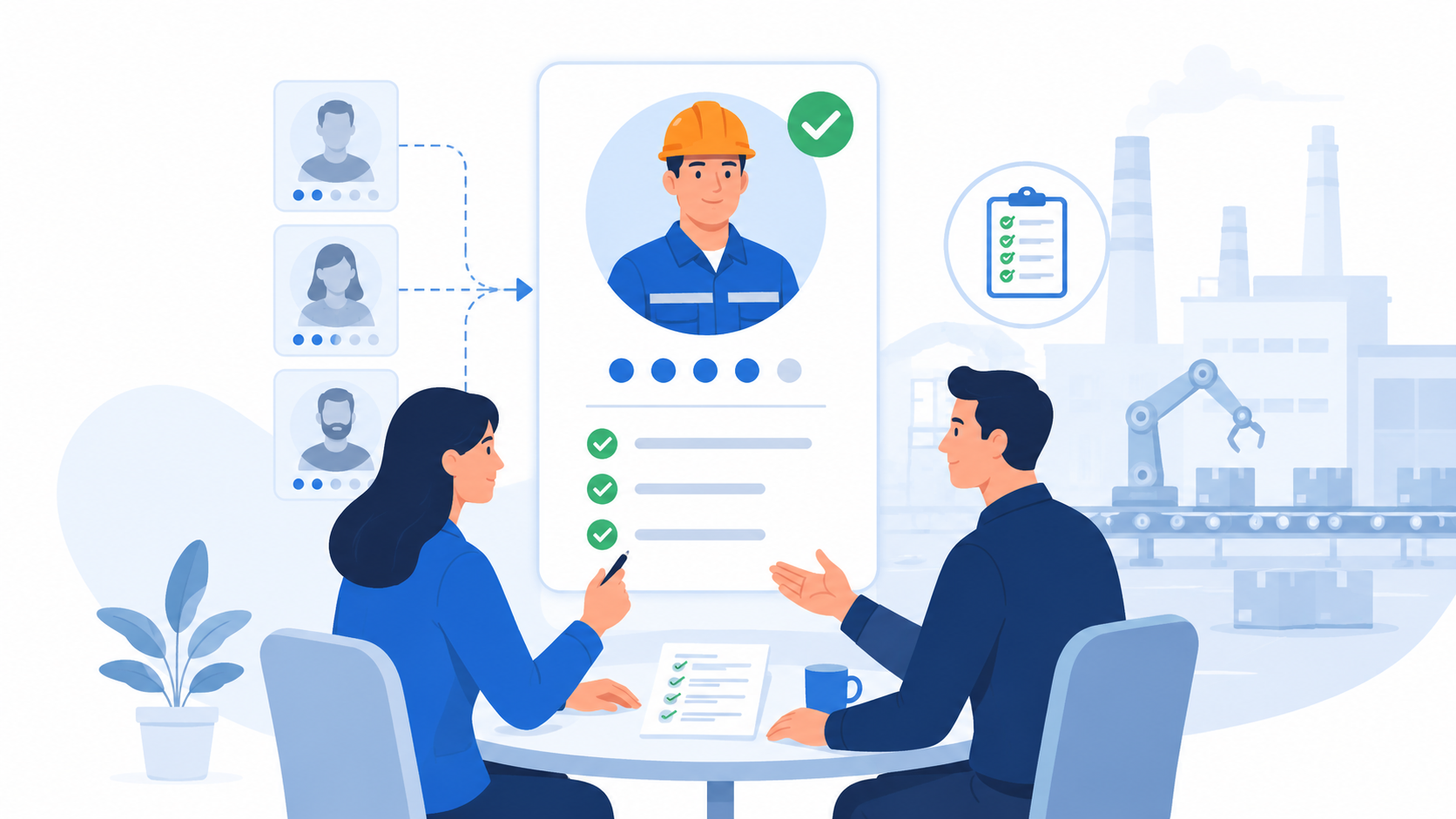
A Manufacturing Candidate Screening Checklist helps HR teams review production, warehouse, operator, technician, and quality control candidates more consistently before moving them to the next hiring stage.
Manufacturing hiring is different from many office-based roles because candidate fit is not always clear from a CV. HR teams often need to assess shift readiness, machine or tool familiarity, safety awareness, production discipline, and the ability to follow instructions.
That is why manufacturing screening should not rely only on general interview questions or basic CV checks. A stronger checklist helps HR teams screen candidates based on how manufacturing roles actually work on the floor, in the warehouse, or across production sites.
Manufacturing candidates can look suitable on paper but still be a poor match for the actual work environment.
A CV may show factory experience, but it may not show whether the candidate can work rotating shifts, follow safety procedures, communicate with supervisors, handle repetitive production tasks, or respond properly when a quality issue appears on the line.
That is why manufacturing candidate screening should not stop at “Do they have relevant experience?”
Recruiters need a checklist that separates:
This is especially important when HR teams are hiring across production, packing, warehouse, technician, and quality roles at the same time.
KitaHQ’s manufacturing page positions the product for factory, warehouse, technician, and quality roles, with AI video interviews, bulk CV shortlisting, custom assessments, and candidate reports supporting the screening workflow before manager review.
Before sending candidates to hiring managers, use the checklist in four screening layers.
This flow keeps the blog practical. HR does not need to make every technical judgment alone, but recruiters should prepare enough information so manager interviews are sharper and faster.
Use this checklist before moving manufacturing candidates to manager interviews.
The final item matters. A screening checklist can help HR identify readiness signals, but it should not replace formal verification, site-specific safety clearance, or final hiring judgment.
Manufacturing hiring becomes weaker when every candidate is screened with the same generic questions. Use the table below to adjust the checklist based on the role.
This section helps the article stay specific to manufacturing hiring instead of becoming a generic HR checklist.
Recruiters do not need to ask too many questions. The goal is to identify whether a candidate is worth sending to manager review.
These questions are useful because they do not only confirm experience. They reveal how the candidate thinks in real manufacturing situations.
AI candidate screening is useful when HR teams need to review many manufacturing candidates before manager interviews.
For manufacturing roles, it can help recruiters apply the same checklist more consistently across candidates.
1. Review CVs against manufacturing role criteria
AI resume screening can help recruiters review manufacturing CVs against role criteria such as factory experience, machine exposure, warehouse background, quality inspection, shift history, and location fit.
KitaHQ’s AI resume screening page positions the tool around high-volume screening and role-based CV scoring, not only keyword matching.
2. Ask consistent role-specific questions
AI video interviews can help recruiters ask the same screening questions to every candidate applying for the same role. This is useful when hiring across multiple plants, shifts, or locations.
For example, all line operator candidates can be asked the same safety, SOP, and production-pressure questions before manager review. With AI video interviews, candidates can complete the same structured first-round questions on their own time, without live scheduling. Recruiters can then review responses more consistently before deciding who should move forward.
3. Assess practical responses, not only CV claims
Manufacturing screening should not rely only on written experience. A candidate may list “machine operation” on a CV, but recruiters still need to understand how the candidate communicates, follows instructions, and responds to floor issues.
KitaHQ’s AI interview assessment supports role-specific questions and evaluation criteria, which fits structured manufacturing screening. For example, manufacturing and technical teams such as PT SCG Indonesia and PT Benderang Hidup Indonesia have used KitaHQ to support role-specific screening before recruiter or manager review.
4. Prepare better candidate reports for hiring managers
Candidate reports help hiring managers review summaries, scores, strengths, concerns, transcripts, and recordings before the next interview. This helps manager interviews focus on validation instead of repeating basic screening.
KitaHQ’s candidate analytics helps hiring teams review candidate summaries, side-by-side comparisons, strengths, concerns, transcripts, and recordings before deciding who should move to the next step.
5. Reduce repetitive screening admin
When candidate volume is high, recruiters can lose time sending reminders, arranging interviews, and moving candidates between stages manually. AI resume screening helps review CVs against role criteria, while recruitment automation helps with repetitive follow-ups such as interview invites, reminders, re-invites, rejection messages, and hiring manager handoffs.
The goal is not fully automated hiring. The goal is to make early candidate information easier to collect, compare, and review.
For example, manufacturing and technical teams such as PT SCG Indonesia and PT Benderang Hidup Indonesia have used KitaHQ to support role-specific screening before recruiter or manager review.
See also: Is AI Recruitment Software Fair for Candidate Screening?
Before moving a manufacturing candidate forward, recruiters should prepare a short handoff that helps hiring managers validate the right things instead of repeating the first screen.
A useful handoff can include:
This keeps the manager interview focused on technical validation, team fit, and final judgment. It also makes clear that the screening checklist supports human review rather than replacing it.
Before sending a candidate to the hiring manager, use this final review.
If most answers are “yes,” the manager interview can focus on technical validation, team fit, and final judgment.
If several answers are “no,” the recruiter may need another screening step before moving the candidate forward.
For HR teams hiring factory, warehouse, technician, or quality roles, KitaHQ helps make the screening process more structured before candidates reach hiring managers.
As manufacturing recruitment software, KitaHQ supports recruiters with AI candidate screening to review CVs against role criteria, run AI video interviews without live scheduling, assess responses using role-specific rubrics, and prepare candidate reports for hiring manager review.
This can be especially useful when manufacturing teams deal with:
KitaHQ does not replace final hiring decisions, licence checks, employment verification, or site-specific compliance review. Instead, it helps HR teams organize early screening information so recruiters and hiring managers can review candidates with more clarity.
.avif)
KitaHQ is an AI hiring software that helps teams screen faster, run AI video interviews, and evaluate candidates consistently.