%20(1).png)

August 6, 2026
Ecommerce Hiring Process: A Practical Guide to Building a Team That Can Scale
Build a stronger ecommerce hiring process with eight practical steps for defining roles, screening candidates, running interviews, and scaling responsibly.
.avif)
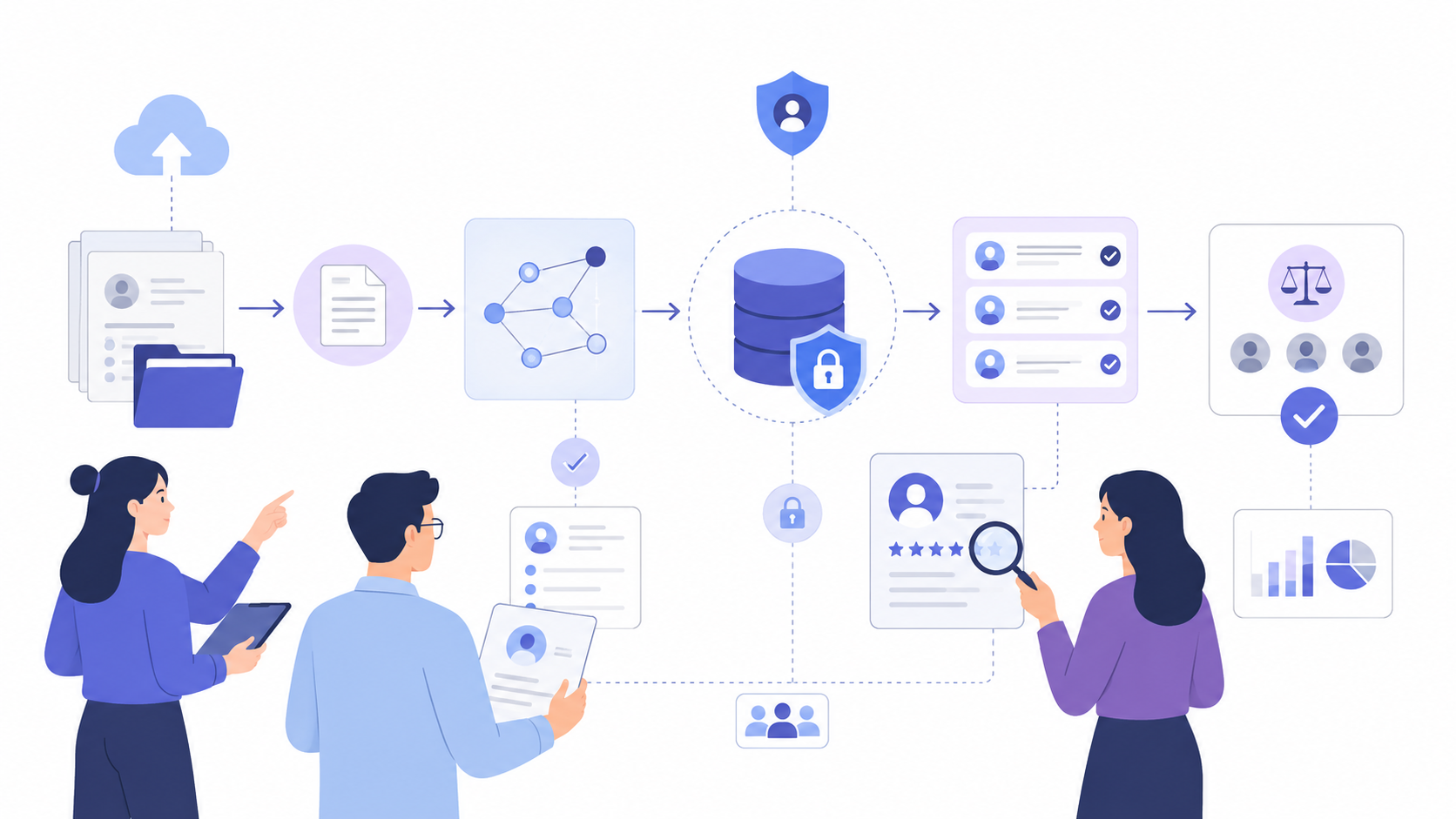
When hiring teams use AI recruitment software, candidate data does not simply “go into AI.” It moves through a workflow: resumes are uploaded, interview responses may be collected, reports are generated, and recruiters or hiring managers review the results.
That makes candidate data handling one of the most important questions to ask before choosing a platform. The issue is not only whether a tool is fast. The issue is whether your team understands what data is collected, how it is processed, what outputs are created, who can access them, and how long they are retained.
This article explains what usually happens to candidate data inside AI recruitment software and what recruiters should check before using it in an early-stage screening process.
Candidate data can enter AI recruitment software from different points in the hiring workflow. The most common inputs include:
Not every platform collects all of these. A resume screening tool may mainly process CV data. An AI video interview platform may process video, audio, transcripts, and response summaries. A recruitment automation platform may process workflow status, invitation history, reminders, and handoff rules.
The important point is simple: buyers should not treat “candidate data” as one thing. They should map each type of data to the workflow step where it is collected and used.
See also: AI Recruitment Software vs Applicant Tracking System: Which One Do You Actually Need?
A practical way to understand candidate data is to follow it through the screening workflow.
This lifecycle is more useful than asking only, “Is the tool secure?” Security matters, but candidate trust also depends on transparency, purpose limitation, access control, retention, and human review.
See also: Top AI Recruiting Tools in 2026: From Sourcing to Screening
The biggest risks are usually not mysterious. They come from unclear data practices.
This is where AI recruitment software evaluation should become specific. A vendor does not need to answer only “yes, we are secure.” They should be able to explain how candidate data moves through the system and what controls exist at each step.
See also: Can Candidate Screening Software Improve Candidate Experience?
Use these questions when evaluating AI recruitment software candidate data handling.
Ask vendors to list the types of candidate data collected during resume screening, AI video interviews, assessments, reports, and automation workflows.
For example:
If a data point does not support the hiring purpose, ask why it is needed.
AI recruitment platforms may generate derived outputs from candidate inputs. These can include summaries, scores, rankings, interview reports, recommended next steps, or candidate comparisons.
Ask whether recruiters can review the original source behind the output. A score without context is less useful than a report that lets the recruiter review candidate responses, transcripts, and role-related strengths or concerns.
Access should be limited to the people who need it for the hiring process. For example, a recruiter may need full screening information, while a hiring manager may only need candidate reports for shortlisted candidates.
Ask whether the platform supports role-based access, permissions, and audit-friendly controls.
Candidates should understand when AI is part of the recruitment process and what kind of information is processed. This is especially important when AI video interviews, scoring, or automated workflow rules are used.
Ask whether the platform provides candidate-facing privacy information or supports your team’s own candidate notice process.
For most hiring teams, the safer and more practical model is AI-assisted screening with human review. The platform can help structure early-stage screening, but recruiters and hiring managers should still decide who moves forward and who gets hired.
Ask vendors how human review is built into the workflow. If the system only gives a score and hides the context, that is a red flag.
Different data types may need different retention periods. CVs, interview recordings, transcripts, reports, and application answers may not all need to be stored for the same length of time.
Ask whether retention can be configured based on your internal policy, legal obligations, or customer contract.
Candidates may have rights to access, correct, delete, restrict, object to, or withdraw consent depending on the law that applies. Your recruitment software should make it practical to respond to these requests.
Ask vendors how candidate rights requests are handled, who is responsible, and what support the platform provides.
See also: AI Recruitment Trends in 2026: What Hiring Teams Should Watch
KitaHQ is an AI-powered candidate screening software that helps hiring teams manage early-stage screening with more structure, consistency, and visibility before human interviews.
In this workflow, candidate data is not only processed for speed. CV details, interview transcripts, recordings, summaries, and scores are organized into structured review material so recruiters and hiring managers can compare candidates with more context before deciding who should move forward.
KitaHQ should be a fit for teams that need:
KitaHQ is not a fit if your main need is background checks, license verification, sanctions checks, fraud checks, credential verification, full ATS workflows, or post-hire performance tracking.
For a broader overview of KitaHQ’s early-stage screening platform, visit the AI recruitment software page. For data-handling details, review the KitaHQ Privacy Notice and confirm contract-specific terms with the KitaHQ team.
Candidate data in AI recruitment software should be treated as a workflow, not a black box. The data enters through CVs, applications, interviews, and candidate responses. The system may then structure it into scores, summaries, transcripts, recordings, and candidate reports for recruiter or hiring manager review.
The right software should make this flow easier to understand, not harder. Before choosing a platform, hiring teams should ask how candidate data is collected, processed, reviewed, retained, secured, and explained to candidates.
For teams that need early-stage screening workflow, KitaHQ can help structure candidate data for review while keeping hiring teams in control of next steps.
Industry: Banking
KitaHQ is an AI hiring software that helps teams screen faster, run AI video interviews, and evaluate candidates consistently.