%20(1).png)

August 6, 2026
Ecommerce Hiring Process: A Practical Guide to Building a Team That Can Scale
Build a stronger ecommerce hiring process with eight practical steps for defining roles, screening candidates, running interviews, and scaling responsibly.
.avif)
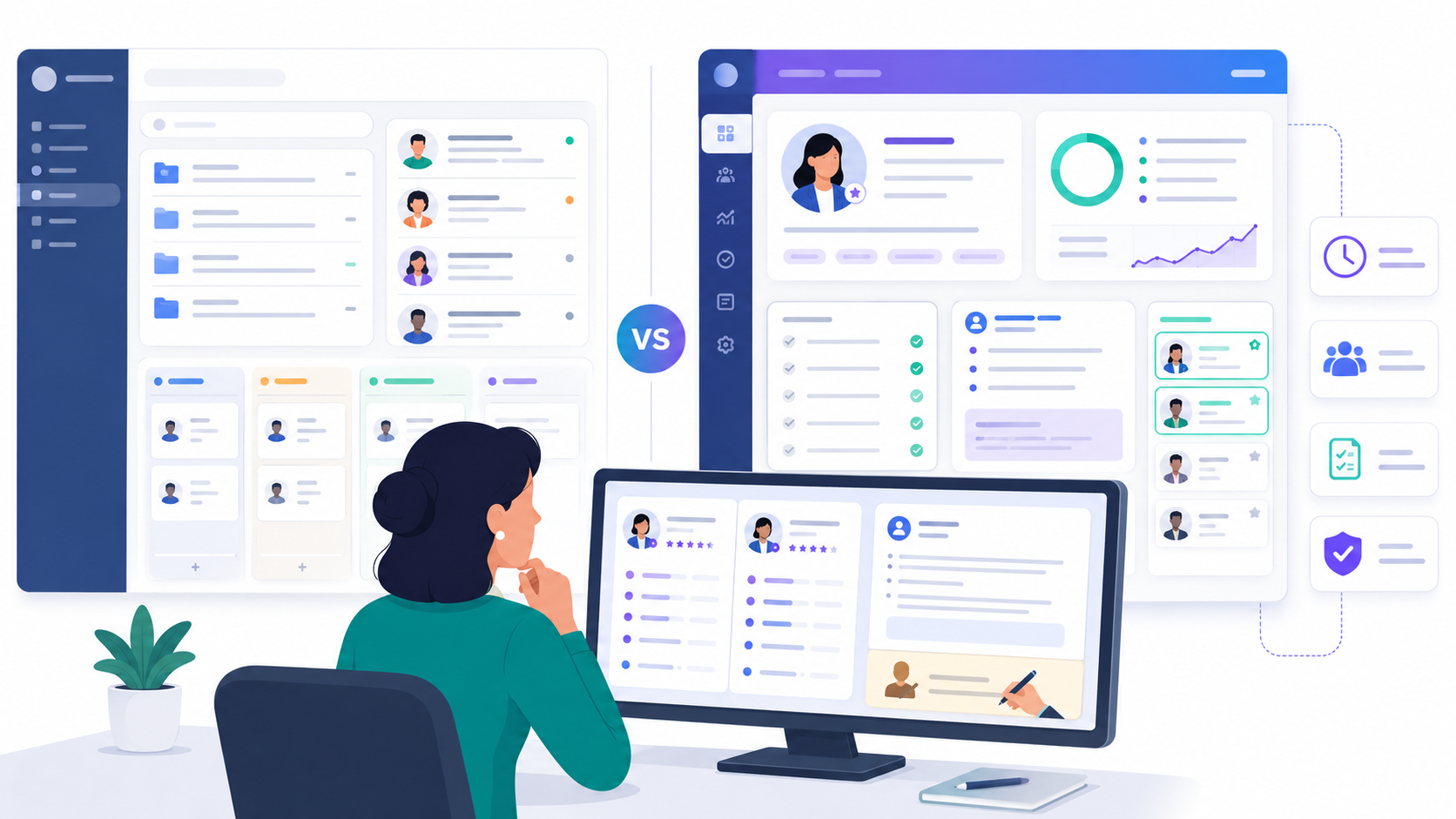
· An ATS helps teams manage candidate records and hiring stages, but it does not usually solve the manual work of early-stage evaluation.
· AI recruitment software is the better fit when the main bottleneck is resume screening, first-round interviews, candidate assessment, or structured reporting.
· KitaHQ can support teams that already receive applicants but need a clearer way to screen candidates before recruiter and hiring manager review.
When recruitment teams start evaluating tools, two categories come up quickly: applicant tracking systems (ATS) and AI recruitment software. At first, both tools may sound similar because they support hiring workflows, manage candidate-related tasks, and can include automation.
But they solve different problems at different stages of the hiring process. Confusing them leads to buying the wrong tool, or realizing you needed both all along but used neither correctly.
This guide explains what each tool actually does, where each one fits in a real hiring workflow, and how to identify which gap your team actually needs to solve.
An ATS is primarily a record-keeping and pipeline management system. Its core job is to track where each candidate sits in your hiring process, from the moment they apply to the moment they receive an offer or a rejection.
Most ATS platforms handle:
What an ATS does not typically do well: evaluate candidates. It can collect applications and move candidates through stages, but it cannot assess whether a candidate's resume actually matches your role criteria, run a structured interview, or generate a scored candidate report for a hiring manager.
That evaluation gap is where most teams still rely on manual work: reading every CV individually, scheduling phone screens, running informal first-round conversations, and writing up notes by hand. The ATS tracks all of it. It does not do any of it for you.
AI recruitment software helps hiring teams use AI to make recruitment workflows faster, more structured, and easier to review.
It usually supports the evaluation layer of hiring. Depending on the platform, this may include resume screening, structured interviews, candidate assessment, screening automation, and candidate reports for recruiter or hiring manager review.
What AI recruitment software does not do: it does not post jobs to boards, manage offer letters, maintain a full applicant database, or replace an ATS in its tracking and pipeline coordination role. At KitaHQ, final hiring decisions always remain with your recruiter or hiring manager.
See also: Top AI Recruiting Tools in 2026: From Sourcing to Screening
The simplest way to understand the distinction:
An ATS tracks where candidates are. AI recruitment software helps your team decide which candidates deserve to move forward.
See also: 6 Best AI Interview Tools for Global Hiring in 2026
These two tools are not alternatives to each other. For most hiring teams, they work at different stages of the same process.
A standard hiring workflow runs like this:
You need AI recruitment software specifically, not just a better ATS, when your real problem is in the evaluation stage, not the tracking stage.
Signs your team's actual problem is evaluation:
If your team already has an ATS but still struggles with screening quality, screening time, or evaluation consistency, that is an AI recruitment software problem. More ATS configuration will not solve it.
See also: 5 Best AI Recruiting Software for Singapore Companies in 2026
If your team does not yet have a centralized system to collect applications, track candidates, or coordinate between recruiters and managers, an ATS is the right starting point.
Prioritize an ATS when:
ATS-first makes sense when your foundational tracking problem is larger than your screening volume and evaluation consistency problem.
Many hiring teams do not need to choose between an ATS and AI recruitment software. They may need both.
The ATS can manage the recruitment pipeline.
AI recruitment software can support the screening layer before candidates move deeper into the hiring process.
Mind Stretcher is a good example of how AI recruitment software can support the screening layer when recruiters need to reduce repetitive first-stage work.
They adopted KitaHQ to move first-round screening to AI video interviews that candidates could complete on their own time, without live scheduling. The result was a 50% faster hiring cycle, 5 hours of recruiter time saved per hire, and a 25% increase in HR team productivity.
If your team already receives applicants but still spends too much time reviewing resumes, scheduling first-stage interviews, and summarizing candidates for hiring managers, the bottleneck may not be applicant tracking. It may be early-stage screening.
That is where KitaHQ fits. KitaHQ is AI recruitment software that helps hiring teams move faster from application review to shortlist through AI resume screening, AI video interviews, AI interview assessment, and recruitment automation.
KitaHQ can support workflows such as:
Learn how KitaHQ supports early-stage candidate screening without replacing recruiter or hiring manager review.
Industry: Banking
KitaHQ is an AI recruitment software that helps companies screen candidates, manage applicants, and keep candidate communication moving in one connected workspace.