
August 6, 2026
Ecommerce Hiring Process: A Practical Guide to Building a Team That Can Scale
Build a stronger ecommerce hiring process with eight practical steps for defining roles, screening candidates, running interviews, and scaling responsibly.
.avif)
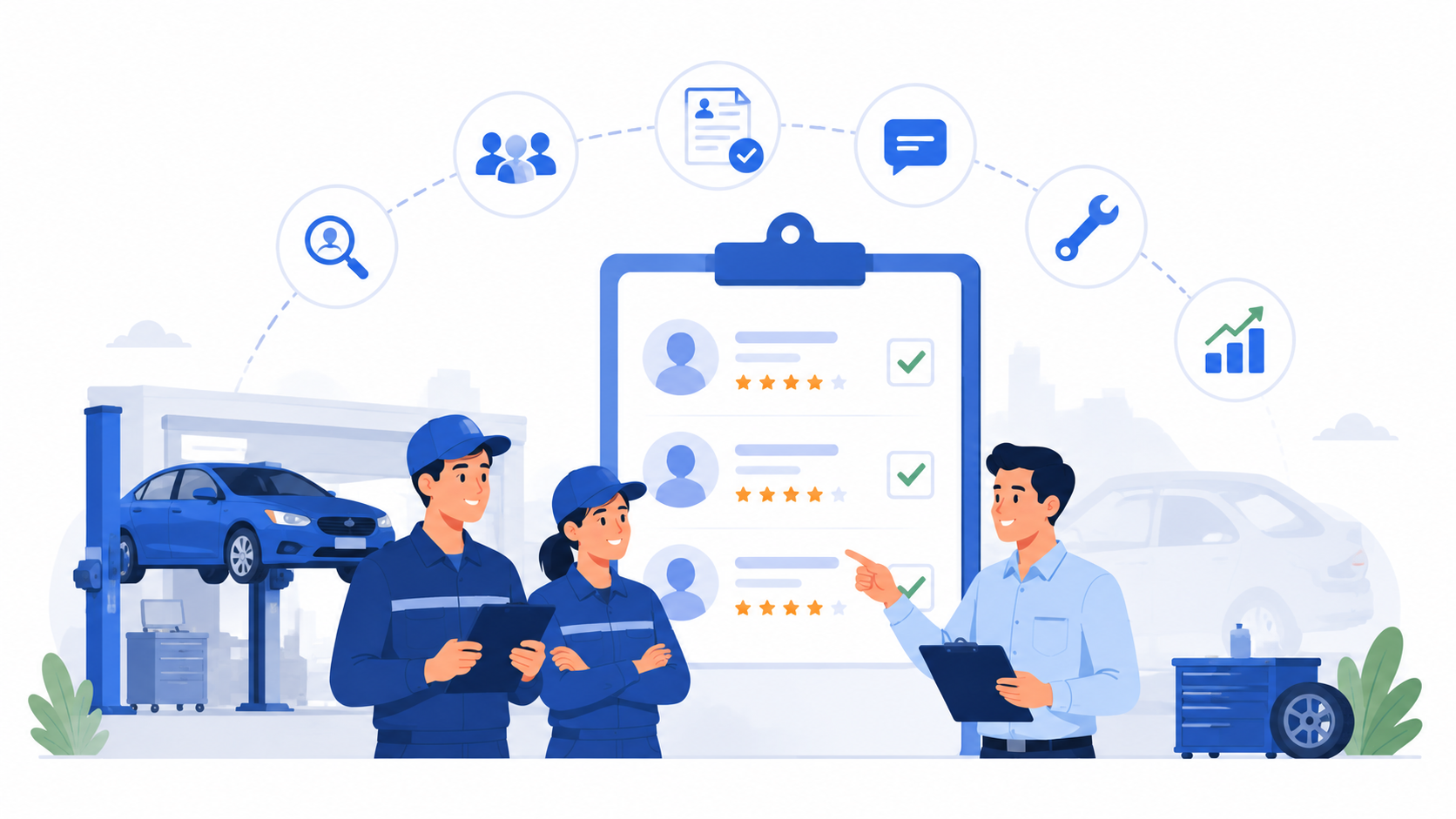
The best automotive hiring software should solve the part of recruitment that is actually slowing your team down.
For a dealership, that may be repeated first-round calls for service advisors and technicians. For a manufacturer, it may be high-volume frontline screening across plants. For an automotive group, it may be keeping hiring consistent across locations.
This guide compares nine platforms for dealerships, service centers, repair chains, manufacturers, suppliers, and other automotive employers.
The tools are not identical: some focus on early-stage screening, while others are full applicant tracking systems (ATS), frontline hiring platforms, or broader HR suites.
The right choice depends on your hiring bottleneck, role mix, location footprint, and existing technology - not simply which vendor has the longest feature list.
Automotive companies rarely hire one type of employee. The same organization may recruit technicians, service advisors, parts staff, sales consultants, plant operators, engineers, finance staff, and branch managers.
Each job family creates a different screening challenge. A service advisor needs clear customer communication and sound judgement. A technician may need specific experience, stated certifications, shift availability, and a hands-on skills check. Production hiring may require fast mobile applications and consistent screening across multiple sites.
The volume can also be significant. In the United States, the Bureau of Labor Statistics projects about 70,000 openings for automotive service technicians and mechanics each year, on average, from 2024 to 2034.
A useful automotive hiring platform should therefore help with at least one of these areas:
It also helps to identify the type of product you need. An ATS organizes applicants through a hiring pipeline. Screening software evaluates candidates before live interviews. An HR platform may continue into onboarding, employee records, time tracking, and performance.
See also: AI Recruitment Software vs Applicant Tracking System: Which One Do You Actually Need?
We reviewed current public product information available in July 2026 and prioritized five factors:
KitaHQ publishes this guide. We rank KitaHQ first for the specific use case of structured early-stage automotive screening, while clearly noting what it does not replace and where another platform may be a better fit. Product capabilities and pricing can change, so confirm critical requirements directly during a demo.
Best for: Dealerships, service centers, repair networks, and multi-location automotive employers that want to screen more candidates before involving service managers or hiring managers.
KitaHQ focuses on the early stages of hiring. Teams can use AI resume screening to review applicants against role criteria, then invite shortlisted candidates to complete AI video interviews on their own time.
This workflow is useful for repeatable roles such as service advisor, parts advisor, front desk, sales, branch support, and technician hiring. Recruiters can ask consistent questions about relevant experience, schedule availability, customer scenarios, work habits, and stated role requirements before committing manager time to live interviews.
Every completed interview can produce a structured summary, scores, transcript, and recording for recruiter review. Hiring teams can use AI interview assessment to evaluate responses against role criteria, then review candidate analytics and interview reports before deciding who should move forward.
Why KitaHQ ranks first: Its workflow directly addresses a common automotive bottleneck: too many repetitive early checks and too few manager interview hours. It can support screening across branches without turning the AI output into an automatic hiring decision.
Core capabilities:
Consideration: KitaHQ is not a full ATS, job-board distribution service, payroll system, onboarding suite, or dealership management system. Employers should still verify licences and certifications, run required background checks, conduct hands-on trade tests, and make final hiring decisions themselves.
Explore automotive recruitment software to see how it fits before the manager interview stage.
Best for: Independent dealerships, service centers, repair shops, and growing auto groups, especially in the United States.
Wizehire combines an ATS with job distribution, automotive job templates, screening tools, candidate communication, offer support, and access to hiring coaches. Its platform can publish a role to more than 100 job boards and help managers evaluate applicants through screening questions, interview guides, and DISC+ assessments.
The automotive-specific templates and coaching are helpful for owners or department managers who hire regularly but do not have a large in-house recruiting team.
Consideration: Wizehire is positioned most clearly for small and growing US businesses. Global employers should confirm local job boards, language support, data requirements, integrations, and plan limits before choosing it for a multi-country rollout.
Best for: Retail automotive groups that need consistent hiring across dealerships, departments, and locations.
Hireology is built around decentralized dealership hiring. Its capabilities include career sites, job distribution, candidate texting, prescreening, interview scheduling, background-check support, offer workflows, onboarding, and location-level visibility.
The platform is particularly relevant when general managers and department heads need a simple way to act on candidates while HR maintains process control across multiple rooftops.
Consideration: Hireology's strongest positioning is retail automotive rather than plant or engineering recruitment. Manufacturers and employers outside the US dealership model should confirm workflow, compliance, DMS, payroll, and HRIS requirements. Pricing is provided through its sales process.
Best for: Tire, repair, maintenance, and other automotive franchise networks with owner-operated locations.
CareerPlug helps businesses publish jobs, manage applicants, automate interview scheduling, and evaluate candidates through screening questions, assessments, and structured scorecards. It also offers branded career pages, text-to-apply, background-check integrations, onboarding, and retention tools.
Its franchise focus can help a central team create a repeatable hiring process while still giving local operators a practical way to manage applicants.
Consideration: CareerPlug is strongest for franchises, service networks, and growing businesses. Large automotive manufacturers should check whether its enterprise governance, technical recruiting, analytics, and integration depth match their requirements.
Best for: Auto shops, EV companies, manufacturers, and growing automotive employers that want a stronger career site and candidate journey.
Teamtailor combines applicant tracking with a flexible career-site builder, candidate communication, interview scheduling, video features, workflow triggers, analytics, and a mobile app. It is a useful option when an employer needs to improve how automotive roles are presented and keep candidates engaged through the pipeline.
It can support different job families while giving recruiting teams a consistent brand and collaborative workflow.
Consideration: Teamtailor is a broad ATS rather than a dedicated automotive credential or compliance platform. Teams must configure their own screening criteria, practical-test handoffs, licence checks, and location-specific workflows.
Best for: Automotive manufacturers, service networks, logistics operations, and distributed locations hiring large numbers of hourly or frontline workers.
Fountain is designed for high-volume workforce hiring. It offers mobile-first applications, automated screening and scheduling, candidate communication, location-level dashboards, onboarding, and workforce workflows.
This makes it relevant when speed and applicant conversion matter across plants, branches, shifts, or operational sites. It can reduce manual coordination when the same qualification steps must be repeated at scale.
Consideration: Fountain's core strength is recurring frontline hiring. Automotive companies recruiting specialist engineers, senior leaders, or highly relationship-led roles may need a separate workflow or a complementary platform.
Best for: Global manufacturers, OEMs, suppliers, and large organizations with complex talent-acquisition requirements.
iCIMS offers a broad talent acquisition suite covering career sites, recruitment marketing, candidate relationship management, applicant tracking, communication, offers, onboarding, analytics, and integrations.
Its configurability is valuable for automotive employers that recruit across corporate, technical, plant, and frontline roles and need a central system to connect multiple recruiting tools or regions.
Consideration: Enterprise breadth usually brings a larger implementation and administration requirement. A single dealership or repair shop may not need the full scope, while a global buyer should still validate regional compliance, data residency, and integrations.
Best for: Growing suppliers, auto-tech companies, and multi-location employers hiring corporate, engineering, operational, and customer-facing roles.
Workable combines job distribution, candidate sourcing, applicant tracking, AI-assisted screening, talent pools, interview kits, scorecards, one-way video interviews, workflow automation, reporting, and HR features.
The platform is flexible enough for a varied workforce and can be useful when a company wants one general recruiting system rather than an automotive-only product.
Consideration: Workable does not provide a dedicated automotive workflow out of the box. Teams need to configure job-family criteria, certifications, shift questions, technical assessments, and practical-test stages. Some advanced capabilities or services may also depend on the selected package.
Best for: Smaller automotive employers, suppliers, and teams already using the Zoho ecosystem.
Zoho Recruit combines applicant tracking and recruitment CRM features with job posting, resume parsing, candidate matching, assessments, hiring pipelines, workflow automation, analytics, and a broad integration ecosystem.
Its customization and entry-level plan options make it attractive for teams moving away from email and spreadsheets without immediately adopting an enterprise suite.
Consideration: Zoho Recruit is general-purpose software. Automotive employers must build the right stages, fields, screening rules, and verification handoffs themselves. Plan limits, add-ons, and user licensing should be checked against expected hiring volume.
See also: Best AI Candidate Screening Software in 2026
Start with the bottleneck, then compare features. Buying a large platform will not help if it improves a stage that is already working.
Choose a screening platform when resumes and repeated first-round calls are consuming recruiter or manager time. Choose an ATS when the larger problem is organizing applications, job posting, communication, and hiring stages. Choose an HR suite when onboarding, employee records, time, compliance, or performance must also sit in the same system.
Some companies will use more than one layer. For example, an ATS can remain the system of record while a screening platform handles first-round candidate evaluation.
A dealership group, repair franchise, component plant, and global OEM do not need the same setup. Map the roles, hiring locations, monthly applicant volume, responsible managers, and required integrations before making a shortlist.
For US-focused platforms, international buyers should verify local job-board coverage, languages, data residency, support hours, messaging channels, payroll or DMS integrations, and employment-compliance capabilities.
Ask each vendor to demonstrate a real role. For a service advisor, test customer communication and schedule fit. For a technician, test job knowledge and diagnostic reasoning, then keep a practical assessment and certification check in the process.
Review how the platform creates scores, what evidence a manager can see, and whether recruiters can change criteria before candidates enter the workflow.
Candidates should be able to apply or complete early screening easily from a phone. Managers should receive a clear shortlist, not another dashboard full of unstructured data.
During a demo, test application length, interview completion, reminders, accessibility, multilingual needs, report clarity, mobile review, and the handoff to the next stage.
Automotive recruitment software can organize applications, standardize questions, collect responses, and prepare reports. Recruiters and hiring managers should still review candidate context, exceptions, practical ability, licences, safety requirements, compensation, and the final hiring decision.
For a deeper framework, read what recruiters should still review when using recruitment automation.
The strongest shortlist is not the one with the most features. It is the one that matches your hiring stage, role mix, volume, locations, existing systems, and human review requirements. Run each demo with a real automotive role and compare the output your recruiters and managers would actually use.
If you are comparing the best automotive hiring software for faster, more consistent early-stage screening, explore automotive recruitment software and book a demo to see how it fits your dealership, service center, or multi-location hiring workflow.
Industry: Banking
KitaHQ is an AI recruitment software that helps companies screen candidates, manage applicants, and keep candidate communication moving in one connected workspace.