%20(1).png)

August 6, 2026
Ecommerce Hiring Process: A Practical Guide to Building a Team That Can Scale
Build a stronger ecommerce hiring process with eight practical steps for defining roles, screening candidates, running interviews, and scaling responsibly.
.avif)
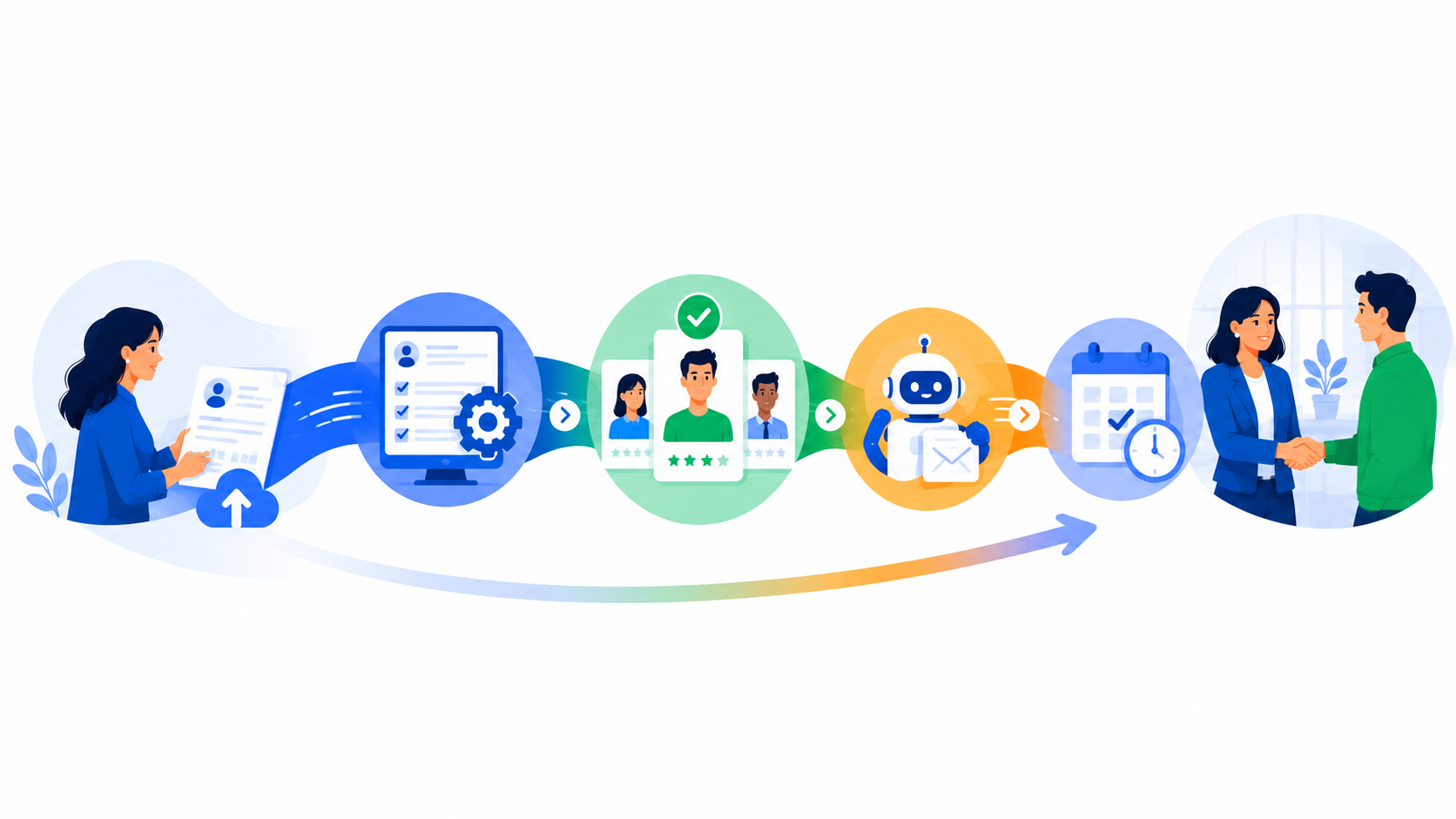
An automated recruitment workflow is only useful when it moves candidates forward without creating confusion for recruiters, hiring managers, or candidates.
Many hiring teams want to automate early-stage screening because manual CV review, candidate follow-up, interview coordination, and report preparation take too much time.
But automation can create new problems when the workflow is built before the team has defined who should move forward, what recruiters still need to review, and what hiring managers need before the next interview.
This guide explains how to build an automated recruitment workflow from CV upload to interview handoff, with clear checkpoints for automation and human review.
Before building the workflow, define what a “ready for handoff” candidate looks like.
This matters because automation should not simply move every candidate from one stage to another. It should help recruiters separate clear-fit candidates, unclear candidates, and poor-fit candidates based on criteria the hiring team has already agreed on.
In KitaHQ, this kind of workflow works best when hiring teams first define the role criteria, screening rules, invite triggers, and report expectations before candidates move from CV review to interview review.
A clear handoff should define:
For example, a recruiter hiring for a high-volume sales role may want the workflow to check sales experience, communication signals, location fit, and availability before the candidate is invited to complete an AI video interview. A recruiter hiring for an operations role may care more about shift readiness, process discipline, and relevant work exposure.
The workflow should reflect the role, not just the tool.
An automated recruitment workflow helps recruiters move candidates through repeatable screening steps without handling every task manually.
A simple workflow can look like this:
The point of this workflow is not to remove recruiters from screening. It is to reduce the repetitive steps that slow them down, such as manually checking every CV, sending every interview invite, chasing every incomplete interview, and preparing every candidate summary from scratch.
The handoff still matters. Before candidates move to the next round, recruiters should review the candidate’s information, interview output, role fit, and any edge cases that automation may not fully understand.
See also: AI Candidate Screening Software vs Manual Screening: Which Creates Better Shortlists?
Automation works better when the rules are specific. It becomes risky when hiring teams automate a step before deciding what the rule should mean, who should review the result, and when exceptions should be handled manually.
Recruiters should define rules for workflow movement, not final hiring decisions. For example, KitaHQ can help hiring teams automate when a candidate should receive an interview invite, when a reminder should be sent, or when a candidate report should be prepared for review. But the decision to move a candidate forward should still involve recruiter or hiring manager judgment.
A practical rule-setting framework can look like this:
This distinction keeps automation useful without making the hiring process too rigid. The system can help move candidates through repeatable steps, while recruiters stay responsible for interpreting results, handling exceptions, and deciding who should continue in the process.
A good rule should be clear enough to automate, but not so broad that it replaces judgment. If the rule cannot explain why a candidate should receive an invite, reminder, re-invite, or handoff, it should be reviewed before automation is turned on.
See also: Recruitment Automation Without Automated Hiring Decisions: What Recruiters Should Still Review
After candidates complete the automated interview step, recruiters still need to review whether the screening output is strong enough to support the next decision. This review should focus on candidate context, response quality, and role relevance, not just whether the candidate completed the interview.
Recruiters should check:
This makes the automated workflow more reliable. Recruiters do not need to manually chase every candidate, but they still need to decide whether each completed screening output is ready for the next stage.
An automated recruitment workflow should not be built around automation alone. It should be built around the handoff.
When the team defines role criteria, screening rules, candidate communication, report requirements, and human review points first, automation becomes more useful. It helps reduce repetitive admin work while keeping recruiters involved in the decisions that need context.
This is where KitaHQ fits naturally into CV-to-interview screening workflows. KitaHQ helps hiring teams automate AI resume screening, interview invites, reminders, AI video interviews, and candidate reports, while keeping recruiter and hiring manager review in the process.
The best workflow is not the one that automates the most steps. It is the one that helps the right candidates reach the right reviewer with the right information at the right time.
Industry: Banking
KitaHQ is an AI hiring software that helps teams screen faster, run AI video interviews, and evaluate candidates consistently.