%20(1).png)

August 6, 2026
Ecommerce Hiring Process: A Practical Guide to Building a Team That Can Scale
Build a stronger ecommerce hiring process with eight practical steps for defining roles, screening candidates, running interviews, and scaling responsibly.
.avif)
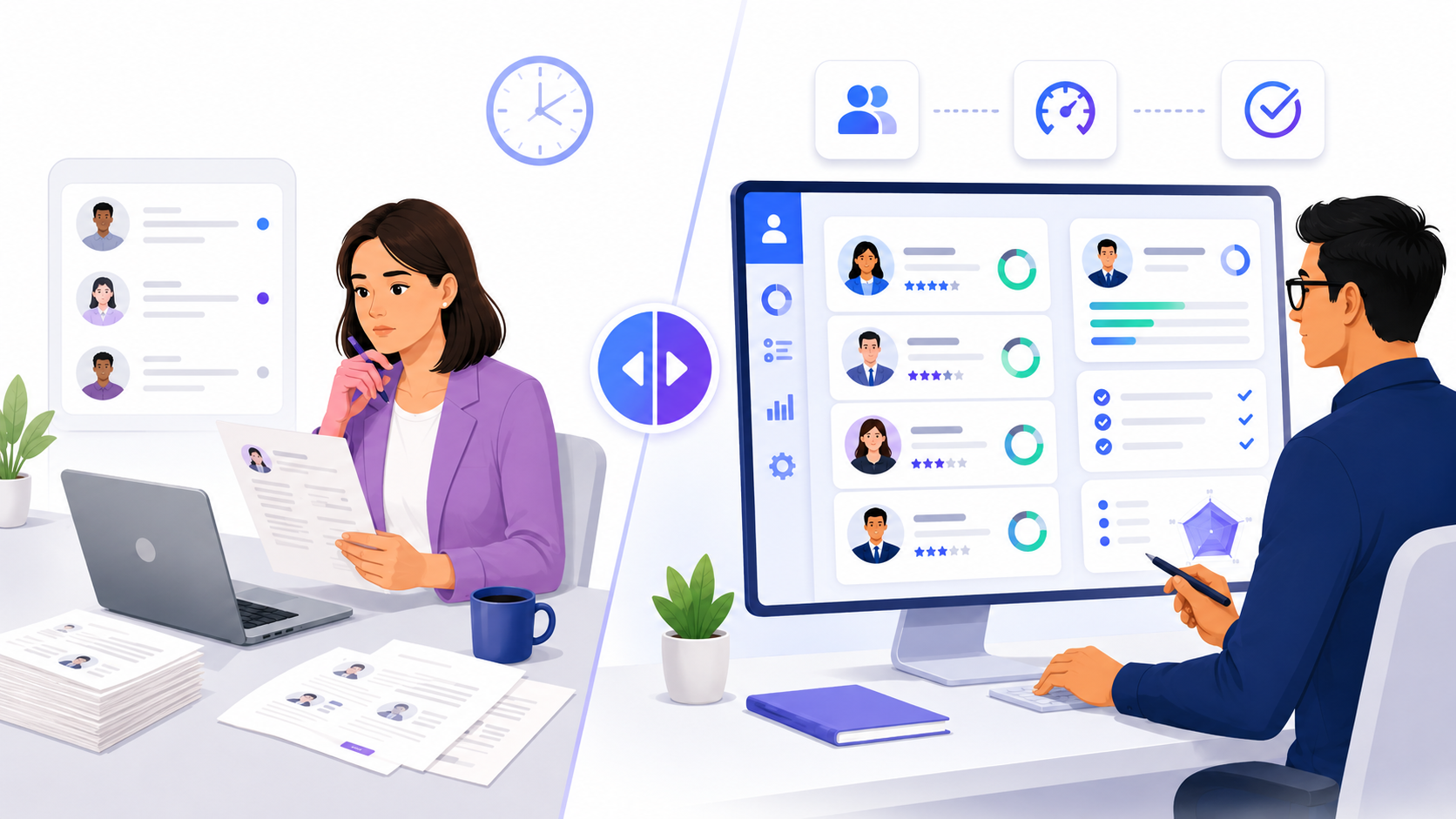
Manual screening often looks manageable at first. Recruiters review resumes, call candidates, ask basic questions, write notes, and send shortlists to hiring managers.
But as hiring volume grows, the real problem is not only that manual screening takes time. The bigger issue is that candidate evaluation can become inconsistent from one recruiter, role, location, or hiring cycle to another.
That is why many teams start comparing AI candidate screening software vs manual screening. The goal is not to replace recruiters or hiring managers. The goal is to create a more structured screening workflow so teams can review candidates faster, compare them more clearly, and send stronger shortlists to the next interview stage.
Manual screening usually starts to break when recruiters need to repeat the same steps across many candidates.
They read resumes one by one, check basic requirements, schedule first-stage calls, ask similar questions, and write notes for hiring managers. This process gives recruiters control, but it also creates variation.
One recruiter may focus on years of experience. Another may focus more on communication. Another may spend more time checking availability or salary expectations.
None of these signals are wrong, but when they are not captured consistently, hiring managers may receive shortlists that are hard to compare.
Manual notes depend heavily on the recruiter’s writing style, available time, and memory after the call. A strong candidate may be undersold because the notes are too brief. A weaker candidate may look better because the summary is more polished.
This is where shortlist quality can suffer. The issue is not only whether the candidate was screened. The issue is whether the hiring manager receives enough clear context to decide what should happen next.
Manual screening often depends on live phone calls or first-stage interviews. When candidates are working shifts, studying, or applying from different locations, scheduling becomes a bottleneck.
Even if the recruiter knows what to ask, the shortlist cannot move forward until each candidate is contacted, scheduled, screened, and summarized.
See also: How to Improve Your Candidate Screening Process
AI candidate screening software does not remove the need for recruiter review. Instead, it helps structure the work that happens before recruiter or hiring manager decisions.
For example, instead of manually reviewing every resume and scheduling every first-stage call, recruiters can define screening criteria, invite candidates to complete AI video interviews, and review candidate reports after responses are submitted.
With AI candidate screening software, candidates can be reviewed against the same role criteria and asked more structured questions. This helps reduce the variation that often happens when different recruiters screen similar candidates in different ways.
The output is not just a shorter list of candidates. Ideally, it is a shortlist with clearer reasoning behind why each candidate should move forward.
Hiring managers often need more than a resume and a short recruiter note. They need to understand how the candidate answered role-specific questions, whether the candidate showed relevant experience, and whether there are signals worth exploring in the next interview.
Candidate reports, interview summaries, transcripts, recordings, and scores can help hiring managers review candidates with more context before deciding who to interview next.
For repeatable roles, recruiters often ask the same basic questions again and again. AI candidate screening software can help move this repetitive work into a more structured workflow, so recruiters spend less time coordinating and summarizing every first-stage screen manually.
The recruiter still reviews the outcome. The hiring manager still decides who moves forward. But the process before that decision becomes easier to manage.
See also: 5 Most Common Candidate Screening Methods (Plus Recommended Tools)
Manual screening is not automatically wrong. In some hiring situations, it is still the better option.
Manual screening makes sense when the role is senior, sensitive, highly specialized, or low-volume. In these cases, each candidate may need deeper individual review from the start.
Recruiters may need to understand career context, motivation, stakeholder fit, leadership style, or compensation expectations before deciding whether the candidate should move forward.
It also works when the team has enough recruiter capacity to review every candidate carefully. If hiring volume is low and quality conversations matter early, manual screening may provide the nuance your team needs.
The key is not to replace manual screening everywhere. The key is to know when manual screening is still adding value and when it has become repetitive admin work.
See also: Best AI Candidate Screening Software for Singapore Hiring Teams
AI candidate screening software is a better fit when the screening process is repeatable, high-volume, or difficult to manage consistently.
This often happens in roles such as sales, customer service, retail associates, operations staff, collections, call center agents, education support roles, and other frontline or location-based hiring workflows.
KitaHQ helps hiring teams make early-stage screening faster and easier to review through AI resume screening, AI video interviews, AI interview assessment, AI candidate analytics, and recruitment automation.
Recruiters can screen resumes against role criteria, invite candidates to complete interviews on their own time, review candidate responses, and share clearer candidate reports with hiring managers before the next interview.
Instead of replacing recruiter or hiring manager review, KitaHQ supports the screening layer before candidates move deeper into the hiring process.
Explore how KitaHQ’s AI candidate screening helps teams turn manual screening into a more structured, reviewable candidate screening workflow.
Manual screening still works when hiring volume is low, roles are complex, or every candidate needs individual review from the beginning.
But manual screening becomes inefficient when recruiters repeat the same resume review, phone screening, scheduling, and note-writing tasks across many candidates.
AI candidate screening software is useful when your team needs a faster and more structured way to move from application review to a clearer shortlist.
The goal is not to remove human judgment. The goal is to reduce repetitive screening work so recruiters and hiring managers can spend more time reviewing the right candidates.
Industry: Banking
KitaHQ is an AI recruitment software that helps companies screen candidates, manage applicants, and keep candidate communication moving in one connected workspace.