%20(1).png)

August 6, 2026
Ecommerce Hiring Process: A Practical Guide to Building a Team That Can Scale
Build a stronger ecommerce hiring process with eight practical steps for defining roles, screening candidates, running interviews, and scaling responsibly.
.avif)
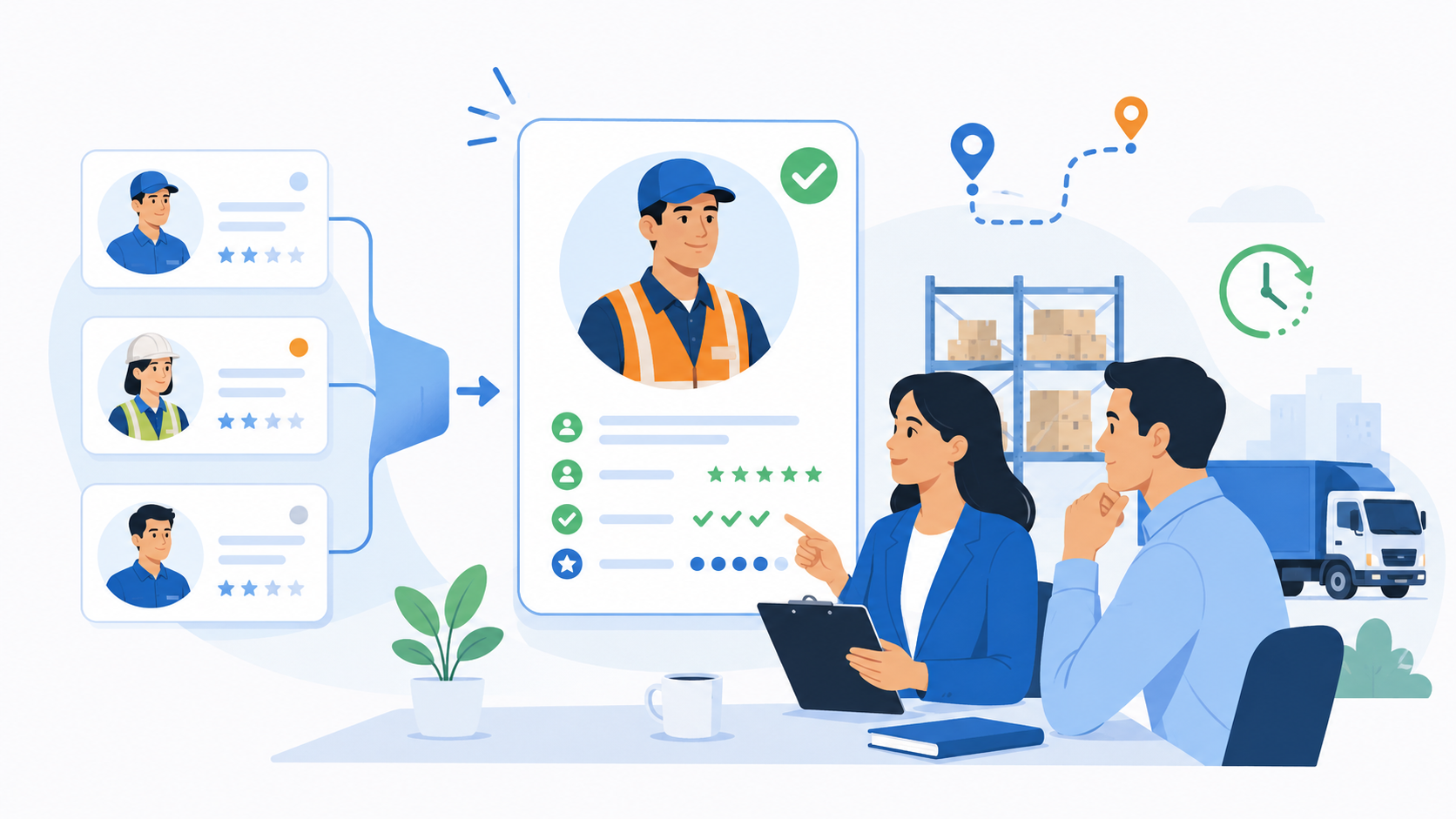
Logistics hiring breaks differently from office-based hiring.
Recruiters are not only reviewing CVs. They are checking availability, location fit, route or site expectations, communication under pressure, operational judgment, and whether candidates understand the pace of delivery, warehouse, field, or support roles.
That is why choosing the best logistics recruitment software should not start with the longest feature list. It should start with one question:
“Where does your screening workflow slow down or lose quality?”
Some logistics teams need an applicant tracking system. Some need sourcing automation. Some need better candidate communication. Others need AI candidate screening and AI video interviews so recruiters and operations managers can review stronger shortlists without repeating the same screening conversations manually.
This guide compares logistics recruitment software by workflow fit, not just by brand name.
Use this table before comparing vendors.
Before shortlisting vendors, test the workflow with one real logistics role.
Use one role such as delivery courier, warehouse support, QA operations, or customer experience support. Then ask:
Can the tool screen resumes against the criteria recruiters actually use?
Can candidates answer structured role-fit questions without live scheduling?
Can the system show transcripts, recordings, summaries, scores, strengths, and concerns for manager review?
Can recruiters send invites and reminders without manually chasing every candidate?
Can hiring managers understand why a candidate was shortlisted without repeating the whole first-round interview?
If the answer is weak, the tool may still be useful as an ATS, but it may not solve the logistics screening problem.
KitaHQ is a strong fit for logistics teams that need a more structured way to screen candidates before recruiter or hiring manager review.
For logistics roles, the challenge is often not only volume. It is quality control across repeated screening steps. Recruiters may need to evaluate delivery candidates, warehouse support staff, routing support, operations coordinators, QA operations, internal audit associates, and customer experience support roles across different sites or hiring campaigns.
KitaHQ supports this workflow with AI resume screening, AI video interviews, AI interview assessment, candidate reports, and recruitment automation. For logistics teams, the focus is early-stage screening: helping recruiters review role fit, communication, availability, work-condition fit, and operational judgment before candidates move to the next hiring step.
For teams comparing logistics recruitment software, KitaHQ is most relevant when the screening problem looks like this:
With KitaHQ AI video interviews, candidates can complete structured first-round interviews through a web link on desktop or mobile, without live scheduling. Recruiters and hiring managers can then review scores, summaries, transcripts, and recordings before deciding who should move forward.
This makes KitaHQ especially useful for logistics teams hiring repeatable roles where recruiters need to assess communication, role understanding, availability, work-condition fit, operational judgment, and process discipline before passing candidates forward.
PT Tri Adi Bersama, Anteraja used KitaHQ to support screening for logistics and operations candidates across courier, customer experience, quality assurance, and data-related roles before recruiter review. For logistics teams, this reflects the same workflow challenge: screening repeatable roles consistently before manager time is used.
A secondary parallel is PT Sejahtera Mitra Solusi, a staffing and HR consulting company recruiting across 147 cities. Their team moved from manual phone screening to a more structured screening workflow and reported 50% faster time-to-hire, a 75% reduction in screening time, and a 2x increase in recruiter productivity.
This is not a logistics-specific case study, but it shows how structured early-stage screening can help distributed hiring teams reduce repetitive manual screening work.
Best fit when:
Workable is a broad recruiting platform that can support companies looking for ATS functionality plus screening-related features.
Workable may fit teams that need AI-powered resume screening, one-way video interviews, interview kits, scorecards, assessments, and candidate profile summaries.
For logistics teams, Workable may fit when the hiring team wants a central place to manage job postings, candidate stages, collaboration, and basic screening workflows. It can be useful for growing companies that do not want to manage several separate tools.
The tradeoff is depth. If the main hiring problem is logistics-specific candidate evaluation, such as testing operational judgment, route expectations, communication under pressure, or manager-ready interview reports, the team should test whether the screening outputs are detailed enough for frontline hiring decisions.
Best fit for:
Growing logistics companies that want a general ATS with screening support.
Greenhouse is an applicant tracking and hiring platform known for structured hiring workflows. Greenhouse may fit larger teams that need Greenhouse as an ATS recruiting platform with built-in AI recruiting tools and structured hiring capabilities.
For logistics companies, Greenhouse may be a strong option when hiring processes involve multiple stakeholders, formal interview stages, compliance expectations, and structured collaboration between recruiters and hiring managers.
It can be useful for larger organizations that want consistent hiring practices across many departments or geographies. However, if the main bottleneck is repetitive early candidate screening for high-volume logistics roles, a dedicated AI candidate screening or AI video interview layer may still be needed.
Best fit for:
Larger logistics or supply chain organizations that need a structured ATS and formal hiring workflows.
iCIMS is an enterprise talent acquisition platform. Its official pages describe capabilities across applicant tracking, candidate engagement, onboarding, employer branding, career sites, and high-volume hiring.
For logistics companies with large-scale hiring needs, iCIMS may fit when recruitment is part of a broader enterprise talent acquisition operation. It can support complex workflows, candidate engagement, and large hiring programs.
The tradeoff is implementation weight. Enterprise platforms can be powerful, but they may be more than what a regional logistics team needs if the immediate pain is screening speed or shortlist quality.
Best fit for:
Enterprise logistics, transportation, warehousing, or supply chain organizations with complex hiring operations.
Avature provides a configurable AI-powered recruitment and talent management platform. Its official site describes highly configurable solutions, candidate relationship management, multichannel engagement tools, and AI-powered matching.
This can fit logistics companies with complex hiring structures, multiple regions, internal mobility needs, or talent community strategies. For example, an enterprise logistics company may want to build segmented talent pools for warehouse staff, drivers, dispatch support, operations roles, or seasonal campaigns.
The main consideration is complexity. Highly configurable systems can support many workflows, but they require clear process ownership. If the team has not defined screening criteria clearly, configuration will not solve the underlying hiring problem.
Best fit for:
Large logistics organizations with complex, multi-region recruitment workflows.
Pinpoint is an applicant tracking system built for in-house talent teams. Its official pages mention automation, workflow builder, candidate communication, reporting, analytics, AI candidate match score, structured scorecards, self-scheduling, and collaborative hiring tools. Pinpoint also has a high-volume hiring page that references automated screening, scheduling, communication, and shared views across roles, locations, and stages.
For logistics teams, Pinpoint may fit when the company has several hiring managers or locations and wants a more organized ATS workflow. It can help centralize candidate review and reduce admin work.
Before choosing it for logistics screening, test whether the candidate evaluation workflow gives managers enough role-specific context. For example, can it capture work-condition fit, customer handling, safety mindset, SLA judgment, and process discipline in a way that is easy to compare?
Best fit for:
In-house logistics hiring teams that need ATS structure across locations.
Breezy HR is a hiring software and ATS platform that supports pre-screening, emails, interview scheduling, and team feedback collection. Its official site says it automates repetitive tasks such as pre-screening candidates, sending emails, scheduling interviews, and collecting feedback.
For small logistics operators, Breezy HR may be useful when the current process is still spreadsheet-based or scattered across email, chat, and manual follow-up.
It is less likely to be the best option if the team needs advanced logistics candidate evaluation, structured AI video interviews, or detailed candidate reports for manager review. But for teams that need a simpler ATS foundation, it can be a practical starting point.
Best fit for:
Smaller logistics teams moving away from manual hiring admin.
Recruitee, now under Tellent, is a customizable hiring software platform. Its official pages describe ATS functionality, collaboration with hiring managers, employer branding, and AI-driven features.
For logistics companies, Recruitee can help when recruiters need to improve collaboration, organize hiring stages, and create a better candidate-facing application process.
It may be especially useful for companies trying to build a more professional hiring operation across warehouse, support, operations, or regional teams. But if the problem is not collaboration and instead is weak candidate screening, the team may need an additional screening layer.
Best fit for:
Logistics teams that need a collaborative ATS and stronger employer branding.
Teamtailor is positioned as an ATS and employer branding platform. Its official site highlights collaboration, AI co-pilot support, onboarding, and candidate-focused recruitment workflows.
For logistics teams competing for frontline or operational talent, candidate experience matters. A smoother career site and application flow can help attract and convert candidates, especially when multiple employers are competing for the same workforce.
However, employer branding does not automatically fix screening quality. If recruiters still need to evaluate operational judgment, communication, shift fit, and readiness at scale, candidate screening capability should be tested separately.
Best fit for:
Logistics companies that want better career pages, candidate experience, and recruitment marketing.
Skima AI is commonly positioned around AI-powered matching, high-volume hiring, skill detection, resume parsing, and talent rediscovery. A logistics recruitment software reference page lists Skima AI as a tool for AI-powered matching, high-volume hiring, and skill detection.
For logistics companies with existing candidate databases, AI matching can help recruiters find candidates who may already be in the system. This can be useful when teams repeatedly hire for similar roles across sites or regions.
The main question is whether the workflow stops at matching or continues into structured candidate evaluation. Matching can help identify likely-fit profiles, but logistics recruiters may still need interview-based signals around work readiness, communication, judgment, and role understanding.
Best fit for:
Teams with large candidate databases that need AI matching and resume parsing.
A better way to evaluate logistics recruitment software is to separate “pipeline control” from “screening quality.”
This keeps the comparison honest. A broad ATS may be the right choice for pipeline control, while a screening platform may be the better fit when the core problem is shortlist quality.
For logistics teams, the best software choice depends on what is actually slowing the hiring process. If the challenge is pipeline organization, an ATS may help; if the challenge is candidate supply, sourcing should be improved first.
But when logistic recruitment challenges come from repeated screening, inconsistent shortlist quality, or managers re-checking the same basic details, teams need tools that support a more structured first screening step.
KitaHQ logistic recruitment software helps recruiters use AI resume screening, AI video interviews, candidate reports, and recruitment automation to collect clearer candidate signals earlier, so hiring managers can review stronger shortlists without repeating every basic screening conversation.
Industry: Banking
KitaHQ is an AI hiring software that helps teams screen faster, run AI video interviews, and evaluate candidates consistently.