%20(1).png)

August 6, 2026
Ecommerce Hiring Process: A Practical Guide to Building a Team That Can Scale
Build a stronger ecommerce hiring process with eight practical steps for defining roles, screening candidates, running interviews, and scaling responsibly.
.avif)
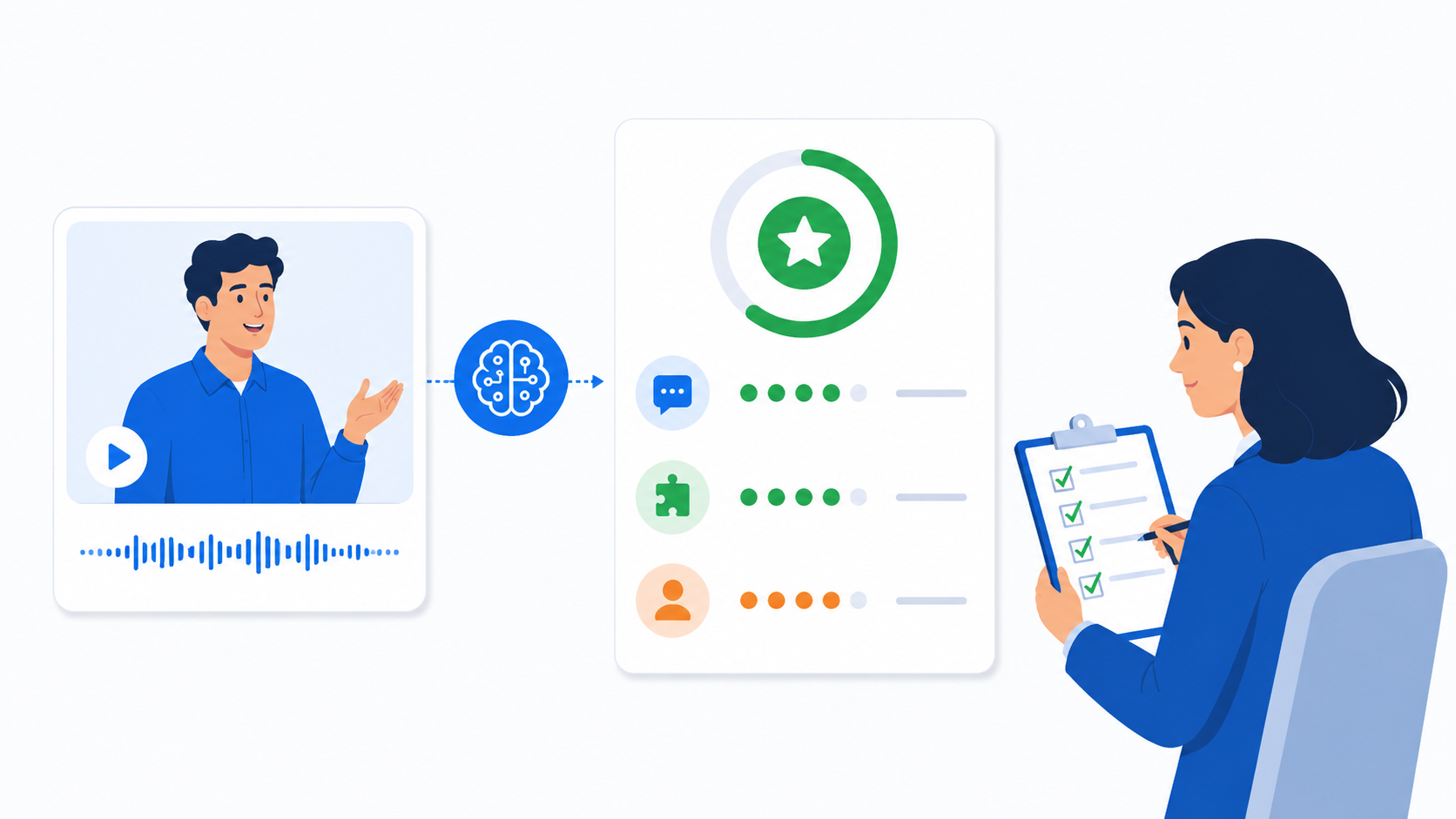
AI interview assessment can help recruiters review candidate responses faster and more consistently. But the score itself should not be treated as the full answer.
A candidate may receive a strong score because their answer matches the criteria well. Another candidate may receive a lower score because their answer is vague, incomplete, or less relevant to the question. In both cases, recruiters still need to understand what the score reflects before deciding who should move forward.
This guide explains how AI interview assessment by KitaHQ scores responses, what recruiters should review behind the score, and where human judgment still matters.
An AI interview assessment score usually reflects how well a candidate’s response matches predefined criteria.
For example, if the role requires customer-facing communication, the assessment may look at whether the candidate explains ideas clearly, responds to the situation directly, and shows practical judgment.
If the role requires technical understanding, the assessment may focus more on reasoning, role knowledge, and how the candidate explains their approach.
The important point is that the score is not a complete judgment of the person. It is a structured signal based on the answer given, the question asked, and the criteria used for review.
That means a score is only useful when recruiters know what it is measuring.
AI interview assessment usually works best when the interview process is already structured. Each candidate should answer relevant questions, and those answers should be reviewed against the same criteria.
The scoring process can be understood in three parts: the question, the criteria, and the review context.
A score starts with the question.
If the interview question is too broad, the score may not be very useful. For example, “Tell me about yourself” can produce many different types of answers, which makes comparison difficult.
A stronger question is tied to a specific hiring signal.
For example:
These questions make the assessment clearer because they ask candidates to show role-related thinking, communication, judgment, or knowledge.
When the question is specific, the score has a clearer context.
See also: AI Video Interview Questions Employers Can Use for Structured First-Round Review
After the candidate answers, the response should be assessed against defined criteria.
The criteria may include areas such as:
For general or entry-level roles, standard criteria may be enough. For more specialized roles, recruiters may need custom criteria that reflect the actual requirements of the position.
This matters because different roles should not be judged by the same generic standard.
A sales candidate may need to explain a product clearly, respond to objections, and sound comfortable speaking with customers. An operations candidate may need to show process discipline, prioritization, and escalation judgment. A back-office candidate may need to show attention to detail, organization, and clear internal communication.
The score becomes more useful when the criteria match the role.
A score alone does not show the full answer.
Two candidates may receive similar scores for different reasons. One may give a clear but basic answer. Another may give a stronger example but explain it less directly. Without reviewing the summary, transcript, or recording, recruiters may miss those differences.
A better review process looks at the score, candidate summary, transcript, recording, strengths and role criteria used for scoring.
Together, these help recruiters understand not just what the score is, but why the candidate may have received it.
AI interview assessment can make candidate review more structured, but recruiters still need to check the quality and context of the response.
The goal is not to approve or reject candidates based on the score alone. The goal is to use the score as a starting point for a more consistent review.
A candidate may sound confident but still fail to answer the question.
For example, if the question asks how the candidate would handle a customer complaint, a weak answer may only say, “I would stay calm and help them.” That answer sounds positive, but it does not explain what the candidate would actually do.
A stronger answer may include:
Recruiters should check whether the answer directly responds to the scenario, not just whether it sounds polished.
A score is only useful if the criteria are relevant.
If the role requires customer communication, the criteria should assess how clearly the candidate explains ideas, handles questions, and responds professionally. If the role requires technical reasoning, the criteria should assess the candidate’s logic, accuracy, and problem-solving approach.
Recruiters should ask:
This is especially important when hiring for specialized, technical, regulated, or customer-sensitive roles.
See also: How to Assess Communication, Problem-Solving, and Role Fit in Interviews
Some responses need extra review.
For example, a candidate may receive a medium score because the answer was partly relevant but not detailed enough. Another candidate may receive a lower score because the transcript was unclear, the answer was too short, or the question did not capture their strongest experience.
Recruiters should review borderline cases before deciding the next step.
This is especially important when:
In these cases, the recruiter should not rely on the score alone.
See also: What AI Recruitment Software Can and Cannot Tell You About Candidate Fit
KitaHQ AI interview assessment scores can help recruiters review candidate responses faster and more consistently, but the score should never be the only thing recruiters look at.
The best use of AI scoring is to structure the review process. Recruiters should still check the question, criteria, summary, transcript, recording, and role context before moving candidates forward.
When used this way, KitaHQ helps hiring teams compare candidates with more clarity while keeping human review at the center of the hiring process.
Industry: Banking
KitaHQ is an AI hiring software that helps teams screen faster, run AI video interviews, and evaluate candidates consistently.