%20(1).png)

August 6, 2026
Ecommerce Hiring Process: A Practical Guide to Building a Team That Can Scale
Build a stronger ecommerce hiring process with eight practical steps for defining roles, screening candidates, running interviews, and scaling responsibly.
.avif)
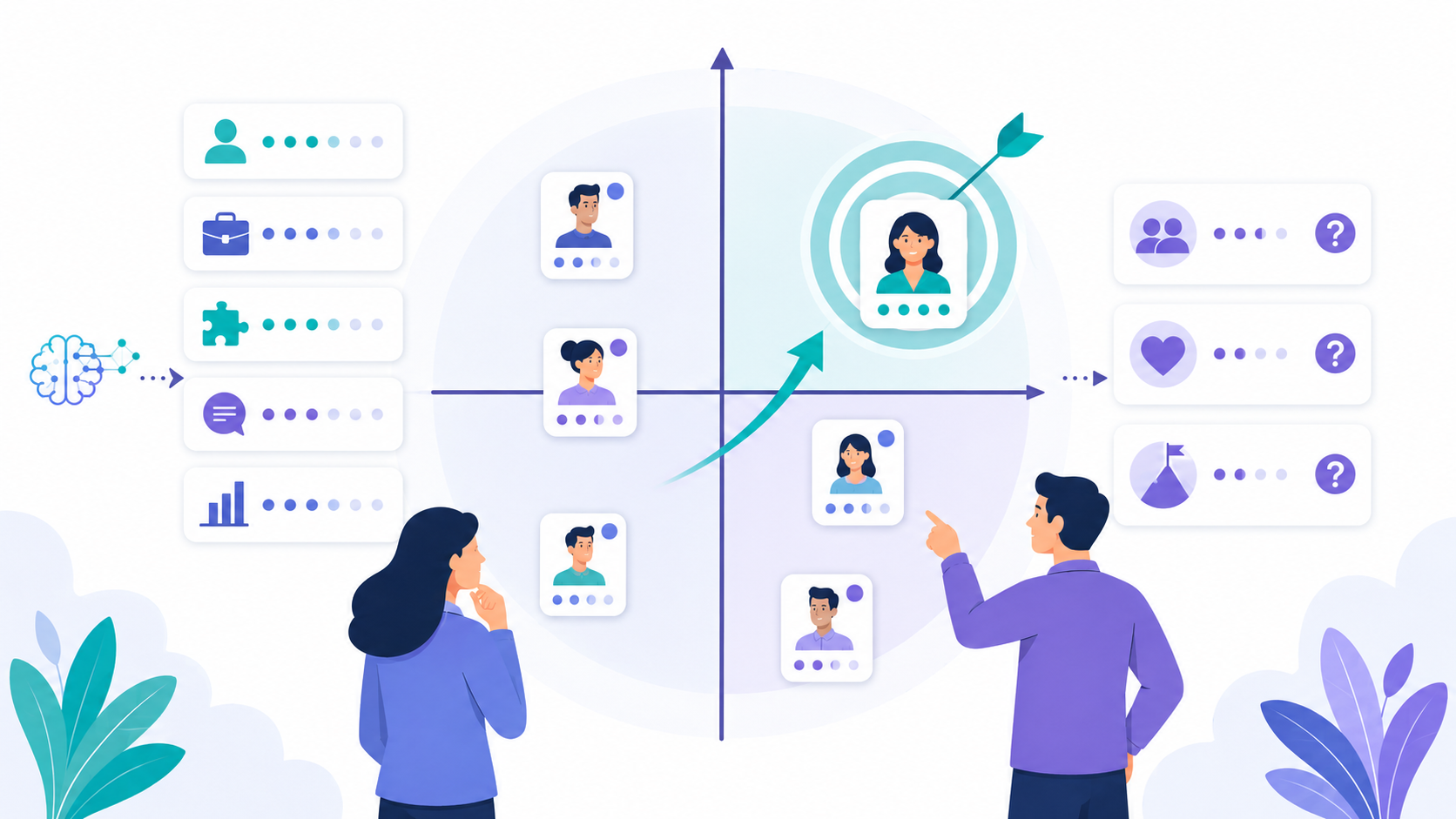
When hiring teams use AI recruitment software, candidate fit should not be treated as one final score. Fit depends on role requirements, experience, communication, judgment, motivation, availability, and business context.
AI can make early-stage screening more structured. But it cannot understand every hiring tradeoff, replace recruiter judgment, or make the final call on who should move forward.
This article explains what AI recruitment software can help reveal about candidate fit, what it cannot confirm, and how recruiters should use AI-generated signals responsibly.
Candidate fit is often discussed as if it is a simple yes-or-no answer.
In reality, fit usually includes several layers:
AI recruitment software is most useful in the first few layers: role fit, capability fit, communication signals, and structured comparison.
It becomes weaker when the question depends on business tradeoffs, manager preference, team dynamics, sensitive context, or information outside the screening workflow.
See also: Is AI Recruitment Software Fair for Candidate Screening?
AI recruitment software is most useful when candidate fit is broken into clear, reviewable signals.
Instead of asking AI to decide whether someone is “the right hire,” recruiters should use it to organize what can be assessed early: resume relevance, structured interview responses, role-related skills, communication signals, and comparison across candidates
AI can help review resumes against criteria such as relevant experience, required skills, education background, role exposure, and other job-related requirements.
This is helpful when recruiters face too many CVs to review manually. Instead of reading every resume from scratch, AI can help organize candidate information against the same role criteria, so recruiters can identify which profiles may deserve closer review.
But resume fit is still only an early signal. A CV can show relevant experience, but it cannot fully show judgment, communication, motivation, or how the candidate performs in realistic situations.
AI can help collect and organize candidate responses through video interviews. This is especially useful when recruiters need to compare many applicants for the same role without relying only on rushed phone screens or inconsistent notes.
For candidate fit, structured interview responses can reveal signals such as:
This does not mean AI knows who should be hired. It means recruiters get more structured material to review before deciding who moves forward.
One of the strongest uses of AI is consistency.
Instead of evaluating each candidate through a different process, AI can help hiring teams collect similar types of information across the same role. This makes it easier to compare candidates against shared criteria rather than relying only on memory, personal impressions, or scattered recruiter notes.
This is useful when hiring teams need to compare many candidates for the same role. For example, if 200 candidates apply for a customer service role, recruiters can review structured signals such as communication quality, service judgment, availability, and role-related experience more consistently.
AI can support candidate fit evaluation when the role has clear assessment criteria.
For client-facing roles, recruiters may want to assess how candidates explain ideas, handle customer concerns, and stay professional. For operations roles, recruiters may care more about process discipline, task prioritization, and issue escalation.
This makes AI more useful when the hiring team defines what “good” looks like before screening starts. The clearer the criteria, the easier it is for recruiters to use AI-generated outputs as review material instead of treating them as vague fit scores.
AI recruitment software can support candidate fit review, but it should not be treated as a complete judgment system. Some fit factors still depend on human context, such as team needs, manager expectations, compliance requirements, and role tradeoffs.
AI can support screening, scoring, summarizing, and comparison, but it should not decide who gets hired.
Final hiring decisions involve context that may not appear in a resume, interview response, or candidate report. Recruiters and hiring managers still need to consider team needs, salary expectations, urgency, manager preferences, follow-up interview results, and role-specific tradeoffs.
See also: Should AI Recruitment Software Make Hiring Decisions?
AI can help identify signals related to communication, work style, or role expectations, but it cannot fully predict how someone will work inside a specific team.
Culture fit is especially risky when it is vague. If hiring teams do not define it clearly, “culture fit” can become a subjective label rather than a job-related evaluation criterion.
AI should not be used as a substitute for background checks, credential verification, license checks, employment verification, sanctions checks, fraud checks, or compliance review.
If a role requires regulated verification, the hiring team still needs a separate verification process outside the AI screening workflow.
Structured screening can help reduce inconsistent evaluation, but AI does not automatically make hiring fair, accurate, or compliant.
The EEOC has highlighted that AI and algorithmic tools used in employment decisions can still create discrimination risks, especially when they affect how applicants or employees are assessed.
So the safer approach is not to ask AI to “solve” candidate fit. It is to use AI to organize early-stage signals, then let recruiters and hiring managers review those signals with clear criteria and accountability.
To make the difference clearer, the table below separates what AI recruitment software can support from what still needs recruiter or hiring manager review.
See also: AI Candidate Screening Software vs Manual Screening
KitaHQ is an AI recruitment software that helps companies screen candidates, manage applicants, and keep candidate communication moving in one connected workspace. Its screening capabilities help hiring teams make candidate review more structured before human interviews.
For candidate fit, this means recruiters do not have to rely only on scattered CV notes or rushed screening calls. They can review clearer signals from each stage of the process.
KitaHQ helps teams start with AI resume screening, then continue with AI video interviews that candidates can complete on their own time. After that, recruiters and hiring managers can review candidate reports with scores, summaries, transcripts, recordings, strengths, and concerns.
The final decision still stays with the hiring team. KitaHQ supports the review process, but recruiters and hiring managers decide which candidates should move forward.
AI recruitment software can help hiring teams understand candidate fit earlier and more consistently, but only when “fit” is defined clearly.
It can show whether a candidate’s resume matches the role, how they answer structured questions, and how they compare against recruiter-defined criteria. It cannot replace human judgment, verify credentials, guarantee fairness, predict long-term performance, or make the final hiring decision.
For hiring teams, the better question is not whether AI can decide candidate fit. It is whether AI recruitment software can help recruiters collect clearer, more consistent signals before the next hiring step.
For teams that need a more structured early-stage screening process, KitaHQ helps turn candidate information into review-ready material while keeping recruiters and hiring managers in control of next steps.
KitaHQ is an AI recruitment software that helps companies screen candidates, manage applicants, and keep candidate communication moving in one connected workspace.