%20(1).png)

August 6, 2026
Ecommerce Hiring Process: A Practical Guide to Building a Team That Can Scale
Build a stronger ecommerce hiring process with eight practical steps for defining roles, screening candidates, running interviews, and scaling responsibly.
.avif)
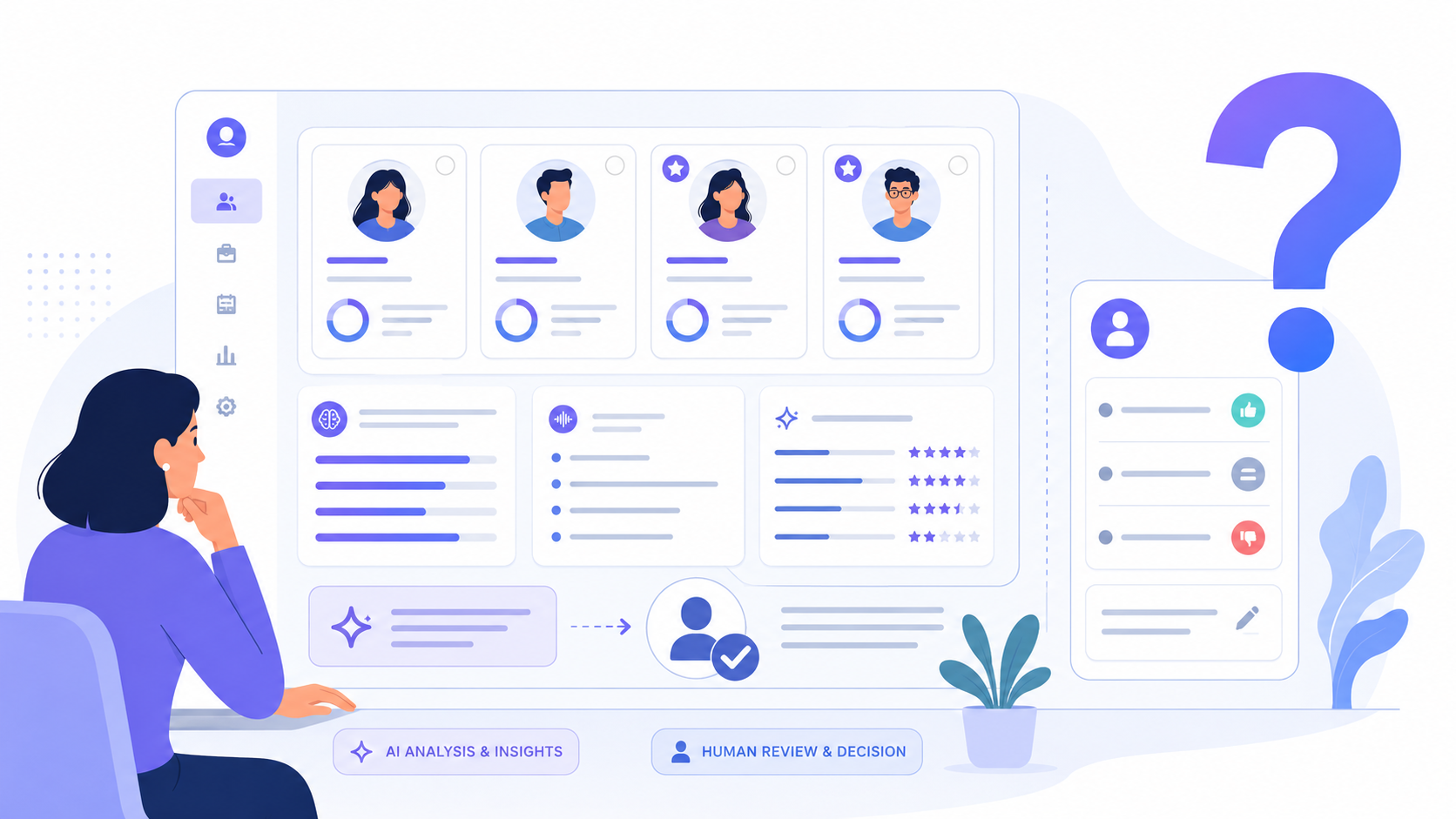
AI recruitment software can help recruiters screen candidates faster, but it should not make hiring decisions on its own.
The better approach is to use AI to support candidate screening, reduce repetitive admin work, and give recruiters better information before they decide who moves forward.
In this article, we’ll explain where AI can safely support early-stage screening and how to implement AI recruitment software without replacing recruiter judgment.
The biggest mistake companies make with AI recruitment software is treating it as a decision-maker.
That creates risk.
Hiring decisions involve role context, business needs, team fit, communication style, candidate potential, and sometimes sensitive information that should not be reduced to a score alone.
AI can help organize candidate information, but it should not own the final call.
A better model is:
This model gives hiring teams the benefit of AI without removing accountability from the people responsible for hiring.
See also: AI Recruitment Software vs Applicant Tracking System: Which One Do You Actually Need?
AI recruitment software can be useful across early-stage hiring, especially when the process is repetitive, high-volume, or difficult to schedule manually.
Here are the areas where AI can support recruiters without replacing their judgment.
Recruiters may receive hundreds of applications, but many candidates may not match the role criteria. Reviewing every CV manually can slow down the process and create inconsistent screening.
AI resume screening can help by reviewing candidates against job requirements, role criteria, and experience signals set by the hiring team.
The important boundary is this: AI resume screening should help recruiters prioritize review. It should not be treated as the final decision on whether someone is qualified.
Recruiters should still review shortlisted candidates, check context, and make judgment calls when needed.
AI video interviews can help recruiters screen candidates beyond the resume.
A CV may show experience, but it does not always show communication clarity, motivation, service mindset, problem-solving style, or how a candidate responds to role-specific questions.
With this feature, candidates can complete structured interviews on their own time. Recruiters and hiring managers can then review the responses later.
KitaHQ is one example of AI-powered video interviewing. Each completed interview can include scores, summaries, transcripts, recordings, and reporting that hiring teams can review.
This is beneficial because it provides recruiters with more complete context about the candidate before deciding who should proceed to the next stage.
However, AI video interviews should not replace recruiter review. The value is not only in the score. The value is in giving hiring teams a structured way to review candidate responses.
Recruitment automation can reduce manual admin work across the screening workflow.
This may include candidate invites, reminders, report generation, rejection messages, and hiring manager handoffs.
This is helpful because many hiring delays do not come from evaluation alone. They come from coordination.
AI recruitment software should not own every part of hiring. Some decisions require human judgment, business context, and accountability.
AI should not be used to fully own:
Even if AI can score, summarize, or rank candidates, the hiring team should still understand what the output means and decide how to use it.
A candidate report can support a decision. It should not become the decision.
See also: AI Candidate Screening Software vs Manual Screening: Which Creates Better Shortlists?
Responsible implementation starts before the tool is used.
Hiring teams need to define how AI will support the process, where human review is required, and what decisions AI should never make alone.
Here is a practical workflow.
AI recruitment software is only useful if the screening criteria are clear.
Before using any screening tools, recruiters and hiring managers should agree on what matters for the role.
This may include:
This step matters because AI should not create the hiring standard by itself.
The hiring team should define the standard, then use AI to apply it more consistently during early-stage screening.
After the criteria are defined, AI resume screening can help recruiters review candidates faster.
Instead of manually reading every CV from the beginning, recruiters can use AI to organize applicants based on role criteria.
This helps recruiters focus their time on candidates who appear more relevant to the role.
A resume rarely tells the whole story.
AI video interviews can help recruiters understand how candidates communicate, explain their experience, and respond to role-specific situations.
They can review candidate responses more carefully, compare candidates more consistently, and use live interviews for deeper evaluation.
Candidate reports are useful because they turn screening activity into reviewable context.
A strong candidate report may include:
Reports help recruiters review faster, but they should not replace recruiter review. Hiring teams should look at the candidate’s actual responses, understand the context, and decide whether the candidate should proceed.
Not every candidate fits the expected pattern.
Some candidates may have unusual experiences. Some may perform better in a live conversation than in a structured screening format. Some may have strong transferable skills that are not obvious from their CV.
Recruiters should be able to override, review, or escalate cases when needed.
This is important because responsible AI implementation is not only about automation. It is also about knowing when to slow down and apply human judgment.
Recruitment automation can help with repetitive tasks such as reminders, invites, report generation, and handoffs.
But accountability should stay with the hiring team.
A good rule is:
Automate the task, not the responsibility.
AI can send reminders. Recruiters still own candidate experience.
AI can generate interview reports. Hiring managers still decide how to interpret them.
AI can support shortlist creation. The hiring team still decides who moves forward.
This balance lets teams move faster without treating hiring as a fully automated decision process.
AI recruitment software for candidate screening works best when it helps hiring teams screen candidates earlier, faster, and more consistently while keeping people responsible for the final call.
You can try KitaHQ. It helps teams screen resumes, run AI video interviews, assess candidate responses, automate repetitive screening steps, and generate candidate reports.
With KitaHQ, recruiters can reduce repetitive screening work, review candidates with more structured information, and keep final hiring judgment where it belongs: with the hiring team.
Industry: Banking
KitaHQ is an AI recruitment software that helps companies screen candidates, manage applicants, and keep candidate communication moving in one connected workspace.