.webp)

August 6, 2026
Ecommerce Hiring Process: A Practical Guide to Building a Team That Can Scale
Build a stronger ecommerce hiring process with eight practical steps for defining roles, screening candidates, running interviews, and scaling responsibly.
.avif)
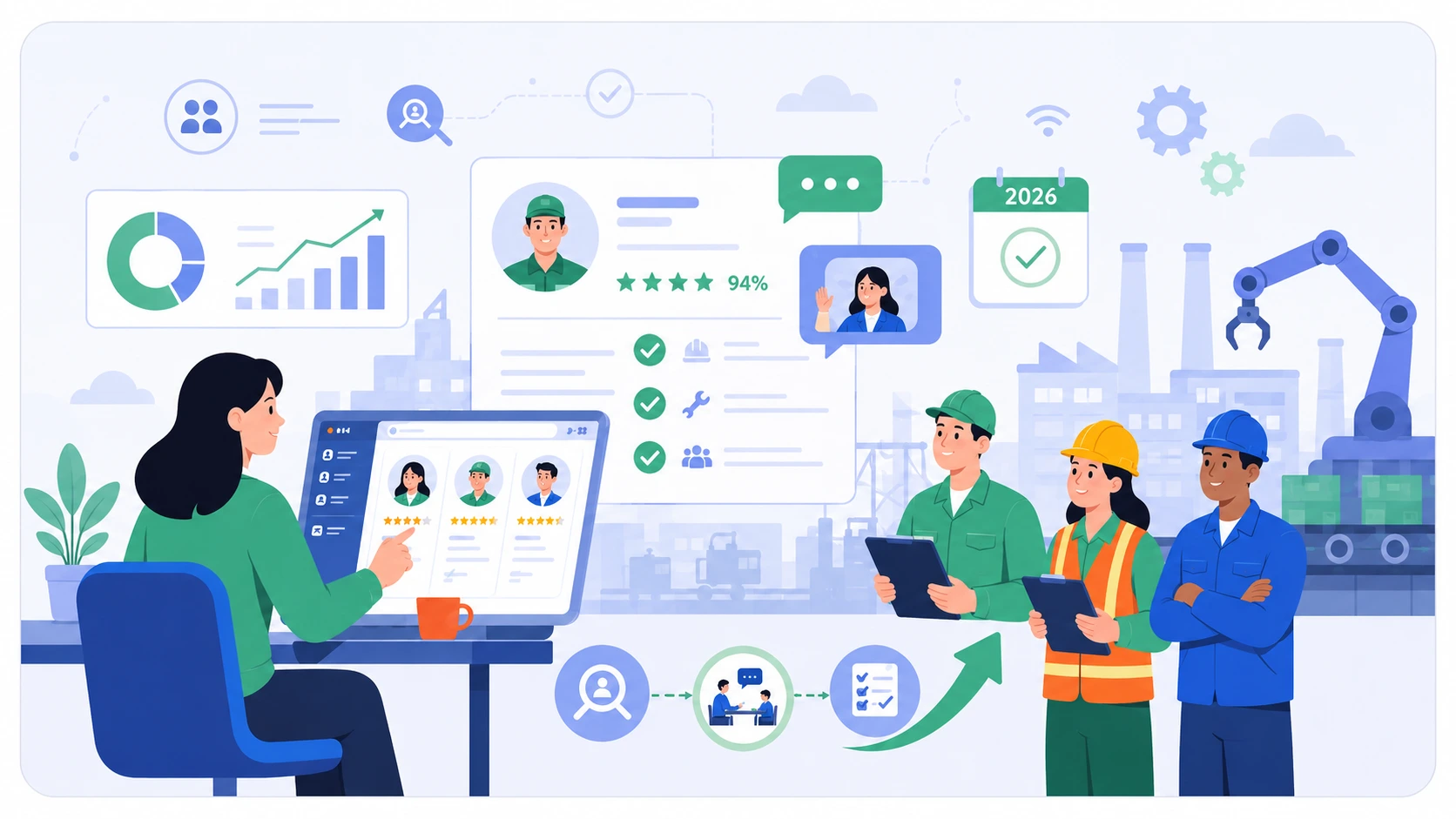
Manufacturing recruiting is no longer just about finding more candidates. For many hiring teams, the bigger challenge is moving from applicant volume to qualified shortlist fast enough, without weakening screening quality.
The pressure is visible in the labor market. U.S. manufacturing employment reached 12.596 million in April 2026, while industry research projects that manufacturers may need as many as 3.8 million roles by 2033, with 1.9 million potentially unfilled if workforce challenges are not addressed.
That is why the most important recruiting trends in manufacturing are not only about sourcing. They are about screening speed, assess role fit, reduce delays, and clearer information for hiring managers before candidates move forward.
Before breaking down each trend, here’s how these shifts translate into practical hiring workflow changes for manufacturing teams.
Many manufacturing teams respond to hiring pressure by increasing sourcing, more job ads, more referrals, more agencies, more applicant channels.
That can help, but it also creates a second problem. If the screening workflow is still manual, more applicants can simply mean more CVs to review, more calls to schedule, and more candidate notes to write. This is especially common in manufacturing roles.
The better question is not only, “How do we attract more candidates?”. It is, “Can we identify the right candidates fast enough once they apply?”.
That is why AI resume screening is becoming more relevant for manufacturing hiring teams. Manufacturing teams are starting to look beyond sourcing and review the full early-stage screening workflow.
Manufacturing candidates often apply to multiple employers. If a hiring process depends on manual CV review, phone screening, and live interview scheduling, delays can build quickly.
This becomes especially risky when teams are hiring for urgent shift coverage, seasonal production demand, high-volume factory roles, warehouse and logistics positions, entry-level production jobs, or technician and quality roles where qualified candidates may have several options.
This is one reason AI video interviews are becoming more relevant in manufacturing recruitment. Instead of waiting for a live recruiter slot, candidates can complete structured interviews on their own time.
Recruiters can then review responses, summaries, transcripts, recordings, and candidate reports later. For manufacturing teams, this helps move early interviews from calendar-dependent calls to structured candidate responses that can be reviewed more consistently.
See also: Phone Screening vs Video Interview: Which Should Recruiters Use?
Manufacturing hiring often fails when teams screen too heavily on surface-level CV signals. A candidate may have the right job title but weak safety judgment. Another candidate may not have the exact previous title but may show strong floor readiness, process discipline, and shift availability. That is why skills-first hiring needs to happen earlier in the process.
For manufacturing roles, early screening should help recruiters understand whether a candidate can work the required shift, handle SOPs under pressure, and bring relevant production or quality experience. It should also help identify whether the candidate can communicate issues clearly to supervisors or quality teams, especially when production speed and quality standards are both important.
This does not mean replacing hiring managers or technical evaluators. It means giving them better candidate information before deeper interviews happen. The trend is clear, manufacturing recruiters need better role-fit signals from the pre-hire assessment before hiring managers spend time on candidates who are not ready for the role.
Manufacturing teams may hire across different sites, regions, and labor pools. In some markets, candidates may be more comfortable interviewing in a local language than in English. This matters because language barriers can affect interview completion, candidate confidence, and recruiter understanding.
For distributed manufacturing hiring, the practical need is simple. Candidates should be able to complete interviews comfortably, recruiters should receive outputs they can review, hiring managers should get consistent candidate information, and the process should not depend on every stakeholder joining a live call.
This is why multilingual interview workflows and structured candidate reports are becoming more relevant in manufacturing recruitment.
See also: Best Multilingual Video Interview Software for Global Hiring in 2026
Manufacturing recruiters do not only need to find candidates. They need to give hiring managers a shortlist that is easy to review.
Weak handoffs often create delays. Recruiters may send CVs without enough context, interview notes may be inconsistent, and hiring managers may need to ask repeated clarification questions before deciding who should move forward. In some cases, final interviews are spent checking basic fit that should have been screened earlier.
This is where AI candidate analytics becomes more important in manufacturing recruitment. Instead of relying on scattered notes, hiring teams need clearer candidate summaries, interview insights, strengths, concerns, and role-fit signals in one place.
The goal is not only faster screening. The goal is to create a smoother handoff between recruiters and hiring managers, so qualified candidates do not get delayed because of manual admin work.
The table below outlines common mistakes that can make manufacturing recruitment slower, less consistent, or harder to scale.
The biggest recruiting trends in manufacturing point to the same operational reality: hiring teams need to move faster without losing consistency.
That requires more than job ads or additional sourcing channels. Manufacturing teams need a better way to screen candidates earlier, reduce repetitive manual work, and give hiring managers clearer candidate information before deeper interviews happen.
This is where AI-supported screening becomes highly relevant. KitaHQ software aligns with this direction by supporting AI candidate screening, AI video interviews, role-specific assessments, recruitment automation, and candidate reports in one early-stage screening workflow. The goal is not to replace human hiring decisions, but to help recruiters screen earlier, move faster, and send more structured candidate information to hiring managers for review.
For manufacturing teams hiring factory, warehouse, technician, and quality candidates at scale, this makes KitaHQ manufacturing hiring workflow is a practical fit for where manufacturing recruitment is heading: faster screening, clearer assessment, better candidate experience, and human-led hiring decisions.
Industry: Banking
KitaHQ is an AI hiring software that helps teams screen faster, run AI video interviews, and evaluate candidates consistently.