%20(1).png)

August 6, 2026
Ecommerce Hiring Process: A Practical Guide to Building a Team That Can Scale
Build a stronger ecommerce hiring process with eight practical steps for defining roles, screening candidates, running interviews, and scaling responsibly.
.avif)
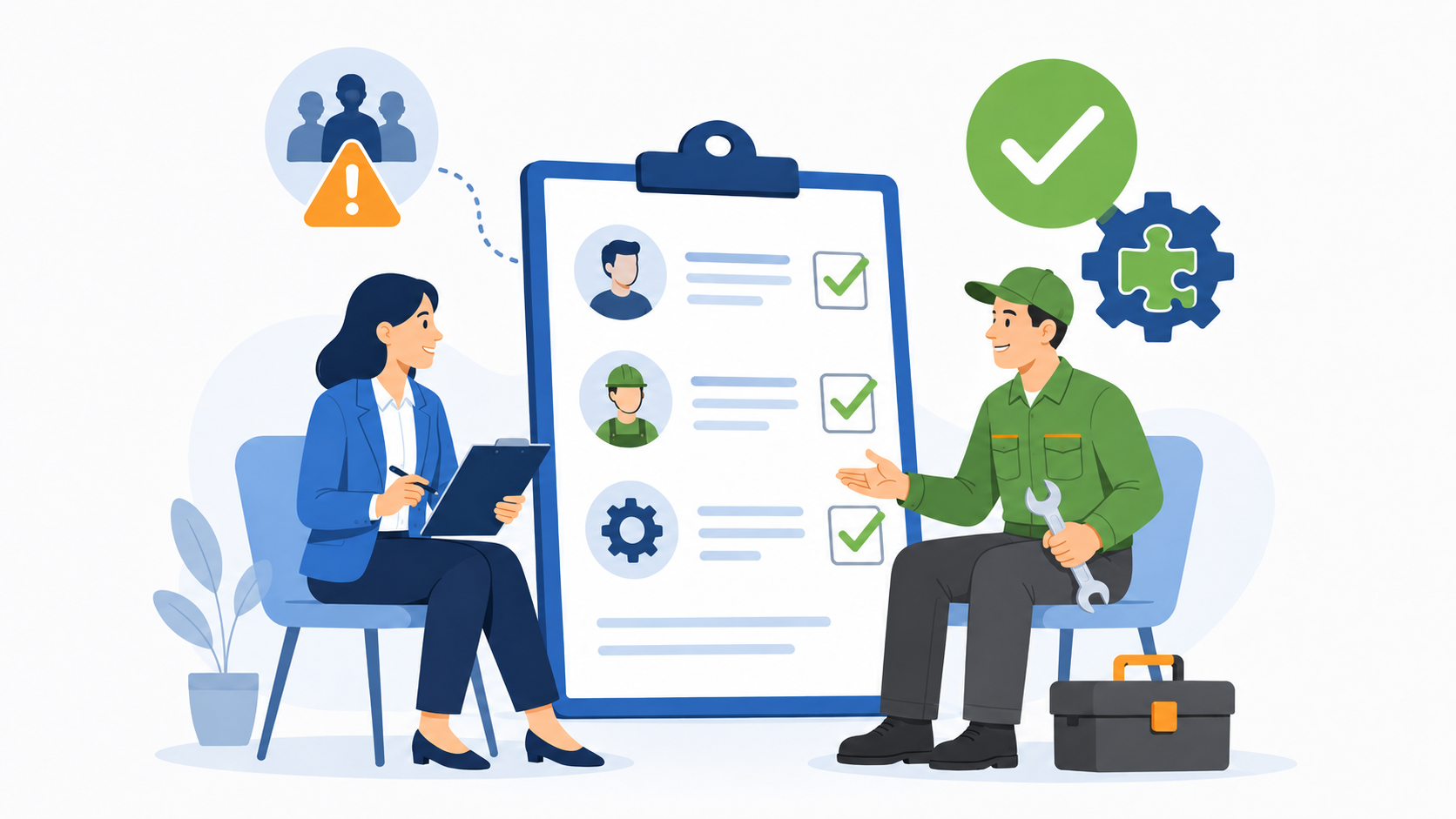
Hiring technicians is difficult because many important signals do not appear clearly on a CV.
A candidate may list machine experience, maintenance exposure, or electrical knowledge, but that does not always show whether they can troubleshoot under pressure, follow safety procedures, document repair work, or fit the shift and site requirements of the role.
That is why technician hiring challenges are not only about finding more applicants. The bigger issue is knowing which candidates are worth moving forward before technical leads spend time on deeper interviews, practical tests, or site-specific validation.
This article explains the common challenges in technician hiring and how recruiters can build a stronger early screening process.
Technician roles often sit between operational need and technical judgment.
Recruiters need to move quickly, but hiring managers or technical leads still need confidence that shortlisted candidates can handle the real work. This creates friction when the hiring process depends too heavily on CV keywords, manual phone screens, or late-stage technical checks.
The result is often a slow shortlist, repeated screening questions, and candidates reaching the final stage before obvious fit gaps are discovered.
Many technician CVs include similar phrases: maintenance, troubleshooting, repair, inspection, equipment handling, or preventive maintenance.
The problem is that these phrases do not always show depth.
For example, two candidates may both mention “machine maintenance,” but one may only follow routine checklists while another can diagnose faults, isolate root causes, and explain repair steps clearly.
Recruiters need to understand whether the candidate’s experience matches the actual role, equipment, work environment, and technical expectations.
For high-volume technician hiring, AI resume screening can help recruiters review CVs against role-based criteria before deciding which candidates should move to the next screening step.
See also: 5 Most Common Candidate Screening Methods (Plus Recommended Tools)
Technician hiring often fails when recruiters rely too much on listed skills.
A candidate may mention PLC, HVAC, mechanical repair, electrical systems, calibration, or preventive maintenance, but those keywords do not prove how they think through problems.
For technician roles, troubleshooting ability matters because the work is rarely only about knowing a tool or system. Candidates may need to explain what they check first, how they identify the likely cause, when they escalate, and how they prevent the same issue from happening again.
This is why early screening should include practical, role-specific questions, not only CV matching.
Examples:
These questions help recruiters and technical leads see how candidates reason through real work situations before a deeper technical interview or practical assessment.
Another technician hiring challenge is alignment.
Recruiters may screen for experience, availability, salary fit, and communication. Technical leads may care more about troubleshooting logic, equipment familiarity, safety judgment, and repair discipline.
Both perspectives matter, but problems happen when the screening criteria are not agreed on early.
This can create weak shortlists. Recruiters may send candidates who look relevant on paper, but technical leads may reject them because the candidates lack the right site exposure, equipment background, or problem-solving approach.
A better process starts by defining what must be screened early and what should stay in the hands of technical leads.
For example:
This keeps early screening useful without pretending it can replace deeper technical judgment.
Technician hiring is not only about skills.
A candidate may be technically strong but not suitable for the role because of shift requirements, travel needs, site conditions, emergency response expectations, or physical work environment.
These fit issues often appear too late when recruiters do not ask about them early.
For example, a field service technician may need to travel across locations. A maintenance technician may need to support night shifts. A facilities technician may need to respond quickly to building issues. An industrial technician may need to work in a production environment with strict safety procedures.
If these expectations are unclear, recruiters may spend time moving candidates forward who were never likely to accept or succeed in the role.
Early screening should include questions about:
Many technician roles require hiring manager or supervisor input.
The issue is that technical leads should not spend their time repeating basic screening questions for every applicant. Their time is better used for deeper technical validation, practical assessment, and final review.
When the early process is too manual, recruiters may spend hours reviewing CVs, calling candidates, scheduling first-round interviews, sending reminders, and preparing notes for hiring managers.
This becomes harder when the company hires technicians across multiple sites, branches, shifts, or project locations.
Recruitment automation can help reduce repetitive early-stage work, such as candidate invites, reminders, re-invites, and report generation, while keeping recruiter and hiring manager review in the process.
A stronger technician hiring process separates early screening signals from final validation.
Recruiters do not need to prove every technical skill at the first stage. Instead, they need enough structured information to decide who deserves technical lead time.
Useful early screening areas include:
This makes the recruiter’s shortlist more useful for technical leads.
See also: Phone Screening vs Video Interview: Which Should Recruiters Use?
Recruiters can use structured screening questions to collect better early signals.
The goal is not to replace technical testing. The goal is to understand whether a candidate has enough relevant experience, reasoning, and work-readiness to move forward.
These questions can be used in phone screens, structured interviews, or AI video interviews when recruiters need candidates to complete first-round screening without live scheduling.
KitaHQ helps hiring teams structure early-stage technician screening before candidates move to deeper technical review.
For technician hiring, recruiters can use technician hiring software to screen CVs, ask role-specific first-round questions, assess candidate responses, and prepare clearer candidate information for recruiter or hiring manager review.
KitaHQ can support technician hiring teams by helping them:
This is most useful for companies hiring repeatable technician roles across facilities, branches, plants, service locations, or operational teams.
However, KitaHQ should not replace human technical judgment. Practical assessments, license checks, certification verification, site-specific safety validation, and final hiring decisions should still be handled by recruiters, technical leads, or hiring managers.
Technician hiring software is most useful when recruiters and technical leads agree on what should be screened early.
CVs can help identify relevant experience, but they rarely show the full picture. Recruiters also need to understand troubleshooting approaches, safety judgment, documentation habits, shift fit, and the candidate’s ability to explain technical work clearly.
The strongest process does not push every decision into the first stage. It uses early screening to filter weaker matches, give technical leads better context, and reserve human review for the decisions that truly need technical judgment.
For teams hiring technicians repeatedly, KitaHQ can help structure early screening with CV review, AI video interviews, response assessment, and candidate reports for recruiter or hiring manager review. This helps teams build stronger shortlists before candidates reach the final interview.
Industry: Banking
KitaHQ is an AI hiring software that helps teams screen faster, run AI video interviews, and evaluate candidates consistently.