%20(1).png)

June 14, 2026
What Recruiters Can Learn from AI Video Interview Responses
Learn what recruiters can review in AI video interview responses, common red flags to watch for, and why human review still matters before candidates move forward.
.png)
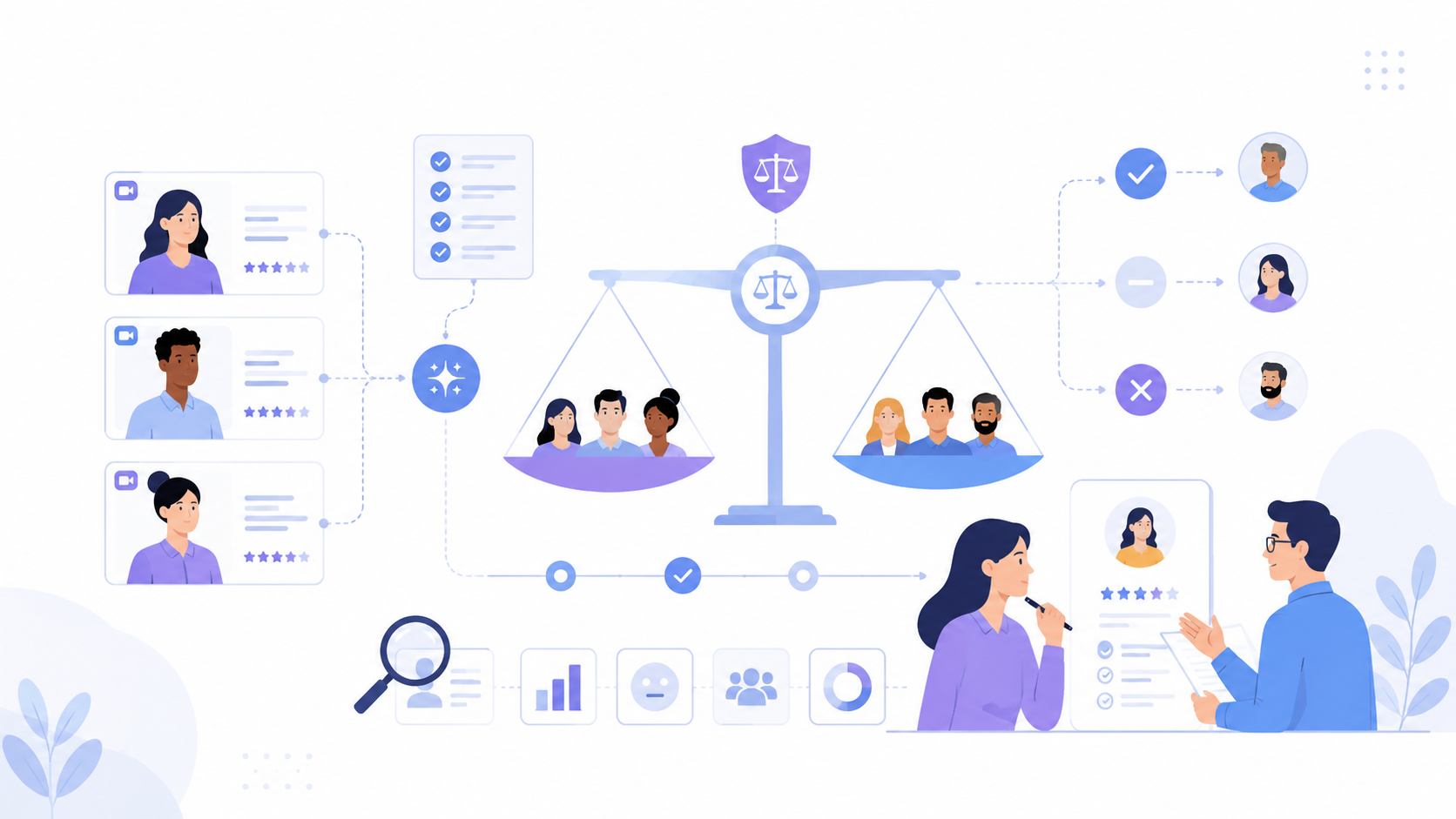
Interview bias is hard to remove because it often hides inside ordinary hiring habits. One interviewer asks follow-up questions freely. Another focuses on confidence. A hiring manager remembers one strong answer but forgets weaker signals. Over time, candidates are not always assessed against the same standard.
That is why many hiring teams ask whether AI video interviews can reduce bias. The practical answer is: they can reduce some sources of inconsistency, but they cannot make hiring bias-free by themselves.
AI can help make early-stage interviews more structured, consistent, and easier to review. But they cannot guarantee fair hiring, replace human judgment, or fix weak hiring criteria by themselves.
Interview bias is not always obvious. It does not always look like intentional discrimination or a clearly unfair decision.
In early-stage interviews, bias often appears through inconsistency.
One candidate may get more time to explain an answer. Another may be interrupted early. One interviewer may value confidence more than substance. Another may prefer candidates with a similar background, accent, school, communication style, or career path.
Common forms of interview bias include:
This is why bias is difficult to manage through good intentions alone. Even careful interviewers can evaluate candidates unevenly if the process itself is unstructured.
See also: How AI Video Interviews Improve Candidate Experience
AI interviews are most useful when they make the interview process more consistent.
They do not make hiring automatically fair. But they can reduce some of the process gaps that allow bias to enter early-stage screening.
In a manual first-round interview, different recruiters may ask different questions depending on time, mood, urgency, or personal style.
That creates uneven candidate data.
With AI, hiring teams can give every candidate the same role-based questions. This makes candidate responses easier to compare because everyone is responding to the same core prompts.
This helps reduce bias caused by inconsistent questioning.
In live interviews, recruiters often rely on notes, memory, or quick impressions. This can make the evaluation process subjective, especially when recruiters handle many candidates in a short period.
AI can record, transcribe, and summarize candidate responses so recruiters and hiring managers can review them later.
This matters because reviewable interview data gives the team more context than a rushed note or a single impression.
Bias often increases when hiring teams are unclear about what “good” looks like.
For example, one reviewer may reward polished speaking style. Another may value practical examples. Another may focus on years of experience, even when the role mainly requires customer handling, problem solving, or shift reliability.
AI interviews are more useful when they are paired with clear review criteria. The team should define what skills, competencies, and role signals matter before candidates are assessed.
That does not remove human judgment. It gives human reviewers a more consistent basis for judgment.
Bias is not only about how candidates are scored. It can also appear in who gets the chance to complete the process.
Live interviews can disadvantage candidates who work shifts, live in different time zones, have caregiving responsibilities, or cannot answer calls during office hours.
When candidates can complete interviews on their own time, more candidates can participate without live scheduling. This can make early-stage screening more accessible, especially for high-volume, shift-based, or regional hiring.
AI video interviews are not a fairness guarantee.
They can make the process more structured, but they cannot correct every bias in hiring. In some cases, poorly designed AI hiring workflows can scale bias faster because the same flawed rule is applied to many candidates.
If the role criteria are vague, the AI will still be built around vague criteria.
For example, “good culture fit” is not a useful screening standard unless the team defines what it means in job-relevant terms. Without clear criteria, reviewers may still rely on personal preference.
Better criteria would be:
AI interviews work best when the hiring team defines role-relevant criteria before the interview starts.
AI should not decide who gets hired.
Hiring decisions involve context, tradeoffs, judgment, and responsibility. Recruiters and hiring managers still need to review candidate reports, compare responses, and decide who should move forward.
The right role for AI is to organize early-stage interview data, not to remove human decision-making.
No hiring tool should claim that it guarantees fairness, removes all bias, or ensures compliance outcomes.
AI systems can introduce or amplify bias if they are trained, configured, or used poorly. Hiring teams still need to check whether their process is job-related, explainable, reviewable, and appropriate for the roles they are hiring.
This is especially important when AI is used in a high-stakes area like employment.
Candidates may react negatively to AI interviews if the process feels unclear, impersonal, or overly automated.
A more responsible process should explain what the AI interview is used for, what candidates should expect, and how human reviewers remain involved.
Candidate trust improves when the process feels transparent and respectful, not when the AI is hidden or over-positioned as the decision maker.
See also: Top Video Interview Software for Hiring Teams in 2026
AI is most effective when they sit inside a responsible hiring process.
Here is a practical workflow hiring teams can use.
Start with the role, not the technology.
Before using AI interviews, define the skills, behaviors, and competencies that matter for the job. For example:
Avoid vague criteria such as “good attitude” or “strong personality” unless the team can explain what those mean in job-relevant behavior.
Consistency is one of the clearest advantages of AI.
Every candidate should answer the same core questions for the same role. Follow-up questions can help clarify candidate responses, but the core interview structure should stay consistent enough for fair comparison.
Do not treat AI-generated criteria as final.
Recruiters or hiring managers should review the scoring rubric before launching the interview. The rubric should match the job description, role expectations, and real hiring requirements.
This is especially important for roles where communication style, language, and customer interaction matter.
A candidate report should help the hiring team understand why a candidate may or may not move forward.
Useful reports include summaries, scores, transcripts, recordings, strengths, and concerns. This gives recruiters and hiring managers more context than a simple pass or fail label.
The hiring team should use AI to support early-stage screening, not replace recruiter or hiring manager review.
A better workflow is:
This keeps AI in a support role and keeps accountability with the hiring team.
Candidates should know that they are completing an AI interview, why it is being used, and what happens after completion.
Good candidate communication should explain:
The answer to the final point should be clear: the AI should not make the final hiring decision.
See also: Best Multilingual Video Interview Software for Global Hiring in 2026
KitaHQ’s AI video interview software helps hiring teams run structured early-stage interviews that candidates can complete on their own time, without live scheduling.
This supports bias reduction in a practical way: not by claiming to eliminate bias, but by helping teams create a more consistent and reviewable interview process.
With KitaHQ, hiring teams can:
This matters because early-stage screening often becomes inconsistent when teams rely on repeated live calls, scattered notes, and different interviewer styles.
A more structured process gives hiring teams clearer candidate data before recruiter review or hiring manager review.
For example, Mind Stretcher used KitaHQ to replace repeated first-round screening calls. The team reduced manual scheduling and repetitive screening work while still reviewing candidate communication and presentation before deciding who should move forward.
This is the right way to understand AI video interviews.
The value is not that AI makes hiring decisions. The value is that hiring teams get a more structured, reviewable, and scalable way to understand candidates before the next stage.
AI video interviews can help reduce some sources of interview bias when they make the hiring process more structured, consistent, and reviewable.
They cannot fix vague criteria, poor rubrics, weak human review, or irresponsible automation.
For hiring teams, the practical question is not “Can AI remove bias completely?” It cannot.
The better question is:
Can AI video interviews help us ask more consistent questions, review candidates against clearer criteria, and make better-informed decisions with human oversight?
Used that way, AI video interviews can improve early-stage screening without replacing recruiter or hiring manager judgment.
.avif)
KitaHQ is an AI hiring software that helps teams screen faster, run AI video interviews, and evaluate candidates consistently.