

Teams that regularly hire labor, trade-support, or site-support roles.
Who This Is For in Construction Hiring
Built for construction teams hiring repeatable field, site-support, safety,
and technical roles across projects, shifts, and locations.
and technical roles across projects, shifts, and locations.

Field and Trade Support

Safety and Site Support

Technical and Project Support
Why Construction Hiring Slows Down
Construction recruitment becomes harder when recruiters rely on manual hiring to manage differentroles, job requirements, and long screening processes.

Too Many Unqualified Laborers
Construction recruiters often receive laborer applicants who do not match the required site experience, trade skills, project background, or role requirements.

Slow Site Shortlisting
When recruiters cannot shortlist foremen, site engineers, technicians, operators, or safety officers fast enough, project teams may face slower mobilization and delayed work progress.
.svg)
Weak Site Readiness Signals
CVs rarely show how candidates handle site pressure, subcontractor coordination, safety discipline, shift demands, or real-time problem solving on active projects.
.svg)
Generic Screening Across Roles
Construction hiring covers varied roles, from welders and electricians to QS, HSE, foremen, and site supervisors, so generic screening makes role-based comparison harder.
Where KitaHQ Fits in the Contruction Hiring Process
From construction CVs to manager-ready shortlists, KitaHQ helps hiring teams structure early screening
before final interviews begin.
before final interviews begin.

1
Sourcing and Applications
Candidates apply through job boards, referrals, career pages, staffing pipelines, or internal recruitment channels.

2
Early-Stage Screening
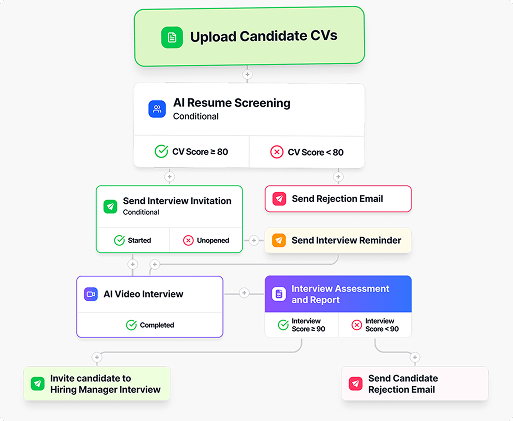
KitaHQ screens CVs, runs AI video interviews, assesses candidate responses, and generates structured reports for recruiter review.
.avif)

3
Manager Interviews
Hiring teams review stronger candidates, validate deeper role fit, and decide who should move forward.

4
Offer and Onboarding
Your existing system can handle offers, onboarding, employee records, and other downstream hiring processes.
AI Resume Screening for Construction Roles
Construction recruitment software helps recruiters turn interview responses into clearer
shortlists for the next hiring stage.
shortlists for the next hiring stage.
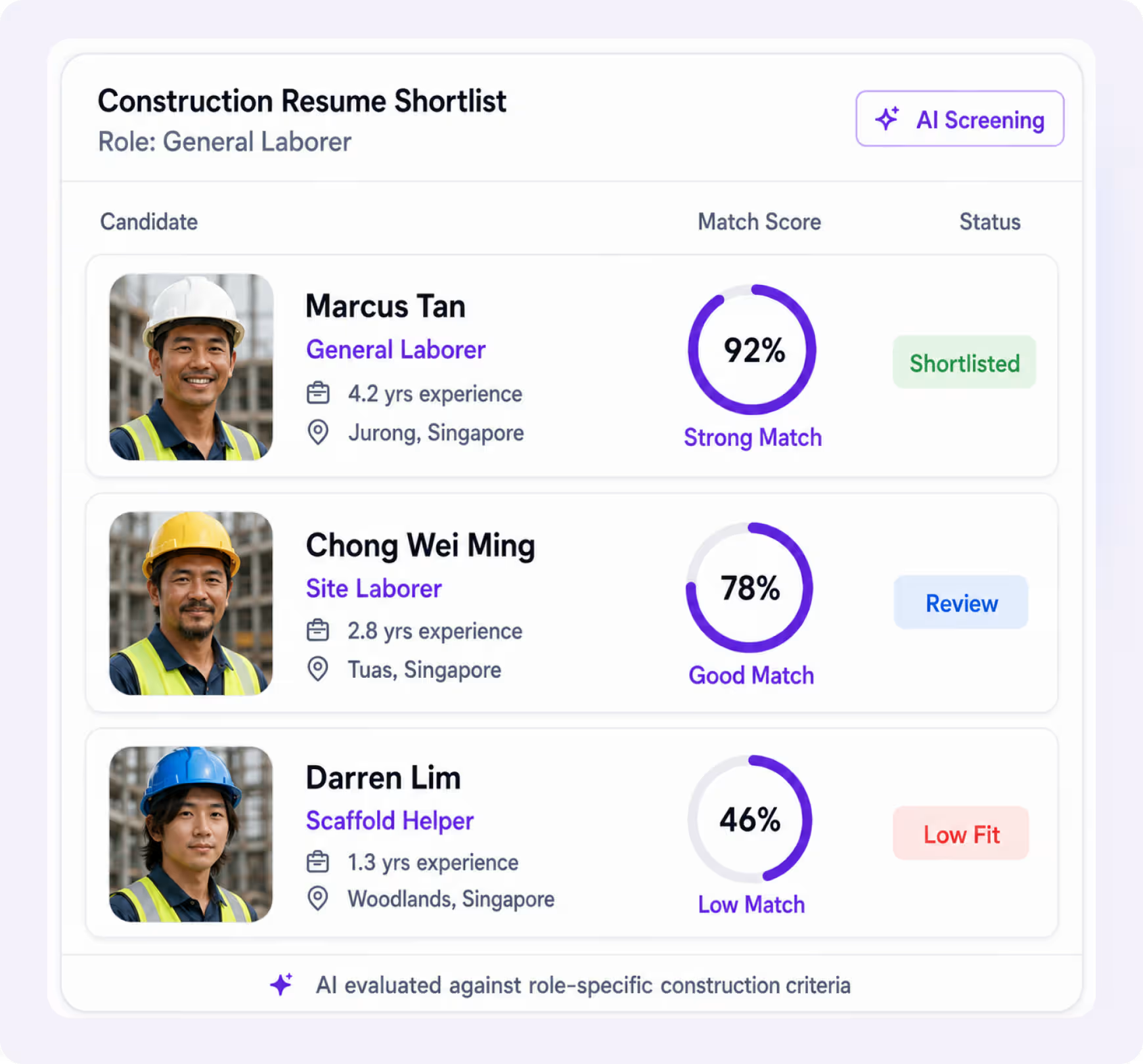
Filter Unqualified Labor Applicants Earlier
AI construction recruitment software helps recruiters screen construction CVs more objectively, so they can identify stronger labor applicants faster before manual review.
- Laborer experience
- Trade skills
- Site exposure
- Project background
- Equipment familiarity
- Technical requirements
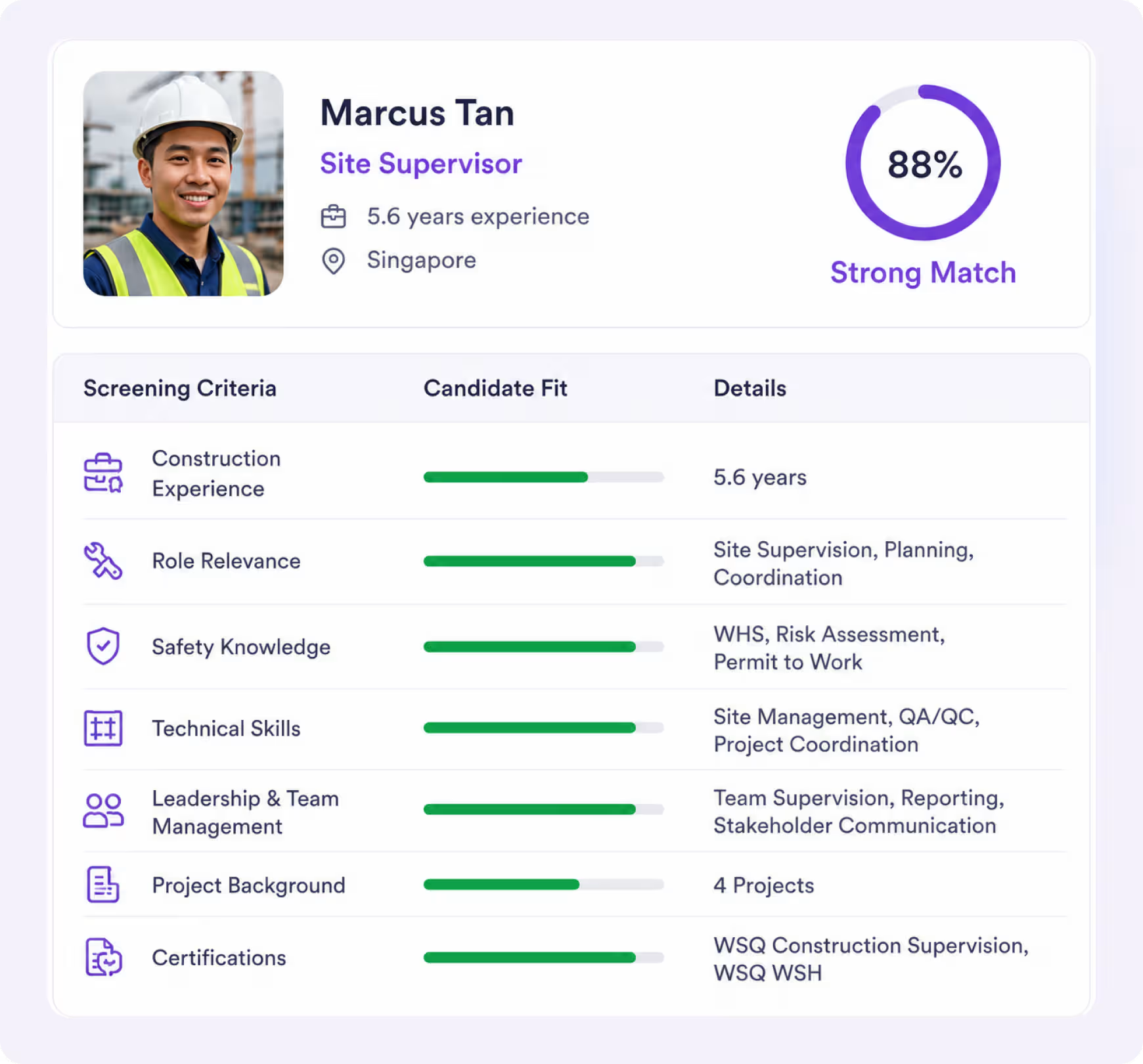
What Construction Recruiters Can Screen Early
Early-Stage Screening
- Prioritized labor applicants
- Match scores by role criteria
- Relevant site and trade exposure
Construction Role Screening
- Screen labor applicants faster
- Review CVs with clearer criteria
- Focus on stronger construction candidates
AI Video Interviews for Construction Hiring
Construction recruitment software helps recruiters ask role-specific questions
and review structured reports without joining every first-round interview live.
and review structured reports without joining every first-round interview live.
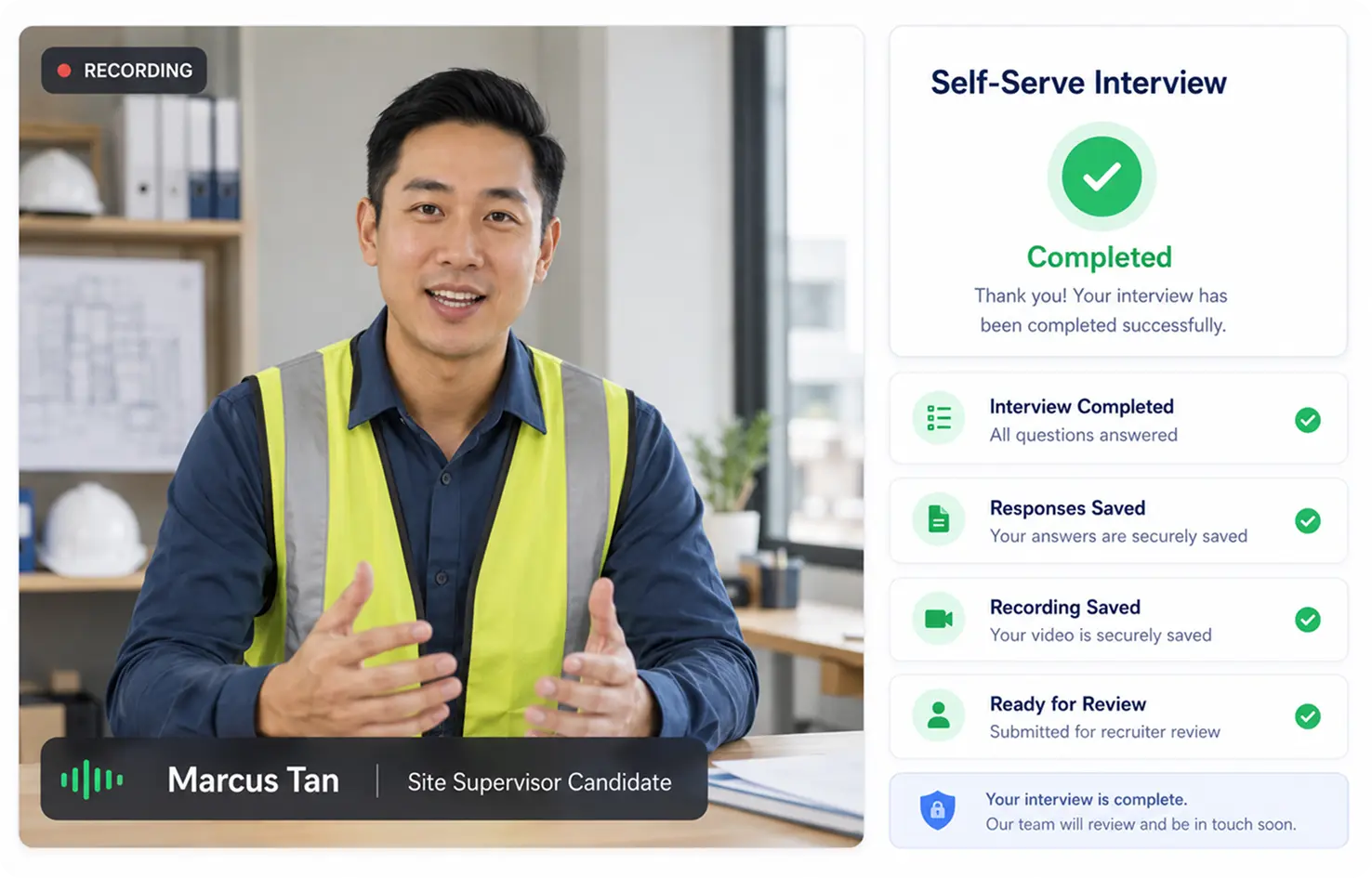
Self-Serve Construction Interviews
Candidates can complete AI video interviews on their own time, so recruiters do not need to attend interviews and can focus on other hiring tasks.
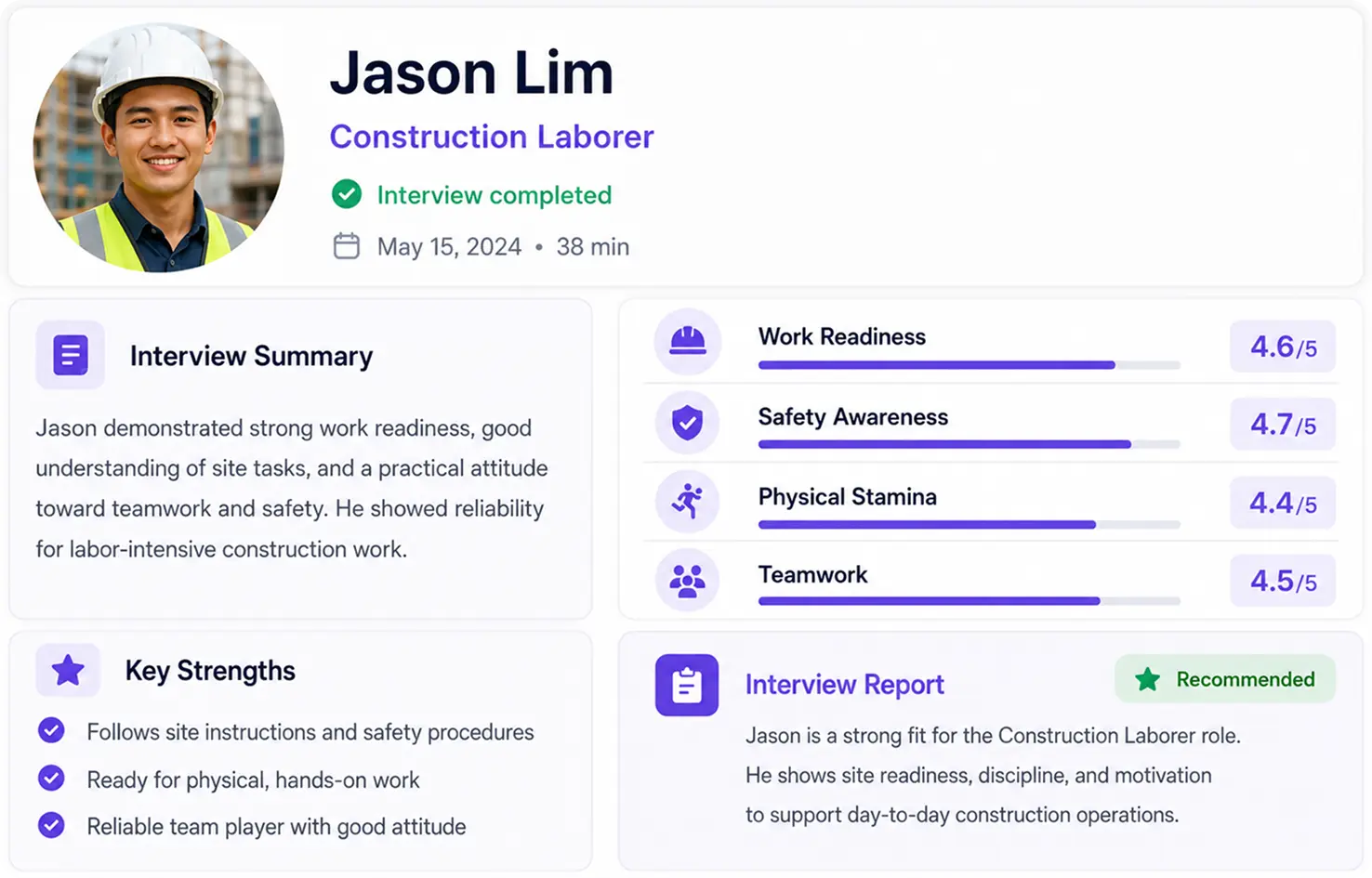
Automated Construction
Interview Reports
Get structured reports based on custom criteria for construction roles, such as site experience, safety awareness, trade skills, and role readiness.
What to Assess in Construction Candidates
Use structured construction interview questions to assess candidate responses against
consistent role criteria before manager review.
consistent role criteria before manager review.
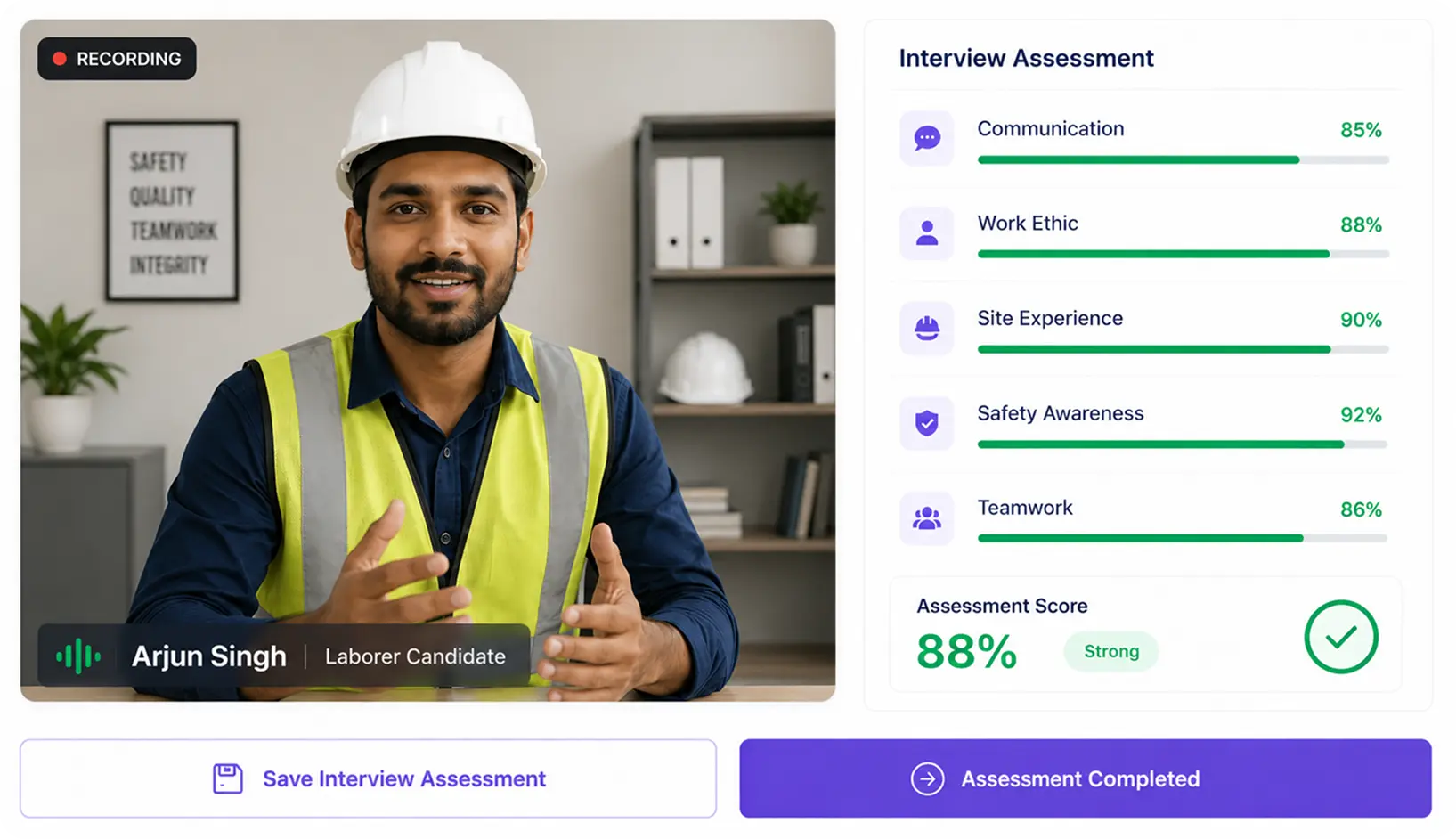
Site Fit
Relevant Site Experience
Assess whether candidates have handled similar construction sites, project types, materials, tools, or daily tasks required for the role.
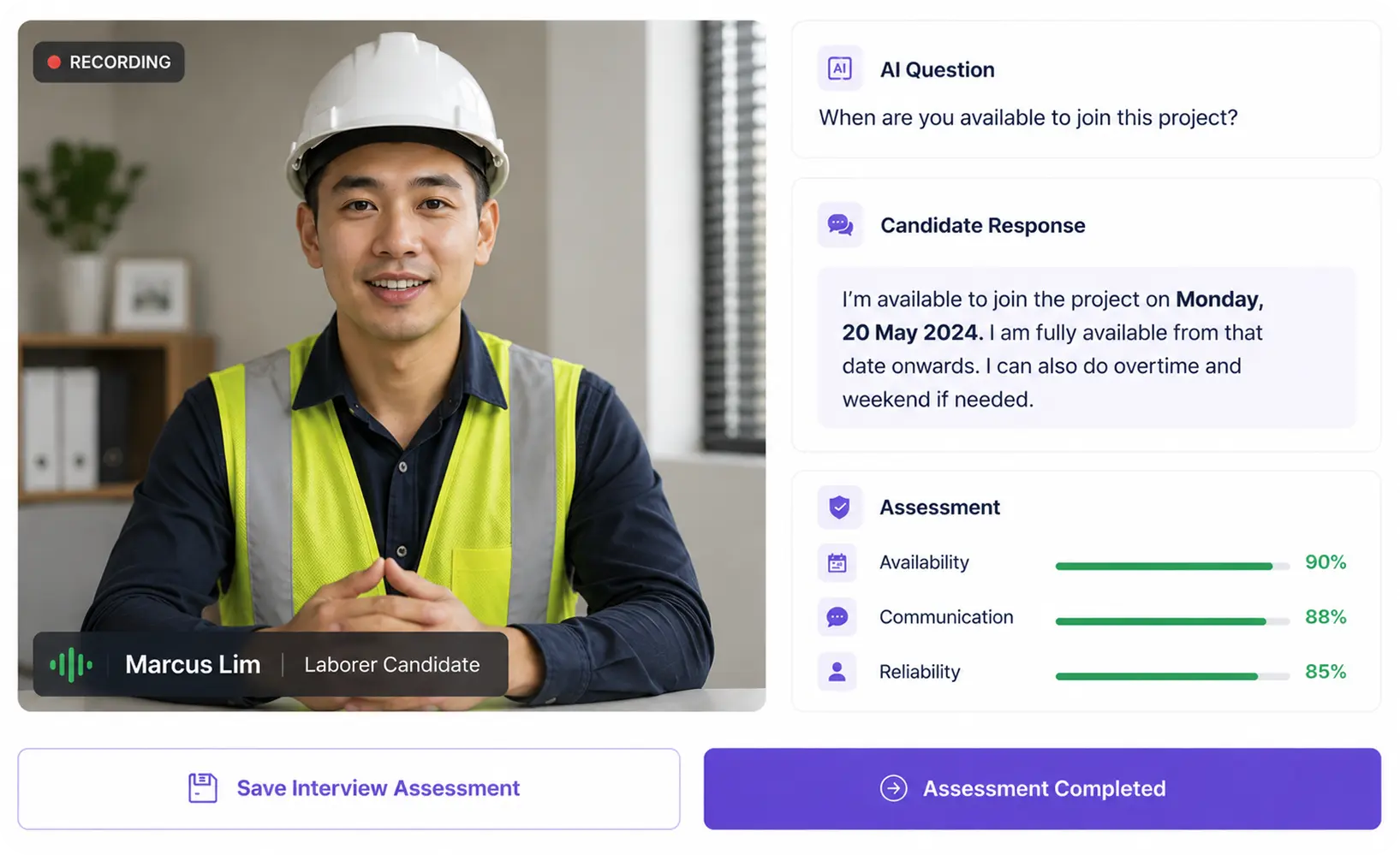
Availability Fit
Shift and Site Readiness
Review whether candidates are ready for the project location, working hours, start date, travel needs, and site working conditions.
Safety Response
Safety Judgment and Escalation
Assess how candidates respond when work conditions are unsafe, unclear, off-spec, or require escalation to the right person.
Work Readiness
Work Expectation Fit
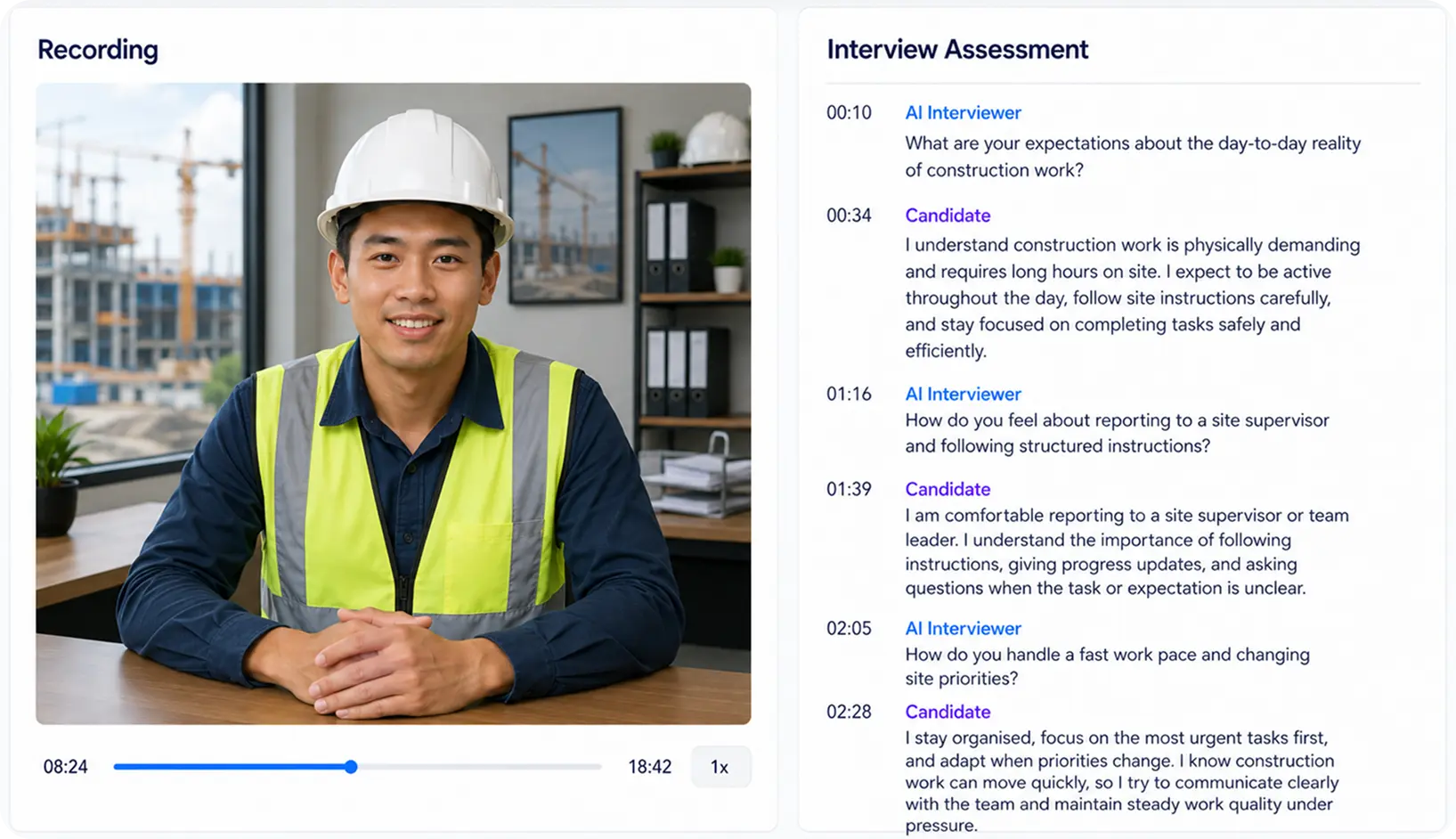
Understand whether candidates are aligned with the physical demands, reporting structure, work pace, and day-to-day realities of construction work.
Example Construction Screening Questions
Use role-specific questions to understand how candidates explain site experience,
safety habits, work expectations, and practical judgment.
safety habits, work expectations, and practical judgment.

Role: Construction Laborer
QUESTION
“Tell us about a time you had to complete a physical task quickly while still following safety instructions.”

Transcript
REAL-TIME ANALYSIS
AI Interview:
12:45
“Tell us about a time you had to complete a physical task quickly while still following safety instructions.”
Candidate
13:02
“I had to help move materials quickly before the next work stage started, but I still followed the supervisor’s instructions and used the right PPE.”
Candidate
13:05
“I checked the pathway first, worked with the team to avoid rushing unsafely, and completed the task without causing delays or safety issues.”

SKILLS ASSESSED
Safety awareness
work discipline
Site Readiness
Team Communication

Bad signal
- Ignores safety steps during site work
- Struggles to follow supervisor instructions
- Unclear about physical work expectations

Good signal
- Follows PPE and site safety rules
- Understands daily laborer work demands
- Communicates clearly with site teams

Role: Drafter
QUESTION
“Tell us about a time you had to revise a construction drawing after receiving feedback.”
Transcript
REAL-TIME ANALYSIS
AI Interview:
12:45
“Tell us about a time you had to revise a construction drawing after receiving feedback.”
Candidate
13:02
“I would acknowledge the concern, ask what feels expensive, and connect the price back to the business outcome they need.”
Candidate
13:05
“I checked the updated dimensions, coordinated with the engineer, and revised the drawing so the site team could follow the latest version clearly.”
SKILLS ASSESSED
Drawing accuracy
attention to detail
revision handling
Bad signal
- Only mentions software, not drafting workflow
- Misses accuracy, standards, and revision control
- Avoids unclear measurements or design changes
Good signal
- Explains drafting steps clearly and practically
- Checks dimensions, layers, and drawing standards
- Clarifies unclear details with site teams
What Hiring Managers Receive After the Interview
A structured output for every candidate, ready to review, compare, and move forward.

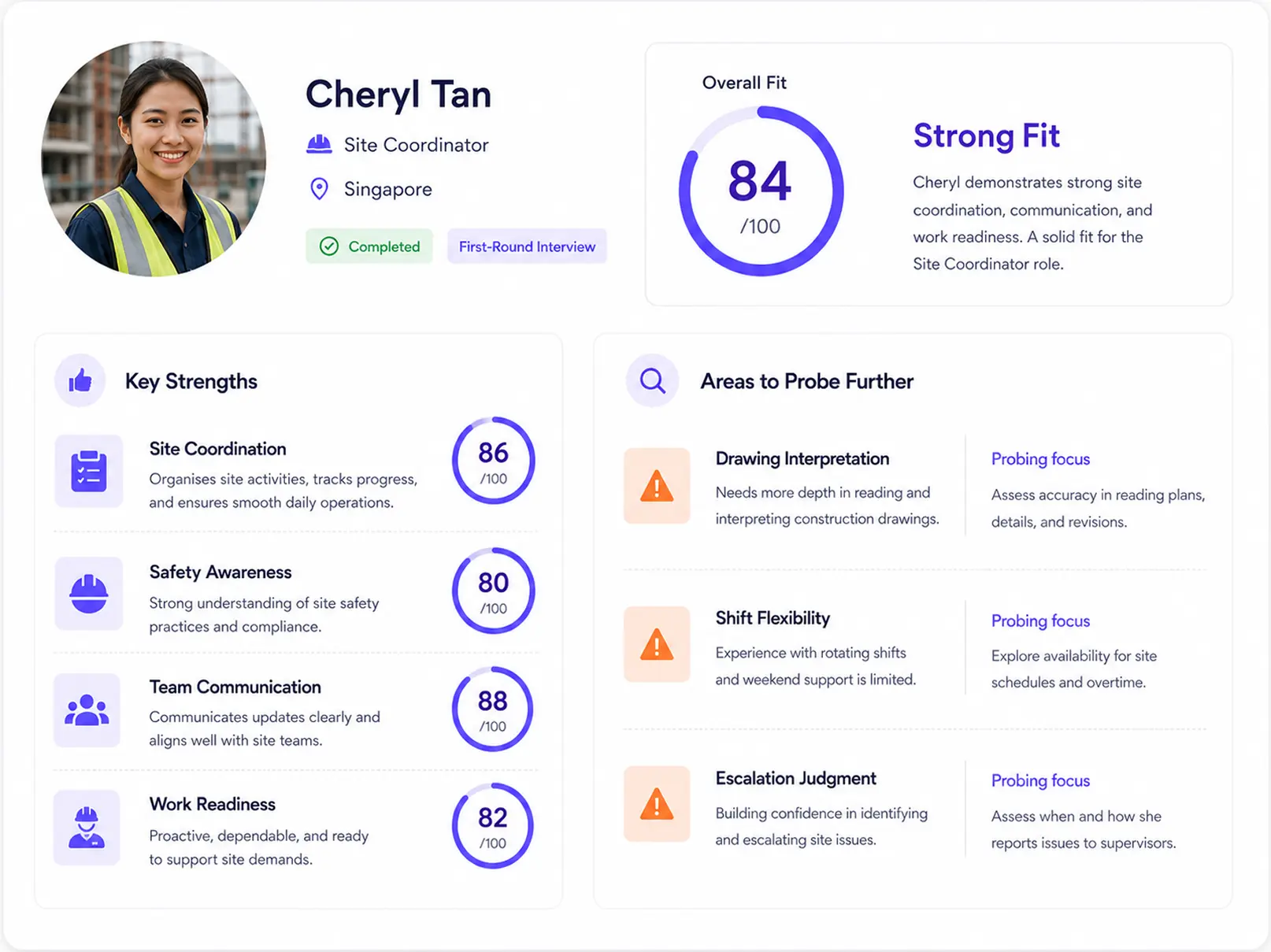
Screening Summary

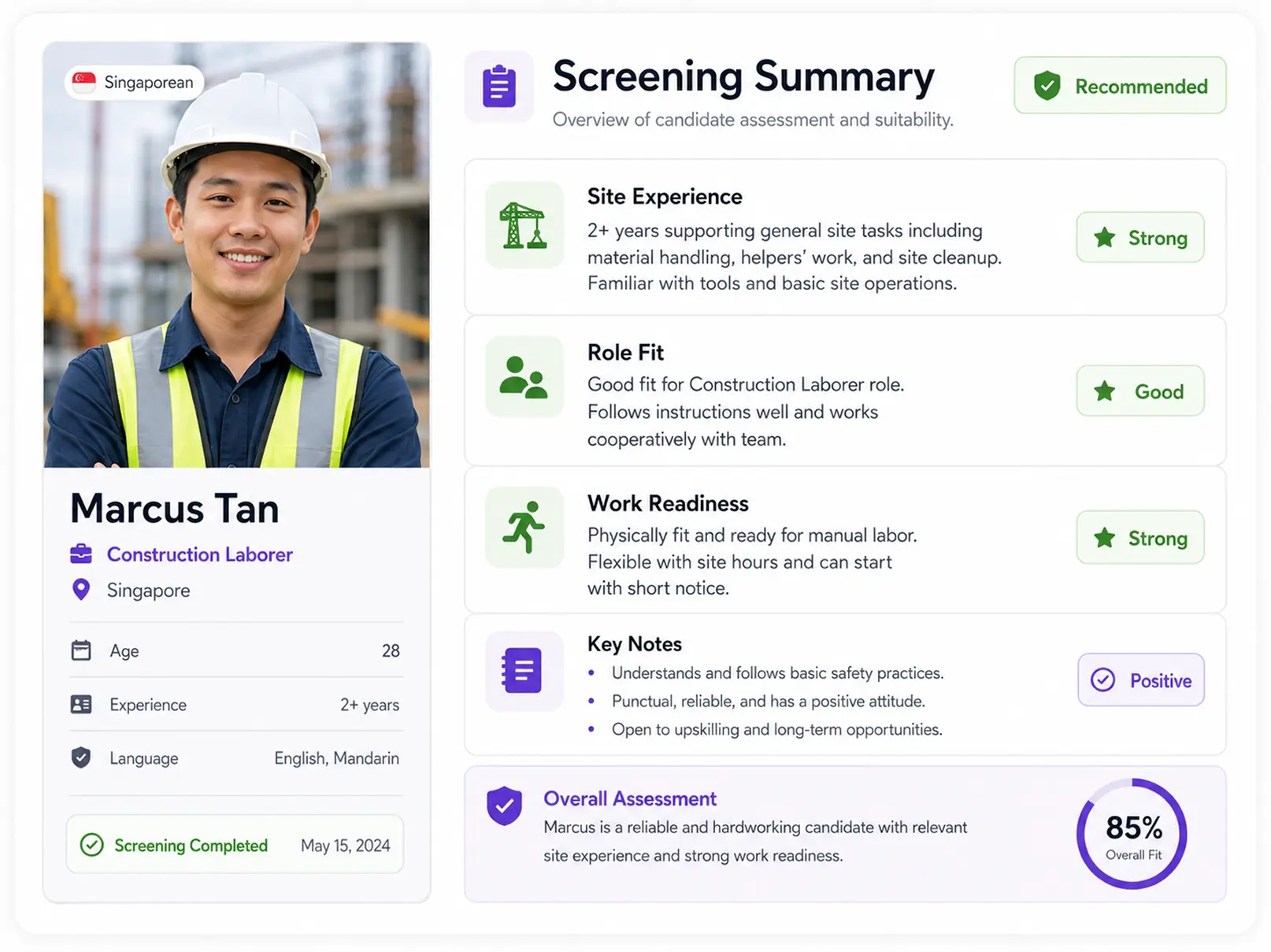
Clear candidate summaries with site experience, role fit, work readiness, and key notes for manager review.

Transcript and Recording
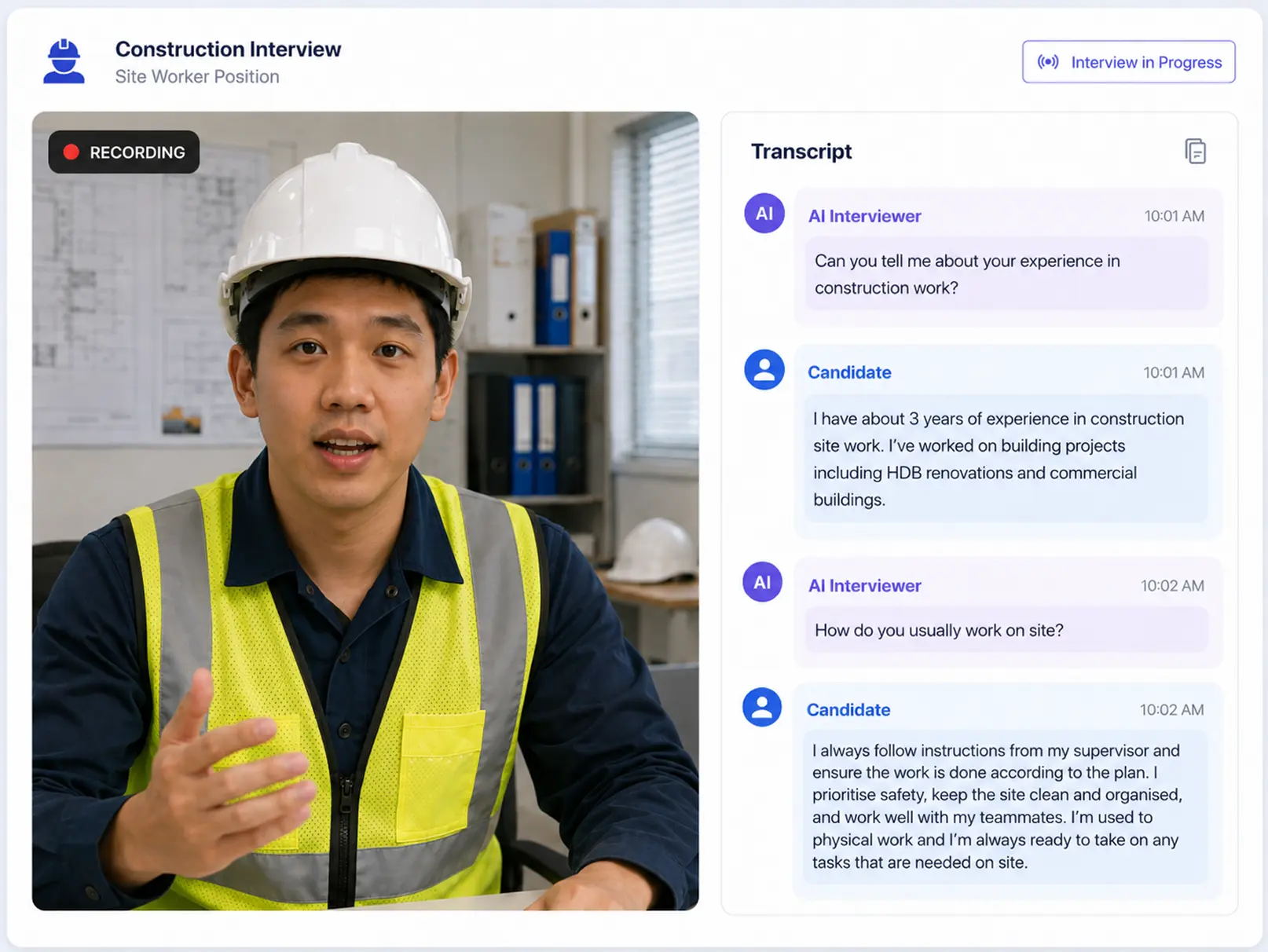
Interview recordings and transcripts that help managers review candidate answers before the next step.

Candidate Fit Signal
Structured signals to help managers understand whether candidates fit the role, site, and work expectations.

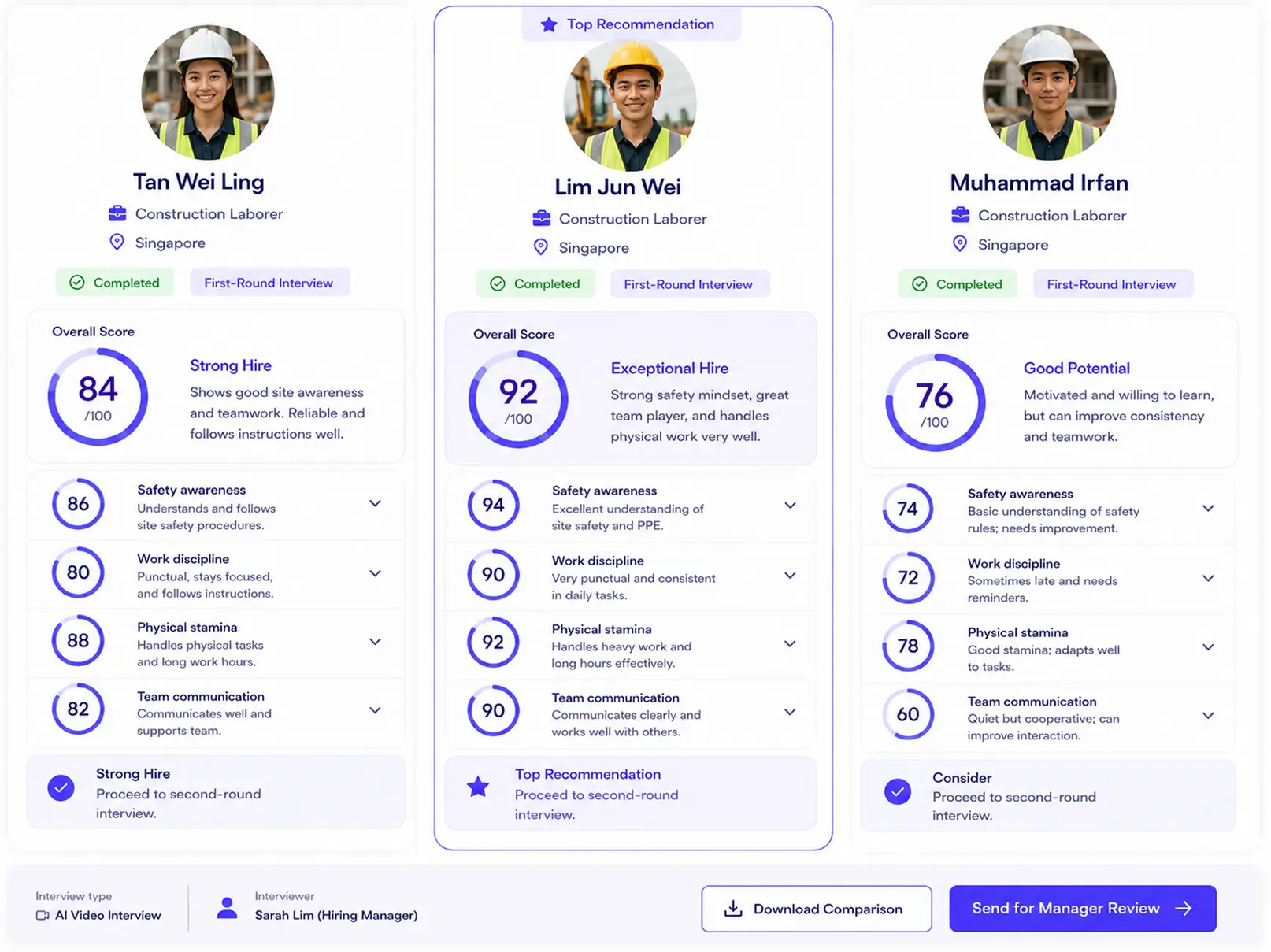
Candidate Shortlist
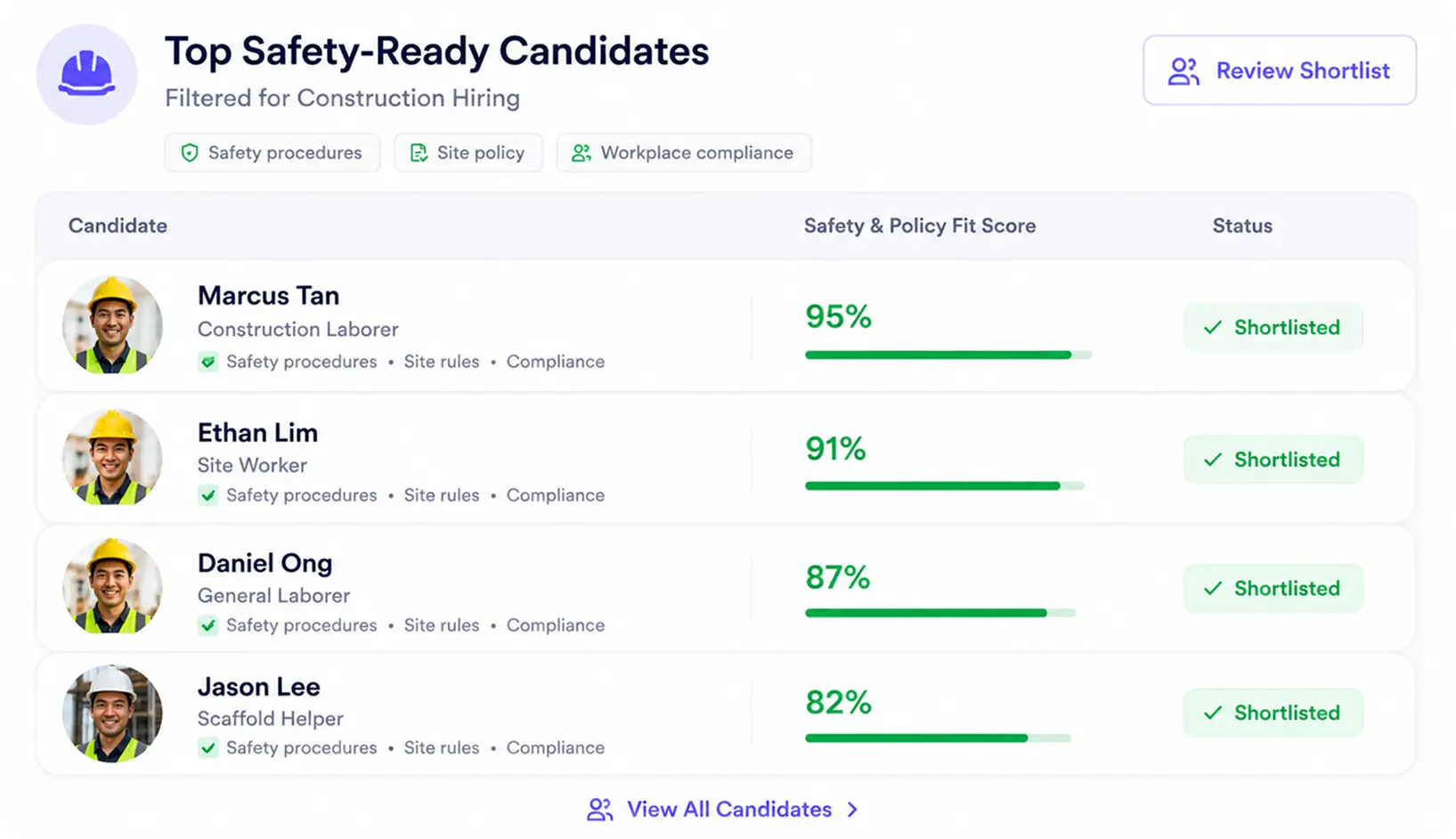
A simple view for managers to compare shortlisted candidates by score, strengths, and interview context.
Features That Make Construction Screening Easier
KitaHQ helps construction hiring teams reduce repetitive screening work while keeping recruiters and
hiring managers in control of who moves forward.
hiring managers in control of who moves forward.

Custom Construction Questions
Create or adjust questions for site experience, work readiness, safety awareness, trade skills, and day-to-day construction expectations by role.

Simultaneous Interviews
Let construction candidates complete AI video interviews on their own time, so recruiters can screen site workers faster without repeating first-round calls manually.

Bulk Interview Invites
Send interview invitations to many construction candidates at once through WhatsApp and email without messaging each candidate manually.

Multilingual Interview
Let candidates complete interviews in the language they are most comfortable with, so construction hiring teams can review answers more clearly.
Recruitment Automation for Construction Candidate Screening
Use construction recruitment software to automate repetitive screening steps for laborers, site workers,
technicians, and project-based roles
technicians, and project-based roles
Proven Results from Different Companies
See how companies use KitaHQ to screen candidates faster and review results more clearly.

Bank Saqu Increased Interview Capacity
Reduced screening time by 75%, from around 2 hours to 30 minutes, while improving recruiter productivity for high-volume hiring.


How Construction Teams Reduce Screening Bottlenecks
Screen construction candidates more consistently before managers spend time on interviews.

Before Using KitaHQ

Too many weak applicants reach manual review

Shortlisting depends on manual follow-up

Site-readiness signals are unclear

Different roles use the same screening flow

Managers receive limited screening context


After Using KitaHQ

AI resume screening filters applicants earlier

AI video interviews speed up first-round screening

AI assessment surfaces site-readiness signals

Custom criteria match each construction role

Candidate reports give managers clearer context
Where KitaHQ Fits in Your Hiring Workflow
Fit Cases to
Use KitaHQ

Construction recruiters who need a consistent first-round screening standard across projects.
Teams that need structured interviews to assess construction candidates more objectively.
Companies that want to reduce time-to-hire for repeatable construction roles.
Where Humans Are
Still Required
- Checking site certificates, licenses, or operator permits.
- Verifying safety records, work history, fraud issues, or past violations.
- Conducting hands-on tool tests or practical construction assessments.
- Making final hiring decisions, job offers, and salary negotiations.


Construction Recruitment Software FAQs
Which construction roles fit this workflow best?
Best for repeatable hiring of laborers, helpers, material handlers, site coordinators, and junior site-support roles.
What still needs human review?
Humans still handle final interviews, trade checks, and final hiring decisions.
Does this cover licence checks or employment verification?
No. It supports early screening, while licence checks, background checks, and employment verification stay human-led.
What do hiring managers get after screening?
A structured summary, transcript, recording, and shortlist view for faster review.
When is this not a fit for construction hiring?
It is a weaker fit for senior hires, one-off specialist roles, and workflows led by trade testing first.
What is the common failure case in construction screening?
Generic questions create weak shortlists. Use role-specific site and safety questions instead.
Hire Qualified Labor, Without the Bias
Standardize construction hiring with KitaHQ. Leverage automated CV screening
and AI-powered video interviews to secure top-tier laborers.
Schedule Your Call