%20(1).png)

August 6, 2026
Ecommerce Hiring Process: A Practical Guide to Building a Team That Can Scale
Build a stronger ecommerce hiring process with eight practical steps for defining roles, screening candidates, running interviews, and scaling responsibly.
.avif)
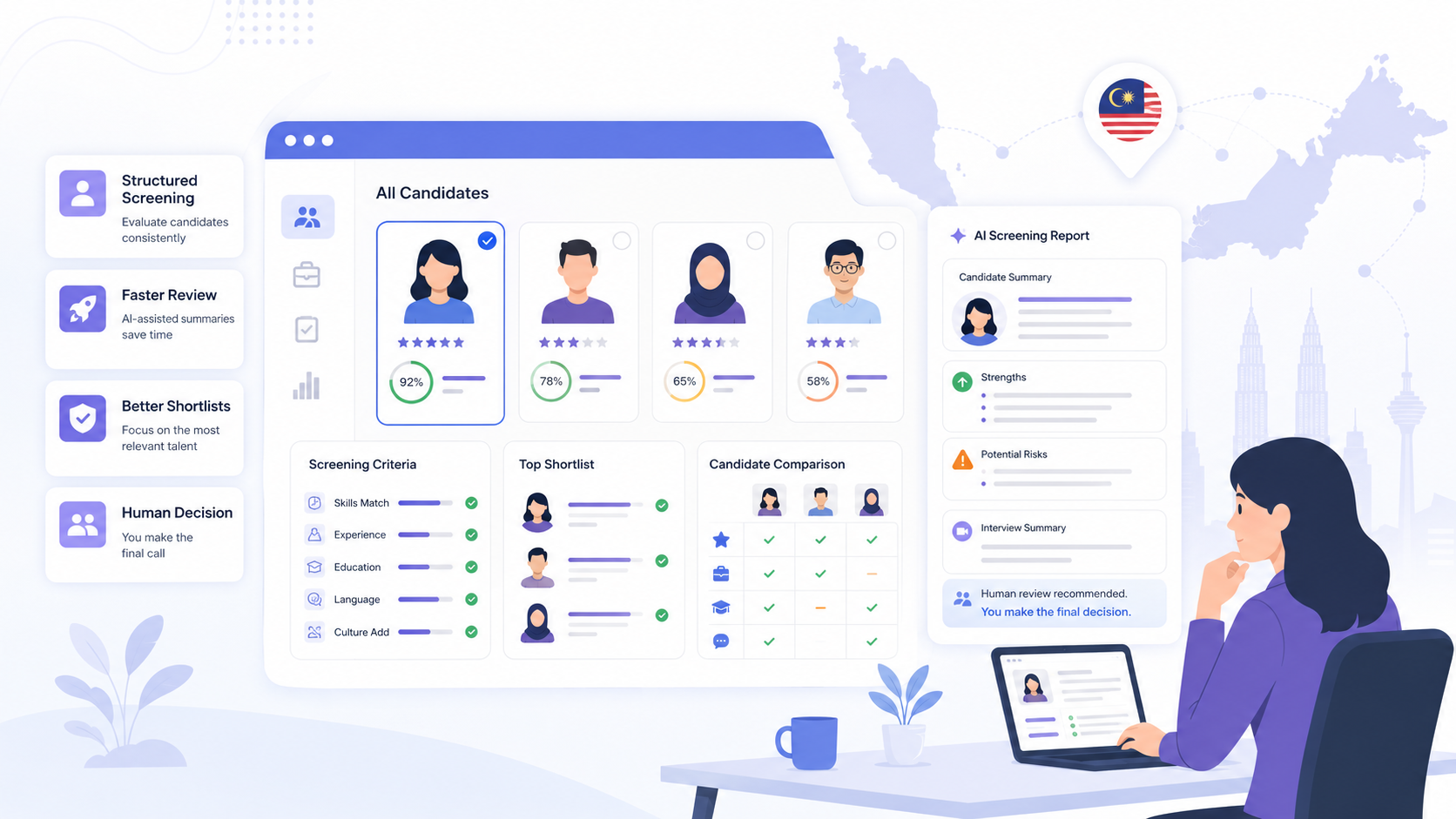
Malaysian employers often need a faster way to screen candidates, especially when hiring across multiple roles, locations, or languages. When applications come in from different backgrounds and experience levels, recruiters need more than a quick CV scan to understand who is worth moving forward.
The right candidate screening software helps make that early review more consistent. It can help recruiters screen applicants faster, collect clearer candidate signals, and give hiring managers better context before they spend time on the next interview stage.
Malaysia hiring teams often deal with a mix of frontline, professional, multilingual, and location-based hiring needs.
A retail employer may need to screen candidates across stores, shifts, customer-facing roles, warehouse roles, and inventory roles. An education employer may need to assess teachers, school operations staff, finance roles, and student-support roles. A regional employer may need candidates to answer in the language they are most comfortable using.
This creates a screening problem that basic resume filtering cannot solve. A CV can show experience, but it often does not show how a candidate explains a product, handles a parent or customer conversation, responds to a role-specific scenario, or communicates in the language required for the job.
For Malaysian employers, candidate screening software should help answer five practical questions:
Before comparing vendors, decide which screening problem you are solving.
Some tools are built around skills tests. Some focus on AI video interviews. Some focus on chat-based interviews. Some are stronger for candidate reports and recruiter-to-manager review. The right choice depends on where your team is losing time or missing candidate signals.
If the main problem is too many resumes, AI resume screening may be enough.
If the main problem is weak shortlists, you need more than CV filtering. You need a way to assess how candidates communicate, explain, answer role-specific questions, or respond to practical scenarios.
For example, a cashier candidate may look qualified on paper, but the recruiter may still need to know whether they can explain a pricing issue, handle a difficult customer, or follow store procedures.
A teacher candidate may have the right background, but the hiring team may still need to review how they explain a concept, communicate with parents, or respond to a classroom situation.
Resume ranking can help recruiters reduce volume, but it does not always show communication quality, judgment, or role readiness.
AI video interviews are useful when hiring teams need candidates to answer structured questions on their own time, without live scheduling. This is especially useful for high-volume roles, repeatable roles, and roles where communication matters.
Malaysia hiring often involves candidates who may answer in English, Bahasa Malaysia, Mandarin, or a mix depending on the role and location.
This matters because screening quality can drop if a tool only works well in one language or expects every candidate to respond in the same way.
A score alone is not enough for recruiter or hiring manager review.
A useful candidate report should help the team understand why a candidate may be worth moving forward. It should show summaries, strengths, concerns, transcripts, recordings, and follow-up areas where relevant.
This is especially important when recruiters need to send a shortlist to hiring managers. Without clear reports, managers may still ask for another call, another summary, or another manual explanation from the recruiter.
Candidate screening software should support better review, not replace human judgment.
Avoid choosing a tool because it promises to “automate hiring decisions.” A safer and more practical expectation is that the software helps recruiters structure early-stage screening, reduce repetitive work, and prepare better candidate information for human review.
See also: AI Recruitment Software vs Applicant Tracking System: Which One Do You Actually Need?
For this comparison, we only include tools that are primarily built for candidate screening, interview screening, or assessment.
Broader ATS and recruitment CRM platforms can be useful, but they are not the focus of this article. Malaysian employers searching for candidate screening software usually need help evaluating applicants before recruiter or hiring manager review, not another full recruitment system.
KitaHQ is AI recruitment software built for early-stage candidate screening. For Malaysian employers, it is especially useful when the team needs to screen many candidates across roles, locations, or languages, but still wants human review before deciding who moves forward.
KitaHQ also offers local support from a Kuala Lumpur-based team, MYR-based pricing, and is trusted by companies across Malaysia, including Jaya Grocer, Valiram, Tealive, and DRB-HICOM Berhad.
What it helps with:
For example, Fairview Education Group used KitaHQ to support Mandarin teacher hiring, where language proficiency is a key part of candidate screening. With KitaHQ’s AI video interviews, candidates can answer in Mandarin, while hiring teams review structured reports in either English or the original interview language.
For retail and warehouse hiring, BilaBila Mart is a relevant Malaysia example. BilaBila Mart used KitaHQ to screen retail and warehouse candidates on customer handling, shift fit, product knowledge, point-of-sale judgment, warehouse safety, and stock accuracy.
Where it fits well:
KitaHQ is a strong fit when the team needs to move from application to shortlist with clearer candidate signals, especially for roles where communication, availability, role fit, and scenario-based judgment matter.
Limitations:
KitaHQ should not be positioned as a full applicant tracking system, a credential verification platform, or a tool that makes final hiring decisions. It supports recruiter and hiring manager review, while humans decide who moves forward.
TestGorilla is a talent assessment platform with skills assessments, AI resume scoring, AI video interviews, custom questions, and custom interviews. Its official site says hiring teams can create custom interviews and scoring criteria, while AI interviews can ask follow-up questions and auto-score responses using criteria the team controls.
What it helps with:
Where it fits well:
TestGorilla may be useful for Malaysian employers that want to evaluate job-related skills before interviews, especially for roles where tests or structured assessments are important.
Limitations:
It may be less suitable for teams that need a broader screening process built around recruiter handoff, interview context, and hiring manager review.
See also: Top Video Interview Software in Malaysia: Buyer Guide
Interviewer.AI is an AI interview platform built around AI-powered video interviews, conversational AI interviews, AI interviewer avatars, mock interviews, admissions screening, and AI analytics.
Its official site positions the platform for hiring teams, universities, and growing businesses that need to evaluate large applicant volumes consistently and at scale.
What it helps with:
Where it fits well:
Interviewer.AI may fit Malaysian employers that want to replace repetitive live screening calls with structured AI video interview screening. It is especially relevant when teams want a video-led way to compare candidates before deciding who should move to deeper interviews.
Limitations:
Teams should review whether its scoring approach and interview format fit the level of human review required for their hiring process.
Willo is a candidate screening platform focused on video interviewing and high-volume hiring. It is trusted by more than 5,000 high-growth hiring teams.
What it helps with:
Where it fits well:
Willo may be useful for Malaysian employers that want a straightforward way to replace repetitive phone screens with recorded candidate responses. It is especially relevant when the hiring team wants speed, consistency, and a better way to review communication before live interviews.
Limitations:
Willo is strong for video screening, but it may not offer the same depth of AI resume screening, role-specific interview assessment, or candidate report structure as platforms built around AI candidate screening and assessment.
Sapia.ai is a chat-based AI interview platform. It measures skills, competencies, and experience through structured AI interviews, with candidate insights and scoring explanations.
What it helps with:
Where it fits well:
Sapia.ai may be useful for Malaysian employers that want a text-first or chat-first candidate screening experience instead of video-led screening. This can be helpful when the hiring team wants structured responses at scale but does not need every candidate to complete an AI video interview.
Limitations:
Sapia.ai is not video-first. If the hiring team specifically wants to assess spoken communication, presentation, or verbal explanation through AI video interviews, compare it carefully against video-led platforms.
See also: AI Recruitment Software Cost: What Hiring Teams Should Compare Before Buying
The best candidate screening software for Malaysian employers is not always the platform with the longest feature list. It is the platform that fits how your team actually hires.
If your main challenge is assessing job skills, a skills assessment platform may be enough. If your challenge is replacing repetitive phone screens, a video screening tool may work. If your team needs chat-based structured interviews, a conversational AI interview platform may be a better fit.
But if your Malaysian hiring team needs AI resume screening, AI video interviews, role-specific assessment, recruitment automation, and candidate reports in one connected platform, KitaHQ can help make early-stage screening faster and easier to review. Candidates complete interviews on their own time, while recruiters and hiring managers get clearer reports before deciding who should move forward.
Industry: Banking
KitaHQ is an AI recruitment software that helps companies screen candidates, manage applicants, and keep candidate communication moving in one connected workspace.